 Back
BackOscillations: Simple Harmonic Motion, Energy, Damping, and Resonance
Study Guide - Smart Notes
 Tailored notes based on your materials, expanded with key definitions, examples, and context.
Oscillations and Simple Harmonic Motion (SHM)
Physical Model of a Mass-Spring System
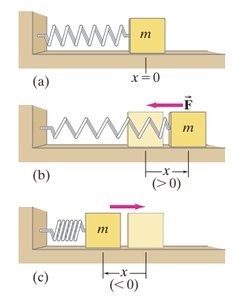
Oscillatory motion occurs when a system moves back and forth about an equilibrium position. The classic example is a block of mass m attached to a spring of stiffness constant k on a frictionless surface. The equilibrium position is where the spring is neither stretched nor compressed (x = 0).
Displacement (x): Signed distance from equilibrium.
Amplitude (A): Maximum displacement from equilibrium.
Restoring Force: Given by Hooke's Law:
Kinematics of SHM
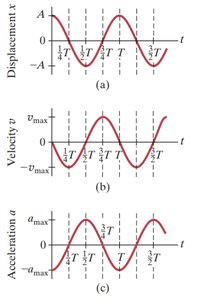
In SHM, the displacement, velocity, and acceleration vary sinusoidally with time. The general solution for displacement is:
Velocity:
Acceleration:
Period:
Frequency:
Angular frequency:
The maxima and minima of these quantities are:
Maximum displacement:
Maximum speed:
Maximum acceleration:
Energy in SHM
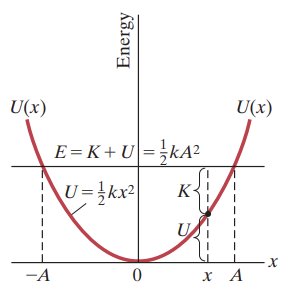
The total mechanical energy in a simple harmonic oscillator is conserved (if no damping):
Potential energy:
Kinetic energy:
Total energy:
At the turning points (), all energy is potential; at equilibrium (), all energy is kinetic.
Damped and Driven Oscillations
Damped Harmonic Motion
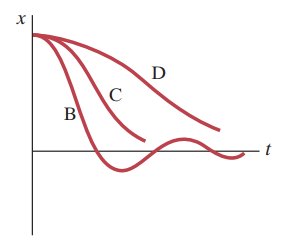
Real oscillators lose energy due to friction or resistance. The equation of motion for a damped oscillator is:
The solution depends on the damping constant b:
Underdamped: Oscillatory motion with exponentially decreasing amplitude.
Critically damped: Returns to equilibrium as quickly as possible without oscillating.
Overdamped: Returns to equilibrium without oscillating, more slowly than critical damping.

Forced Oscillations and Resonance
If an external periodic force acts on the system, the equation becomes:
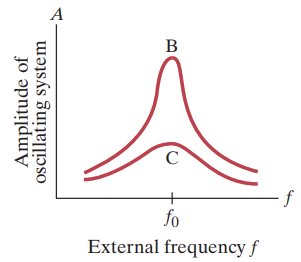
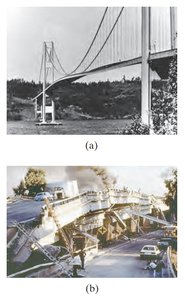
At steady state, the system oscillates at the driving frequency. The amplitude is largest when the driving frequency matches the system's natural frequency—this is resonance.
Resonant frequency (weak damping):
Quality factor: (sharpness of resonance)
Additional Topics
Physical Pendulum and Torque
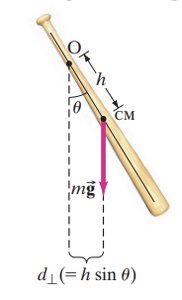
For a rigid body pivoted at a point O, the restoring torque due to gravity is , where is the perpendicular distance from the pivot to the center of mass. The motion can be analyzed similarly to SHM for small angles.
Summary Table: Types of Damped Motion
Case | Behavior |
|---|---|
Underdamped | Oscillates with decreasing amplitude |
Critically damped | Returns to equilibrium fastest without oscillating |
Overdamped | Returns to equilibrium without oscillating, slower than critical |
Additional info: The images included above directly illustrate the physical principles, mathematical relationships, and real-world consequences of oscillatory motion, damping, and resonance as discussed in the study notes.
