 Back
BackOscillations, Simple Harmonic Motion, Pendulums, and Waves: Study Notes
Study Guide - Smart Notes
 Tailored notes based on your materials, expanded with key definitions, examples, and context.
Oscillations and Periodic Motion
Introduction to Oscillations
Oscillations are repetitive back-and-forth motions found in many physical systems, from bobble-head dolls to molecules in a microwave oven. When a motion repeats itself over and over, it is called periodic motion.
Oscillating System: Any system that moves back and forth about an equilibrium position.
Periodic Motion: Motion that repeats in a regular cycle.
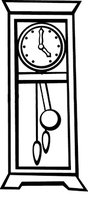
Example: The pendulum in a grandfather clock is a classic example of periodic motion.
Period and Frequency
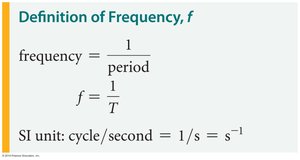
The period (T) is the time required to complete one full cycle of motion. The frequency (f) is the number of cycles per unit time. These quantities are reciprocals of each other.
Period (T): Measured in seconds (s).
Frequency (f): Measured in hertz (Hz), where 1 Hz = 1 cycle/second.
Relationship:
Units and Examples of Frequency
Frequency is often measured in hertz (Hz), kilohertz (kHz), or megahertz (MHz).
1 Hz: One cycle per second.
1 kHz: Hz.
1 MHz: Hz.
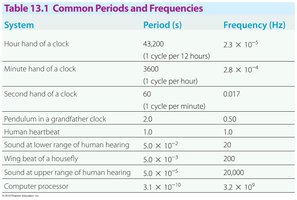
Hour hand of a clock | 43,200 | 2.3 × 10⁻⁵ |
Minute hand of a clock | 3,600 | 2.8 × 10⁻⁴ |
Second hand of a clock | 60 | 0.017 |
Pendulum in a grandfather clock | 2.0 | 0.50 |
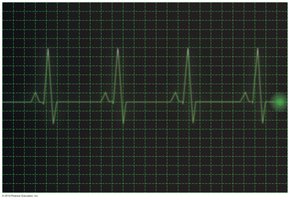
Human heartbeat | 1.0 | 1.0 |
Sound at lower range of human hearing | 5.0 × 10⁻³ | 200 |
Wing beat of a housefly | 5.0 × 10⁻³ | 200 |
Sound at upper range of human hearing | 5.0 × 10⁻⁵ | 20,000 |
Computer processor | 3.1 × 10⁻¹⁰ | 3.2 × 10⁹ |
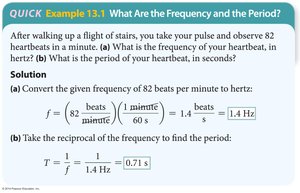
Example: Calculating Frequency and Period
Given: 82 heartbeats per minute.
Frequency: Hz
Period: s
Simple Harmonic Motion (SHM)
Definition and Characteristics
Simple harmonic motion occurs when the restoring force acting on an object is proportional to its displacement from equilibrium.
Restoring Force: The force that brings the object back toward equilibrium.
Example: A mass attached to a spring.
Hooke's Law: (where k is the spring constant, x is displacement)
Cycle of Simple Harmonic Motion
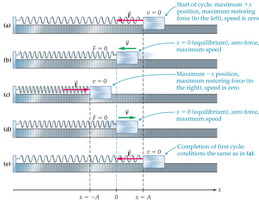
The motion of a mass-spring system can be described as follows:
Displaced to maximum position (x = A), released from rest.
Accelerated toward equilibrium (x = 0).
Passes through equilibrium, continues due to inertia.
Compresses spring, reaches maximum negative displacement (x = -A).
Returns to equilibrium, completing one cycle.
Amplitude and Period
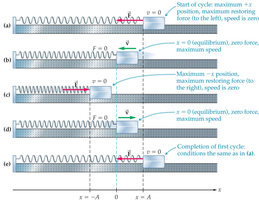
Amplitude (A): Maximum displacement from equilibrium.
Period (T): Time for one complete oscillation.
Mathematical Description
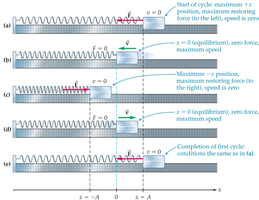
Restoring Force:
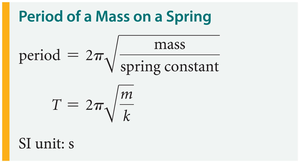
Period of Mass-Spring System:
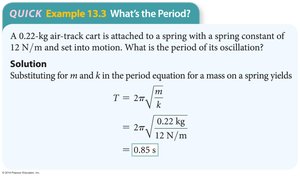
Example: Calculating Period of a Mass-Spring System
Given: m = 0.22 kg, k = 12 N/m
Period: s
Mass Measurement in Space
In microgravity, mass can be measured by attaching the subject to a spring and measuring the period of oscillation. 
Effect of Amplitude on Period
The period of a mass-spring system does not depend on amplitude. Larger amplitude increases speed, but the time for one cycle remains unchanged.
The Pendulum
Definition and Examples
A simple pendulum consists of a mass (bob) suspended by a string or rod of length L. When displaced and released, it swings back and forth about its equilibrium position.
Examples: Grandfather clocks, pocket watches, swings.

Period of a Pendulum
The period depends on the length of the pendulum and the acceleration due to gravity, not on the mass or amplitude.
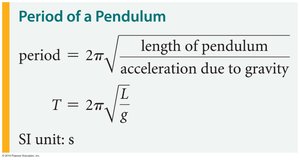
Period Formula:
SI unit: seconds (s)
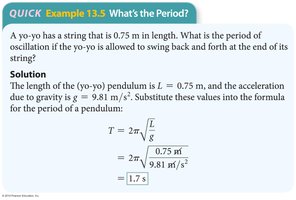
Example: Calculating Period of a Pendulum
Given: L = 0.75 m, g = 9.81 m/s2
Period: s
Factors Affecting Period
Length: Longer pendulums have greater periods.
Gravity: Period increases as gravity decreases.
Mass and Amplitude: Do not affect period for small angles.
Waves and Wave Properties
Definition and Types of Waves
A wave is a disturbance that propagates through a medium, carrying energy.
Transverse Wave: Particles move perpendicular to wave direction (e.g., waves on a string).
Longitudinal Wave: Particles move parallel to wave direction (e.g., sound waves).
Combination: Water waves combine both transverse and longitudinal motion.
Wave Characteristics
Crest: Highest point of a wave.
Trough: Lowest point of a wave.
Wavelength (λ): Distance between consecutive crests or troughs.
Amplitude: Maximum displacement from equilibrium.
Period (T): Time for one wavelength to pass.
Frequency (f): Number of wavelengths per second.
Wave Speed (v):
Wave Speed and Medium
Wave speed depends on the properties of the medium.
Waves travel faster in stiffer media (e.g., sound travels faster in steel than in air).
Reflection of Waves
Waves reflect when they hit a barrier.
Reflection can invert the wave or keep it upright, depending on the boundary conditions.
Interacting Waves
Superposition and Interference
When waves overlap, they combine according to the principle of superposition.
Constructive Interference: Waves add to form a larger amplitude.
Destructive Interference: Waves add to form a smaller amplitude or cancel out.
Standing Waves and Harmonics
Standing Wave: Wave that oscillates in a fixed position, formed by interference of reflected waves.
Nodes: Points of zero displacement.
Antinodes: Points of maximum displacement.
Harmonics: Higher modes of standing waves, with frequencies that are integer multiples of the fundamental frequency.
Applications
Musical instruments (e.g., guitar, piano, violin) utilize standing waves and harmonics.
Resonance can cause dramatic effects, such as the collapse of bridges.
Additional info: These notes expand on the original content by providing definitions, formulas, and examples for clarity and completeness, suitable for college-level physics exam preparation.
