 Back
BackOscillations, Waves, and Sound: Step-by-Step Physics Guidance
Study Guide - Smart Notes
 Tailored notes based on your materials, expanded with key definitions, examples, and context.
Q1. When the displacement of a mass on a spring is half the amplitude, what fraction of the mechanical energy is kinetic energy?
Background
Topic: Simple Harmonic Motion (SHM) and Energy Conservation
This question tests your understanding of how mechanical energy is distributed between kinetic and potential forms in a mass-spring system undergoing SHM.
Key Terms and Formulas
Amplitude (): Maximum displacement from equilibrium.
Mechanical Energy (): Total energy, .
Kinetic Energy (): .
Potential Energy (): .
At any displacement , .
Step-by-Step Guidance
Recall that the total mechanical energy in SHM is constant and given by .
At displacement , calculate the potential energy: .
Express in terms of to find the fraction of energy that is potential at this displacement.
Since , the fraction of kinetic energy is .

Try solving on your own before revealing the answer!
Final Answer: 0.75
At , the kinetic energy is 75% of the total mechanical energy.
This is found by calculating the potential energy at and subtracting from the total energy.
Q2. At what displacement, as a fraction of , is the mechanical energy half kinetic and half potential?
Background
Topic: Energy Distribution in Simple Harmonic Motion
This question asks you to find the displacement where kinetic and potential energies are equal in a mass-spring system.
Key Terms and Formulas
Mechanical Energy:
Kinetic Energy:
Potential Energy:
Set and solve for in terms of .
Step-by-Step Guidance
Set and use the energy expressions: .
Substitute and solve for .
Express as a fraction of by dividing both sides by and taking the square root.

Try solving on your own before revealing the answer!
Final Answer:
At , the kinetic and potential energies are equal.
This is found by solving for .
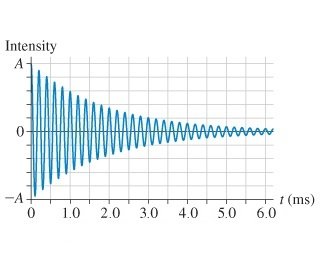
Q3. The common field cricket makes a damped oscillation. What is the frequency of oscillations and the time constant for the decay?
Background
Topic: Damped Harmonic Motion
This question involves analyzing a damped oscillation, where the amplitude decreases over time due to energy loss (e.g., friction or air resistance).
Key Terms and Formulas
Damped Oscillation:
Frequency: , where is the period.
Time Constant (): Time for amplitude to decrease by .
Step-by-Step Guidance
From the graph, determine the period by measuring the time between successive peaks.
Calculate the frequency using .
To find the time constant , observe how long it takes for the amplitude to decrease to of its initial value.
Try solving on your own before revealing the answer!
Final Answer: Hz, s
The frequency is found from the period, and the time constant from the exponential decay of amplitude.
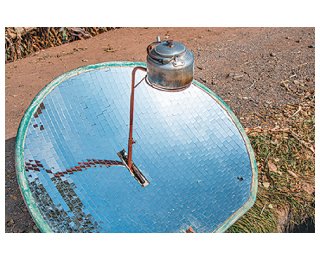
Q4. Using a dish-shaped mirror, a solar cooker concentrates sunlight onto a pot. How much solar power does the dish capture?
Background
Topic: Power and Intensity of Light
This question tests your ability to calculate the power collected by a surface given the intensity of sunlight and the area of the collector.
Key Terms and Formulas
Intensity (): Power per unit area,
Power ():
Area of a circle:
Step-by-Step Guidance
Calculate the radius of the dish from its diameter.
Find the area of the dish using .
Multiply the area by the intensity of sunlight to find the total power captured: .
Try solving on your own before revealing the answer!
Final Answer: W
The power is calculated by multiplying the area of the dish by the intensity of sunlight.
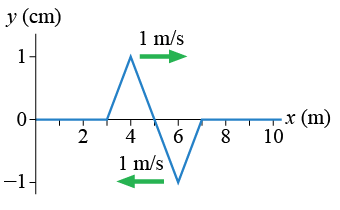
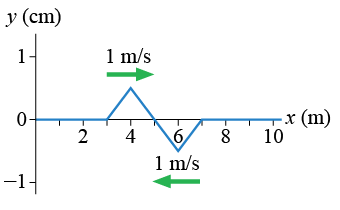
Q5. The figure shows a snapshot graph at s of two waves approaching each other at 1 m/s. Choose the correct snapshot graph showing the string at s and s.
Background
Topic: Superposition of Waves
This question tests your understanding of how two waves traveling in opposite directions interact and how their shapes evolve over time.
Key Terms and Formulas
Wave Speed: m/s
Displacement: Each wave moves in its direction after time .
Superposition Principle: The resulting displacement is the sum of the individual displacements.
Step-by-Step Guidance
At s, each wave has moved 2 m in its respective direction. Shift the original shapes accordingly.
At s, each wave has moved 3 m. Again, shift the shapes and add their displacements where they overlap.
Compare the shifted shapes to the provided graphs to identify the correct one for each time.
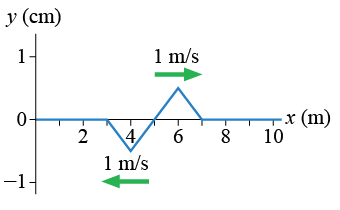
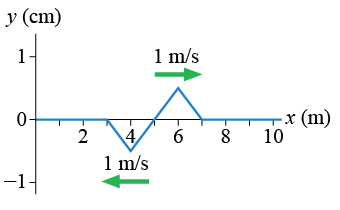
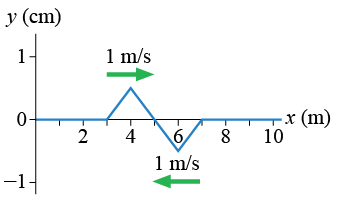
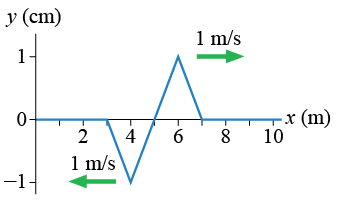
Try solving on your own before revealing the answer!
Final Answer: At s, use image_8; at s, use image_10
The correct graphs are chosen by shifting the original waveforms by the appropriate distances and applying the superposition principle.
Q6. A guitar player bends a string, increasing its tension and frequency. What is the new frequency?
Background
Topic: Standing Waves on Strings
This question involves understanding how the frequency of a vibrating string changes with tension and length.
Key Terms and Formulas
Frequency of a string:
= length of string, = tension, = mass per unit length
When the string is bent, tension increases, and the effective length may change.
Step-by-Step Guidance
Calculate the original frequency using the given length and tension.
Determine how the tension changes when the string is bent (add the force applied to the original tension).
Use the frequency formula to set up the expression for the new frequency with the updated tension.

Try solving on your own before revealing the answer!
Final Answer: Hz
The new frequency is found by substituting the increased tension into the frequency formula for a stretched string.
