 Back
BackPHYS225 - Exam #1 Study Guide (Oscillations, Waves, and Sound)
Study Guide - Smart Notes
 Tailored notes based on your materials, expanded with key definitions, examples, and context.
Oscillations and Simple Harmonic Motion
Spring-Mass Systems
Oscillatory motion occurs when a mass attached to a spring moves back and forth about an equilibrium position. The restoring force is provided by the spring, following Hooke's Law: .
Spring Constant (k): Measures the stiffness of the spring. Calculated by , where is mass, is acceleration due to gravity (note: ), and is the stretch/compression.
Angular Frequency (): or or
Amplitude (A): Maximum displacement from equilibrium.
Maximum Velocity (v_{max}):
Velocity:
Maximum Acceleration (a_{max}):
Period (T): or
Frequency (f): or
Position Function: , where is the phase constant.
Velocity Function:
Acceleration Function:
Initial Position:
Initial Velocity: or
Initial Acceleration: or
Maximum Velocity:
Maximum Acceleration:
Phase Angle:
Note: when x = A the phase shift equals zero
Total Energy (E):
Potential Energy (PE):
Kinetic Energy (KE):
Energy: E = U + K
Springs in Series: ; Springs in Parallel:
Example: A 0.3 kg mass stretches a spring by 0.15 m. The spring is compressed 0.1 m and released. Calculations yield , , , , , , , .
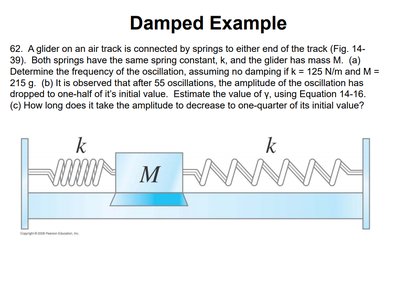
Damped Oscillations
Damping occurs when energy is lost from the system, typically due to friction or resistance. The amplitude decreases exponentially over time.
Damped Position Function: , where is the damping constant.
Amplitude Decay:
Damping Constant (b):
Pendulums
Simple Pendulum
A simple pendulum consists of a mass (bob) attached to a string of length , swinging under gravity. For small angles, the motion approximates simple harmonic motion.
Period (T):
Frequency (f):
Angular Displacement: ,
Moment of Inertia:
Parallel-Axis Theorem:
Example: For , , . After 2 seconds, if released from .
Waves and Sound
Wave Properties
Waves transfer energy through a medium without transferring matter. Key properties include wavelength (), frequency (), amplitude (), and speed ().
Wave Speed:
Transverse Wave Equation:
Wavelength:
Frequency:
Standing Waves on Strings and Air Columns
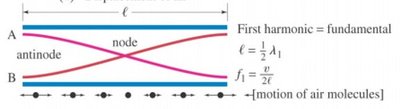
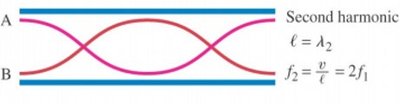
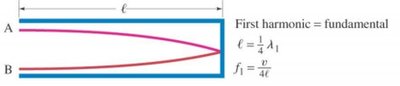
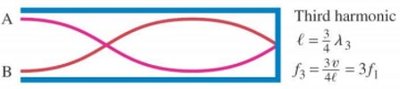
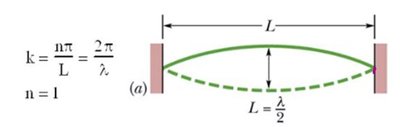
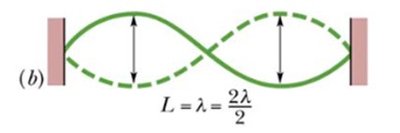
Standing waves form when two waves of the same frequency and amplitude travel in opposite directions and interfere. Nodes are points of no displacement; antinodes are points of maximum displacement.
String Fixed at Both Ends: , ,
Open Tube (Both Ends): ,
Closed Tube (One End): , ,
Doppler Effect
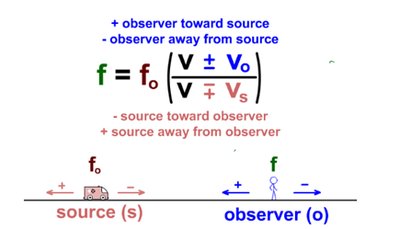
The Doppler Effect describes the change in frequency or wavelength of a wave in relation to an observer moving relative to the source of the wave.
Observed Frequency: , where is the speed of sound, is the observer's speed, is the source's speed.
Use when the observer moves toward the source or the source moves away from the observer; use when the observer is moving away or the source is moving toward the observer.
Shock Waves and Sonic Booms
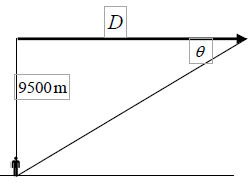
When a source moves faster than the speed of sound, it creates a shock wave, resulting in a sonic boom. The angle of the shock wave depends on the Mach number.
Shock Wave Angle:
Distance Traveled by Jet: , where is altitude.
Sound Intensity and Decibels
Sound intensity is the power per unit area. The decibel (dB) scale is a logarithmic measure of sound intensity relative to a reference level ().
Intensity Level:
Power from Intensity: for a spherical wavefront.
Beats
Beats occur when two sound waves of slightly different frequencies interfere, producing a fluctuation in amplitude at the beat frequency.
Beat Frequency:
Wave Speed on a String
The speed of a wave on a stretched string depends on the tension and the mass per unit length.
Wave Speed: , where is tension, is mass per unit length.
Summary Table: Harmonics in Strings and Tubes
System | Harmonic Number (n) | Wavelength () | Frequency () |
|---|---|---|---|
String, both ends fixed | n = 1, 2, 3, ... | ||
Open tube, both ends | n = 1, 2, 3, ... | ||
Closed tube, one end | n = 1, 3, 5, ... |
Additional info: These notes cover key concepts from oscillations, waves, and sound, including mathematical models, physical interpretations, and practical examples. Images included are directly relevant to the explanation of standing waves, the Doppler effect, shock waves, and damped oscillations.
