 Back
BackOscillatory Motion and Mechanical Waves: Study Notes
Study Guide - Smart Notes
 Tailored notes based on your materials, expanded with key definitions, examples, and context.
Oscillatory Motion
Introduction to Oscillations
Oscillatory motion is a type of periodic motion in which an object moves back and forth about an equilibrium position. Oscillations are fundamental in physics and appear in various systems, from mechanical springs to electrical circuits and even biological cycles.
Oscillation: Repetitive variation, typically in time, of some measure about a central value or between two or more different states.
Examples: Mass on a spring, pendulums, electrical LC circuits, sound waves, electromagnetic waves.
Harmonic Oscillations
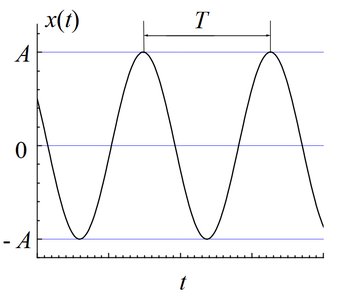
Simple harmonic motion (SHM) is the simplest form of oscillatory motion, where the restoring force is directly proportional to the displacement and acts in the direction opposite to that of displacement.
Displacement as a function of time: , where:
= amplitude (maximum displacement)
= angular frequency (rad/s)
= phase constant (initial phase)
Period (): The time for one complete oscillation.
Frequency (): Number of oscillations per second.
Mass on a Spring: Qualitative Analysis
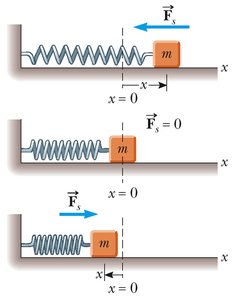
A mass attached to a spring exhibits SHM when displaced from its equilibrium position. The restoring force is given by Hooke's Law.
Hooke's Law: , where is the spring constant and is the displacement from equilibrium.
Restoring force: Always directed toward the equilibrium position.
Mass on a Spring: Formal Analysis
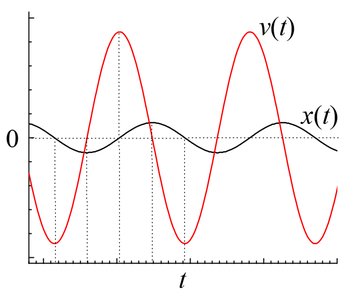
The motion of a mass-spring system can be described by a second-order differential equation.
Equation of motion: or with
General solution:
Velocity:
Acceleration:
Energy in Simple Harmonic Motion
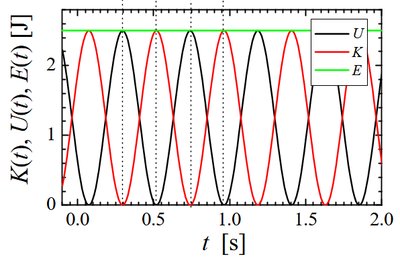
In SHM, energy oscillates between kinetic and potential forms, but the total mechanical energy remains constant (in the absence of damping).
Kinetic energy:
Potential energy:
Total energy: (constant)
Mechanical Waves
Types of Waves
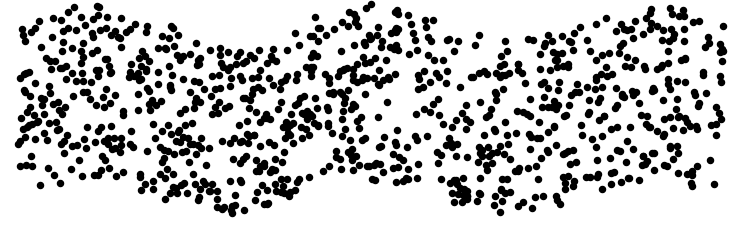
Waves are disturbances that transfer energy from one place to another without the net transfer of matter. Mechanical waves require a medium, while electromagnetic waves do not.
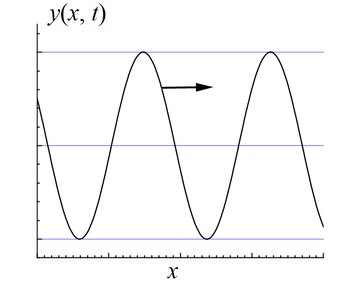
Transverse waves: Oscillations are perpendicular to the direction of wave propagation (e.g., waves on a string).
Longitudinal waves: Oscillations are parallel to the direction of wave propagation (e.g., sound waves).
Wave Function and Propagation
The wave function describes the displacement of points in the medium as a function of position and time.
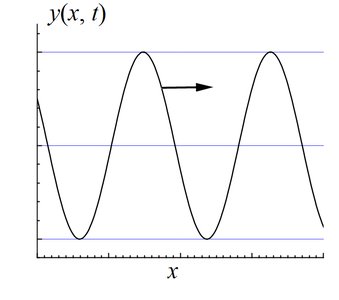
General form: for a wave traveling in the positive x-direction with speed .
Sinusoidal wave:
Wavelength (): Distance between two consecutive points in phase.
Wave number ():
Wave speed:
Superposition and Interference
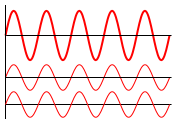
When two or more waves overlap, the resulting displacement is the sum of the individual displacements (superposition principle). This leads to interference patterns.
Constructive interference: When waves add to produce a larger amplitude.
Destructive interference: When waves add to produce a smaller (or zero) amplitude.
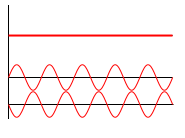
Standing Waves
Standing waves are formed by the superposition of two waves of the same frequency and amplitude traveling in opposite directions. They are characterized by nodes (points of zero amplitude) and antinodes (points of maximum amplitude).
Mathematical form:
Nodes: , where
Antinodes:
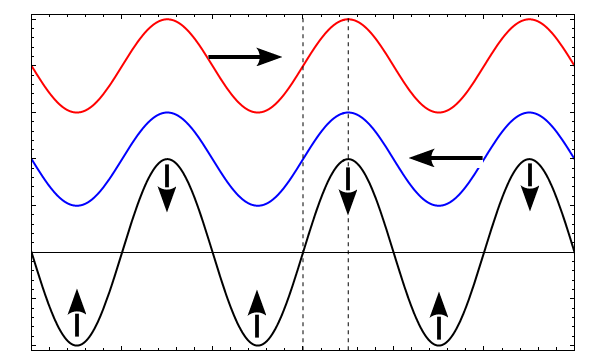
Normal Modes of a String
For a string of length fixed at both ends, only certain wavelengths and frequencies are allowed (normal modes).
Allowed wavelengths: ,
Frequencies: , where is the fundamental frequency
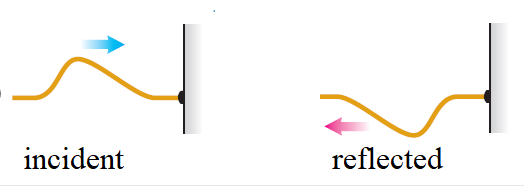
Sound Waves
Speed of Sound in Different Media
The speed of sound depends on the properties of the medium. In solids and liquids, it is related to the elastic modulus and density; in gases, it depends on temperature and molecular properties.
In a string: , where is tension and is mass per unit length.
In a fluid: , where is the bulk modulus and is density.
In a gas: , where is the adiabatic index, is Boltzmann's constant, is temperature, and is molecular mass.
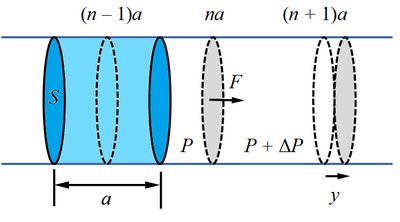
Sound Intensity and Decibels
Sound intensity is the power per unit area carried by a wave. The decibel (dB) scale is used to express sound intensity levels logarithmically.
Intensity: , where is power and is area.
Decibel level: , where is the threshold of hearing.
Standing Sound Waves in Pipes
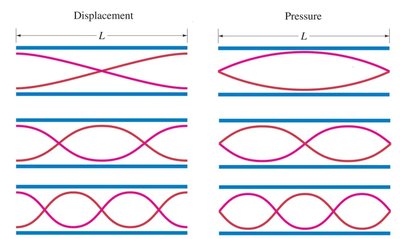
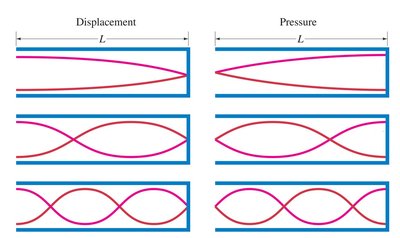
Standing sound waves can form in pipes with different boundary conditions (open or closed ends), leading to different patterns of nodes and antinodes for displacement and pressure.
Both ends open: , ,
One end closed: , ,
Resonance and Beats
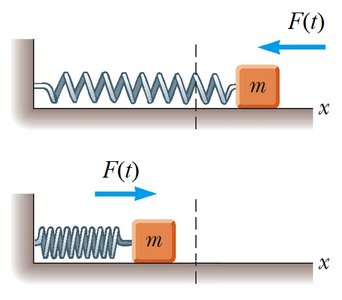
Resonance occurs when a system is driven at its natural frequency, resulting in large amplitude oscillations. Beats arise when two waves of slightly different frequencies interfere, producing a modulation in amplitude at the beat frequency.
Beat frequency:
Summary Table: Key Formulas
Quantity | Formula | Description |
|---|---|---|
Displacement (SHM) | Position as a function of time | |
Angular frequency | Oscillation rate in radians per second | |
Wave speed (string) | Speed of wave on a stretched string | |
Wave speed (fluid) | Speed of sound in a fluid | |
Standing wave frequency (string, both ends fixed) | Allowed frequencies for string of length | |
Standing wave frequency (pipe, one end closed) | , odd | Allowed frequencies for pipe of length |
Sound intensity (dB) | Sound level in decibels |
