 Back
BackOscillatory Motion and Mechanical Waves: Study Notes
Study Guide - Smart Notes
 Tailored notes based on your materials, expanded with key definitions, examples, and context.
Oscillatory Motion
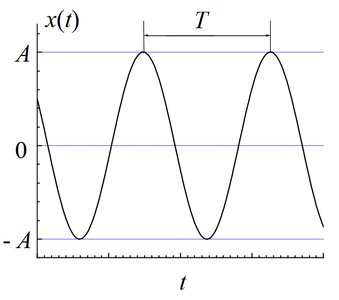
Harmonic Oscillations
Oscillatory motion is a fundamental concept in physics, describing systems that repeat their motion in a regular cycle. Harmonic oscillations are characterized by sinusoidal functions, where displacement varies periodically with time.
Displacement function: , where A is amplitude, \omega is angular frequency, and \phi_0 is the phase constant.
Period (T): The time for one complete cycle, .
Frequency (f): Number of cycles per second, .
Units: [T] = s, [\omega] = s-1, [f] = Hz.
Mass on a Spring: Qualitative Analysis
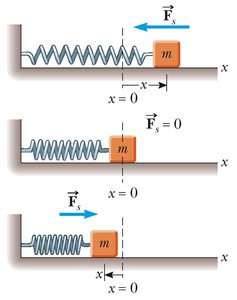
A classic example of oscillatory motion is a mass attached to a spring. The restoring force is described by Hooke's Law:
Hooke's Law: , where k is the spring constant and x is displacement from equilibrium.
The force always acts to return the mass to equilibrium.
Dimensions: [m] = kg, [k] = N/m = kg/s2.
Mass on a Spring: Formal Analysis
The motion of a mass-spring system is governed by a second-order differential equation:
Equation of motion: or with .
General solution: .
Initial conditions determine amplitude and phase constant.
Kinematics of Simple Harmonic Motion
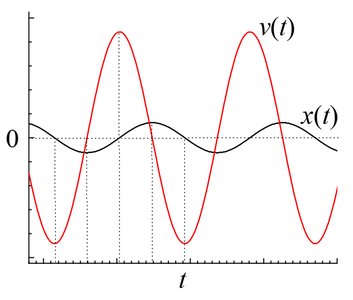
Velocity and acceleration in simple harmonic motion are also sinusoidal and phase-shifted relative to displacement.
Velocity:
Acceleration:
Maximum values: ,
Energy in Simple Harmonic Motion
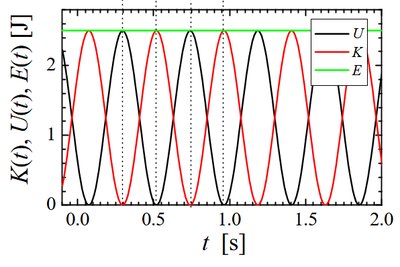
Energy in a simple harmonic oscillator is conserved and alternates between kinetic and potential forms.
Kinetic energy:
Potential energy:
Total energy: (constant)
Mechanical Waves
Wave Function and Propagation
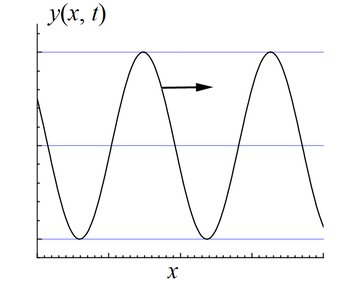
Mechanical waves are disturbances that propagate through a medium without net transfer of matter. The wave function describes the displacement at each point in space and time.
Wave function:
Wave speed (v): The speed at which the disturbance travels.
Wavelength (\lambda): The spatial period of the wave.
Frequency (f): Number of oscillations per second.
Types of Mechanical Waves
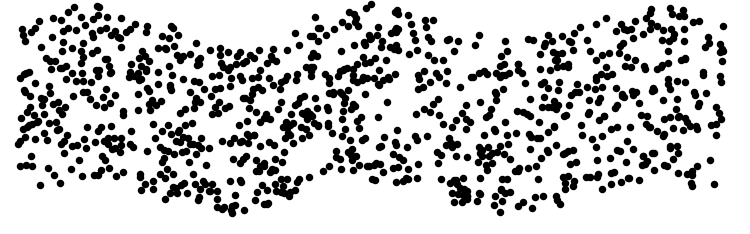
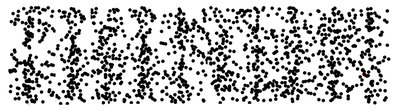
Mechanical waves can be classified as transverse or longitudinal based on the direction of oscillation relative to propagation.
Transverse waves: Oscillations are perpendicular to the direction of propagation (e.g., waves on a string).
Longitudinal waves: Oscillations are parallel to the direction of propagation (e.g., sound waves).
Wave Equation
The wave equation describes the propagation of waves in a medium:
Wave equation:
Solutions include sinusoidal waves and more complex shapes.
Superposition and Interference
When two or more waves overlap, their displacements add according to the principle of superposition, resulting in interference patterns.
Constructive interference: Waves add to produce larger amplitude.
Destructive interference: Waves add to produce smaller amplitude or cancellation.
Standing Waves
Standing waves are formed by the superposition of two waves of equal amplitude traveling in opposite directions. They exhibit nodes (points of zero amplitude) and antinodes (points of maximum amplitude).
Standing wave function:
Nodes:
Antinodes:
Energy Transfer in Waves
Wave Intensity
Waves carry energy, and the intensity is the energy transferred per unit time through a unit area perpendicular to the direction of propagation.
Intensity: (for sound waves)
Intensity depends on amplitude squared.
Summary Table: Oscillatory Motion and Waves
Quantity | Symbol | Formula | Units |
|---|---|---|---|
Period | T | s | |
Frequency | f | Hz | |
Angular Frequency | \omega | rad/s | |
Wave Speed | v | m/s | |
Spring Constant | k | N/m | |
Energy (SHM) | E | J |
