 Back
BackOscillatory Motion and Simple Harmonic Motion: Study Notes
Study Guide - Smart Notes
 Tailored notes based on your materials, expanded with key definitions, examples, and context.
Oscillatory Motion in Physics
Overview of Oscillations
Oscillatory motion is a fundamental concept in physics, describing systems that move back and forth around an equilibrium position. Such motion is observed in mechanical systems, electrical circuits, waves, and even biological and chemical processes.
Mechanical oscillations: Examples include masses on springs and pendulums.
Electrical oscillations: Voltage oscillations in LC circuits.
Wave oscillations: Pressure in sound waves, electric fields in electromagnetic waves, and water levels in surface waves.
Other disciplines: Oscillations are also seen in population dynamics, sleep-wake cycles, heartbeats, ice ages, and chemical reactions.
Terminology of Oscillatory Motion
The key terms in oscillatory motion include amplitude, period, frequency, angular frequency, and phase.
Amplitude (A): The maximum displacement from equilibrium.
Period (T): The time for one complete oscillation.
Frequency (f): The number of oscillations per unit time.
Angular frequency (\omega): Related to frequency by \( \omega = 2\pi f \).
Phase (\phi): Describes the position within the cycle at a given time.
Mathematical description: Period: Frequency: Units: 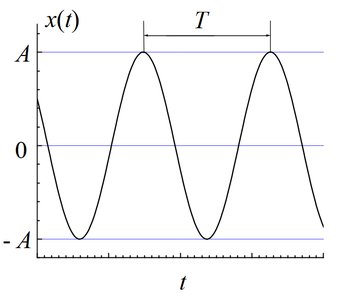
Mass on a Spring: Qualitative Analysis
Restoring Force and Hooke's Law
When a mass is attached to a spring, it experiences a restoring force that is proportional to its displacement from equilibrium, described by Hooke's Law.
Restoring force:
Spring constant (k): Measures the stiffness of the spring.
Dimensions:
Characteristic frequency:
Example: The oscillation frequency of a boat changes when a dog sits in it, illustrating how mass affects the period. 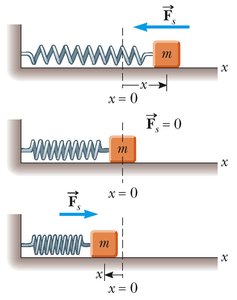
Mass on a Spring: Formal Analysis
Equation of Motion and Solutions
The motion of a mass on a spring is governed by a second-order differential equation.
Equation of motion: or
Angular frequency:
General solutions: or
Superposition principle: The sum of two solutions is also a solution.
Initial conditions: Two constants (amplitude and phase) are determined by initial position and velocity.
Displacement, Velocity, and Acceleration
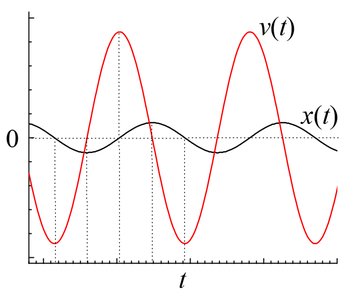
The position, velocity, and acceleration of the mass are sinusoidal functions of time.
Displacement:
Velocity:
Acceleration:
Maximum values: , ,
Finding amplitude and phase:
Energy in Simple Harmonic Motion
Conservation of Energy
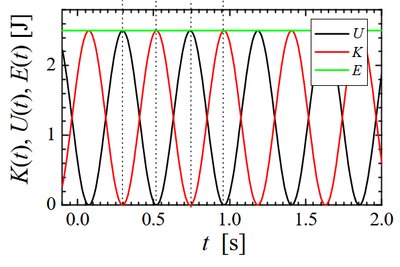
In simple harmonic motion, the total mechanical energy is conserved and is the sum of kinetic and potential energies.
Kinetic energy:
Potential energy:
Total energy:
Exercise Example
Solving for Oscillation Parameters
Problem: A 200 g mass attached to a horizontal spring oscillates at a frequency of 2 Hz. At , the mass is at cm and has velocity cm/s. Find: period, angular frequency, amplitude, phase constant, maximum speed, maximum acceleration, total energy, and position at s.
Period: s
Angular frequency: rad/s
Amplitude:
Phase constant:
Maximum speed:
Maximum acceleration:
Total energy:
Position at s:
Example calculation: Substitute the given values to solve each parameter. Additional info: The above exercise demonstrates how initial conditions and system parameters determine the full motion and energy characteristics of a simple harmonic oscillator.
