 Back
Periodic Motion and Simple Harmonic Motion: Study Notes for Physics with Calculus
Study Guide - Smart Notes
 Tailored notes based on your materials, expanded with key definitions, examples, and context.
Periodic Motion
Definition and Examples
Periodic motion refers to any motion that repeats itself at regular time intervals. It is a fundamental concept in physics, observed at all scales from atomic vibrations to planetary orbits.
Examples: Earth orbiting the Sun, vibrations of atoms, plucked strings of a guitar, swings of a pendulum.
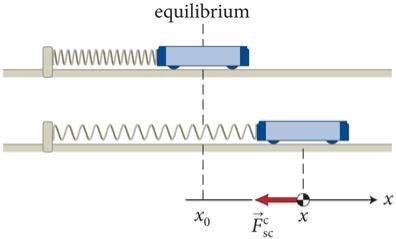
Equilibrium Position: The point where the net force on the system is zero.
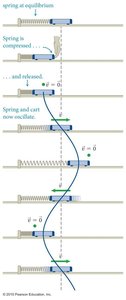
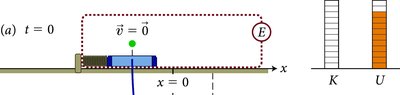
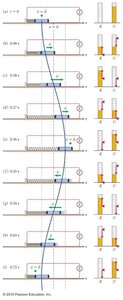
Closed System: In a spring-cart system, all energy is initially stored as elastic potential energy when the spring is compressed.

Energy Conversion in Periodic Motion
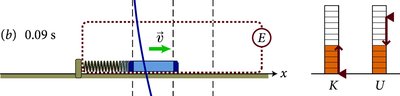
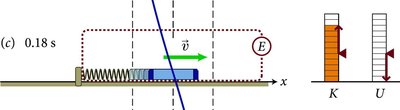
Periodic motion is characterized by a continuous conversion between potential and kinetic energy in a closed system. As the spring expands, kinetic energy increases and potential energy decreases.
At equilibrium: Potential energy is zero, but kinetic energy is not necessarily zero.
Damping: In real systems, energy dissipation causes periodic motion to die out over time.
Key Quantities in Periodic Motion
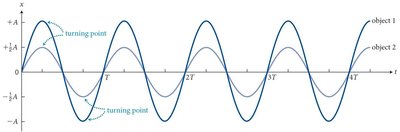
Period (T): The time interval to complete one cycle.
Frequency (f): The number of cycles per unit time, .
Amplitude (A): The maximum displacement from equilibrium.
Isochronous Systems
An oscillating system is isochronous if its period is independent of amplitude (for small amplitudes).
Simple Harmonic Motion (SHM)
Definition and Mathematical Description
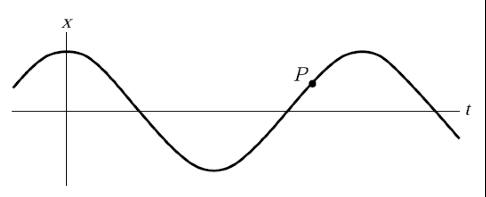
Simple harmonic motion is a type of periodic motion where the restoring force is linearly proportional to the displacement from equilibrium and directed toward equilibrium. The position as a function of time is sinusoidal.
Equation:
Restoring Force: (Hooke's Law for springs)
Angular Frequency:
Phase:
Relation to Circular Motion
SHM is closely related to uniform circular motion. The projection of a point moving in a circle at constant speed onto a diameter traces out SHM.
Position: , where is the radius.
Velocity and Acceleration in SHM
Velocity:
Acceleration:
Newton's Second Law:
Energy in SHM
The total mechanical energy in a simple harmonic oscillator is constant and proportional to the square of the amplitude.
Kinetic Energy:
Potential Energy:
Total Energy:
Restoring Forces in SHM
Stable Equilibrium and Restoring Force
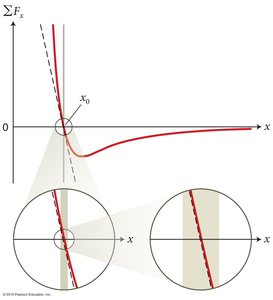
Restoring forces are always linearly proportional to displacement for small deviations from equilibrium. This linearity is essential for SHM.
Stable Equilibrium: Only stable equilibrium allows periodic motion.
Restoring Force for Pendulum: for small angles.
Examples of Oscillating Systems
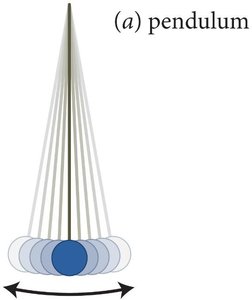
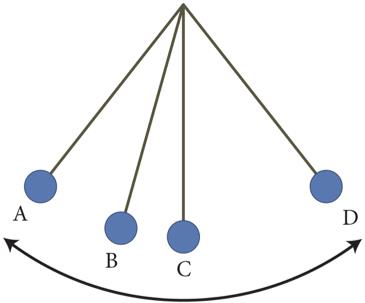
Pendulum: Oscillates due to gravity's restoring force.
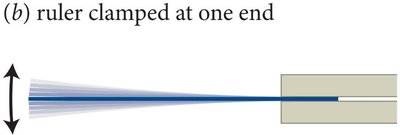
Ruler clamped at one end: Bends and oscillates.
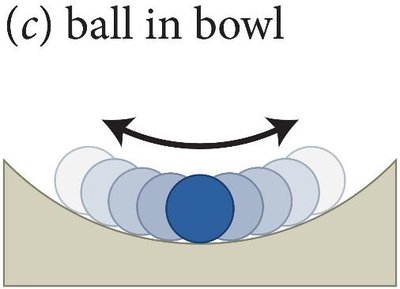
Ball in bowl: Oscillates due to restoring force from bowl shape.
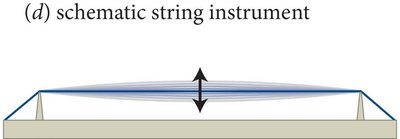
String instrument: Vibrates when plucked.
SHM and Springs
Spring-Cart System
In a spring-cart system, the restoring force is provided by the spring. The equation of motion is derived from Hooke's Law and Newton's Second Law.
Equation of Motion:
Period:
Frequency:

Restoring Torques and Rotational Oscillators
Torsion Oscillator
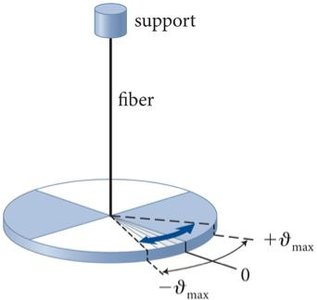
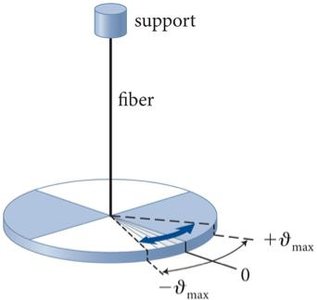
Some simple harmonic oscillators involve rotational motion, such as a torsion oscillator. The restoring torque is proportional to the angular displacement.
Restoring Torque:
Equation of Motion:
Angular Frequency:
Pendulum as Rotational Oscillator
Restoring Torque for Pendulum: (for small angles)
Equation of Motion:
Approximation: Pendulum executes SHM only if the amplitude of angular displacement is much less than 1 radian.
Summary Table: Key Properties of SHM
Property | Spring-Mass System | Pendulum |
|---|---|---|
Restoring Force | ||
Period | ||
Frequency | ||
Energy | (for small angles) | |
Mass Dependence | Period increases with mass | Period independent of mass |
Lecture Examples
Example 1: A 0.250-kg mass on a spring with . Find period, amplitude, frequency, and spring constant.
Example 2: A 5.0-kg cart attached to a spring (), initial displacement 0.32 m, initial velocity 1.5 m/s toward equilibrium. Find amplitude and speeds at equilibrium and maximum displacement.
Example 3: Pendulum clock: Time interval between tick and tock is 0.5 s. Find required length.
Example 4: Mass attached to spring oscillates between and , time from one extreme to the other is 0.20 s. Find amplitude, frequency, and period.
Conceptual Questions and Quizzes
Isochronous Oscillators: Period independent of amplitude for small oscillations.
Equilibrium Types: Only stable equilibrium allows periodic motion.
Pendulum Synchrony: Two swings can swing in synchrony if their lengths are the same.
Restoring Force Direction: Always points toward equilibrium.
Period Dependence: For pendulum, period depends on length and gravity, not mass.
SHM Approximation: Pendulum executes SHM only for small angular displacements.
Additional info: These notes expand on the original lecture slides and quizzes, providing full academic context, definitions, and formulas for exam preparation.
