 Back
BackPhases, Phase Changes, and Thermal Properties of Matter
Study Guide - Smart Notes
 Tailored notes based on your materials, expanded with key definitions, examples, and context.
Phases and Phase Changes
Introduction to Thermodynamics
Thermodynamics is the study of energy, heat, and work, and how they interact in physical systems. The principle of energy conservation states that energy cannot be created or destroyed, only transferred or transformed between forms.
Heat is a form of energy transfer due to temperature difference.
Mechanical work can be converted into heat, as demonstrated by the mechanical equivalent of heat.
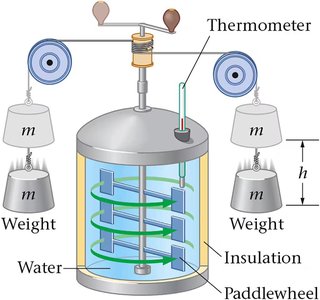
Mechanical Equivalent of Heat:
1 calorie (cal) = 4.186 joules (J)
1 kilocalorie (kcal) = 4186 J
Measuring Heat and Heat Transfer
A kilocalorie is the amount of energy required to raise the temperature of 1 kg of water by 1°C. The nutritional Calorie (with a capital C) is equivalent to 1 kcal.
1 kcal = 1 Calorie (nutritional)
Heat Capacity
Heat capacity (C) is the amount of heat required to change an object's temperature by a certain amount. It is always positive and depends on both the material and the mass of the object.
Formula:
If Q > 0, temperature increases; if Q < 0, temperature decreases.
Example: If a 1 kg block of iron (C = 488 J/K) absorbs 493 J of heat, the temperature change is:
Specific Heat
Specific heat (c) is the heat required to raise the temperature of 1 kg of a substance by 1 K. It varies with the type of material and its mass.
Formula:
Water:
Aluminum:
Lead:
Substance | Specific Heat, c [J/(kg·K)] |
|---|---|
Water | 4186 |
Aluminum | 900 |
Lead | 128 |
Example: Heating a 0.5 kg aluminum pan and 0.25 kg of water from 20°C to 80°C:
Heat required: (calculate separately for pan and water)
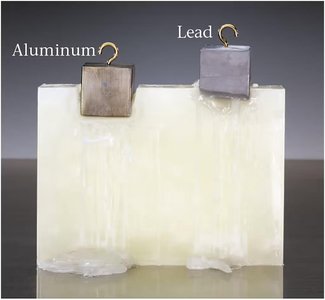
Conceptual Example: Melting Wax with Heated Metals
Given equal volumes of aluminum and lead, both heated to the same temperature and placed on wax, the metal with the higher specific heat (aluminum) will melt more wax because it stores more energy per degree of temperature change.
Calorimetry
Calorimetry is the experimental technique used to measure energy changes and heat flow in physical systems. It often involves mixing substances and measuring the final equilibrium temperature.
Assume no heat is lost to the surroundings (isolated system).
Apply conservation of energy: heat lost by one part equals heat gained by another.
Methods of Heat Transfer
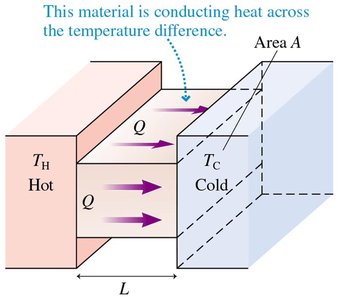
Conduction
Conduction is the transfer of heat through direct contact between particles in a material. Metals are good conductors, while gases and insulators are poor conductors.
Examples: Roasting marshmallows with a metal stick, cooking with a pan.
Convection
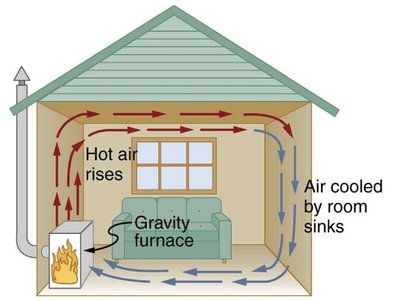
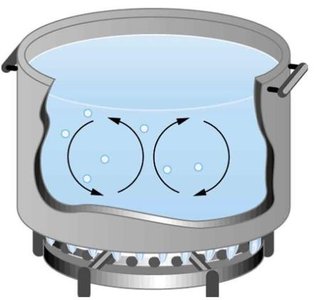
Convection is the transfer of heat by the movement of fluids (liquids or gases). It is responsible for many natural phenomena such as wind and ocean currents.
Occurs when a fluid is unevenly heated, causing bulk movement.
Radiation
Radiation is the transfer of energy by electromagnetic waves. It does not require a medium and can occur in a vacuum.
All objects emit radiation depending on their temperature.
Examples: Feeling heat from a fire, microwaves, infrared thermometers.
Ideal Gases and the Kinetic Theory
Ideal Gases
An ideal gas is a simplified model where intermolecular forces are negligible. The behavior of ideal gases is described by the ideal gas law, which relates pressure, volume, temperature, and the number of molecules.
Equation:
J/K (Boltzmann constant)
Moles and Avogadro’s Number
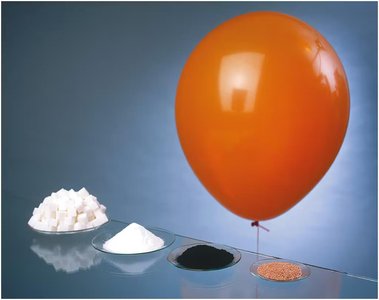
A mole is a unit that measures the amount of substance, defined as containing as many particles as there are atoms in 12 grams of carbon-12.
Avogadro’s number: molecules/mol
1 mol = molecules
Ideal Gas Law in Terms of Moles
R = 8.31 J/(mol·K) (Universal gas constant)
Extensions of the Ideal Gas Law
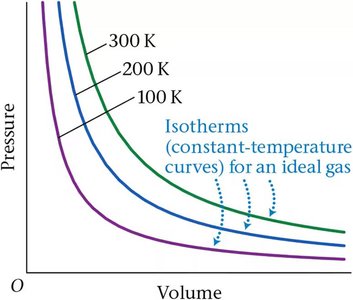
Boyle’s Law: (at constant temperature)
Charles’s Law: (at constant pressure)
Kinetic Theory of Gases
The kinetic theory explains gas pressure as the result of collisions of molecules with the walls of a container. The average kinetic energy of a gas is proportional to its absolute temperature.
Adding heat increases molecular speed and energy.
Phase Equilibrium
Phase Changes and Equilibrium
High-speed molecules in a substance can change phase (e.g., from liquid to gas). At equilibrium, the rate of molecules leaving a phase equals the rate entering it.
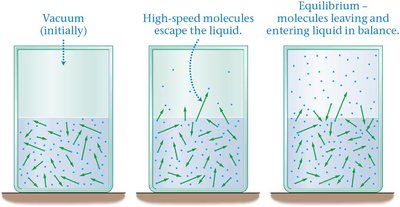
Increasing temperature increases the number of high-speed molecules that can escape.
