 Back
BackPhotoelectric Effect: Equations, Calculations, and Applications
Study Guide - Smart Notes
 Tailored notes based on your materials, expanded with key definitions, examples, and context.
Photoelectric Effect
Introduction to the Photoelectric Effect
The photoelectric effect is the phenomenon in which electrons are emitted from a material when it is exposed to electromagnetic radiation of sufficient frequency. This effect provided crucial evidence for the quantum nature of light and led to the development of quantum mechanics.
Key Concept: Electrons are ejected only if the incident light has a frequency above a certain threshold, regardless of intensity.
Work Function (\( \phi \)): The minimum energy required to remove an electron from the surface of a material.
Threshold Frequency (\( f_c \)): The minimum frequency of light needed to emit electrons from a material.
Photoelectric Effect Equation
The maximum kinetic energy of emitted electrons is given by:
$KE_{\text{max}} = E_{\text{photon}} - \phi = hf - \phi$
\( KE_{\text{max}} \): Maximum kinetic energy of ejected electrons
\( E_{\text{photon}} = hf \): Energy of the incident photon
\( h \): Planck's constant (\( 6.63 \times 10^{-34} \) J·s)
\( f \): Frequency of incident light
\( \phi \): Work function of the material
Cutoff Wavelength and Frequency
The cutoff wavelength (\( \lambda_c \)) is the longest wavelength (lowest energy) that can cause electron emission. It is related to the work function by:
$\lambda_c = \frac{hc}{\phi}$
The cutoff frequency (\( f_c \)) is the minimum frequency required for electron emission:
$f_c = \frac{c}{\lambda_c} = \frac{\phi}{h}$
\( c \): Speed of light (\( 3.00 \times 10^8 \) m/s)
Example Calculations
1. Calculating the Cutoff Wavelength
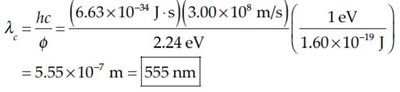
Given \( \phi = 2.24 \) eV, the cutoff wavelength is:
$\lambda_c = \frac{(6.63 \times 10^{-34} \ \text{J·s})(3.00 \times 10^8 \ \text{m/s})}{2.24 \ \text{eV}} \left( \frac{1 \ \text{eV}}{1.60 \times 10^{-19} \ \text{J}} \right) = 5.55 \times 10^{-7} \ \text{m} = 555 \ \text{nm}$
2. Calculating the Cutoff Frequency
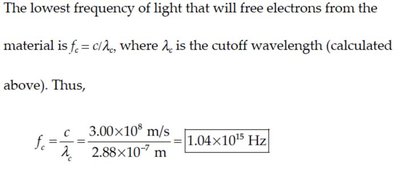
The lowest frequency of light that will free electrons is:
$f_c = \frac{c}{\lambda_c} = \frac{3.00 \times 10^8 \ \text{m/s}}{2.88 \times 10^{-7} \ \text{m}} = 1.04 \times 10^{15} \ \text{Hz}$
3. Calculating the Work Function from Wavelength
Given a wavelength and photon energy, the work function can be found as:
$\phi = \frac{(6.63 \times 10^{-34} \ \text{J·s})(3.00 \times 10^8 \ \text{m/s})}{350 \times 10^{-9} \ \text{m}} \left( \frac{1 \ \text{eV}}{1.60 \times 10^{-19} \ \text{J}} \right) - 1.31 \ \text{eV} = 2.24 \ \text{eV}$

4. Photoelectric Effect Equation at Cutoff
At the cutoff wavelength, \( KE_{\text{max}} = 0 \), so:
$KE_{\text{max}} = \frac{hc}{\lambda} - \phi$

5. Example: Cutoff Wavelength for a Given Work Function
Given \( \phi = 4.31 \) eV:
$\lambda_c = \frac{(6.63 \times 10^{-34} \ \text{J·s})(3.00 \times 10^8 \ \text{m/s})}{4.31 \ \text{eV}} \left( \frac{1 \ \text{eV}}{1.60 \times 10^{-19} \ \text{J}} \right) = 2.88 \times 10^{-7} \ \text{m} = 288 \ \text{nm}$

6. Maximum Kinetic Energy of Ejected Electrons
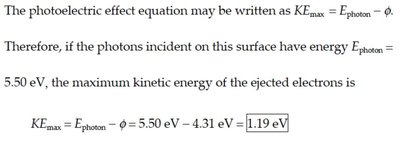
If the photon energy is \( E_{\text{photon}} = 5.50 \) eV and \( \phi = 4.31 \) eV:
$KE_{\text{max}} = E_{\text{photon}} - \phi = 5.50 \ \text{eV} - 4.31 \ \text{eV} = 1.19 \ \text{eV}$
7. Cutoff Frequency for a Given Work Function
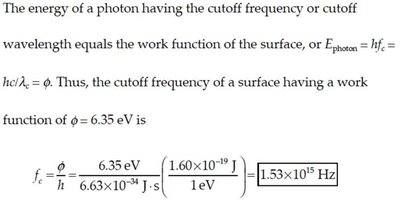
For \( \phi = 6.35 \) eV:
$f_c = \frac{\phi}{h} = \frac{6.35 \ \text{eV}}{6.63 \times 10^{-34} \ \text{J·s}} \left(1.60 \times 10^{-19} \ \text{J/eV}\right) = 1.53 \times 10^{15} \ \text{Hz}$
8. Wavelength from Frequency
Given \( f_c = 1.53 \times 10^{15} \) Hz:
$\lambda_c = \frac{c}{f_c} = \frac{3.00 \times 10^8 \ \text{m/s}}{1.53 \times 10^{15} \ \text{Hz}} = 1.96 \times 10^{-7} \ \text{m} = 196 \ \text{nm}$

Stopping Potential
The stopping potential (\( V_s \)) is the minimum voltage needed to stop the most energetic photoelectrons:
$eV_s = KE_{\text{max}} \implies V_s = \frac{KE_{\text{max}}}{e}$
\( e \): Elementary charge (\( 1.60 \times 10^{-19} \) C)
Example: If \( KE_{\text{max}} = 2.15 \) eV, then \( V_s = 2.15 \) V.

Conservation of Energy and Maximum Kinetic Energy
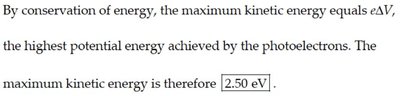
By conservation of energy, the maximum kinetic energy equals \( eV_s \), the highest potential energy achieved by the photoelectrons.
Example: If \( V_s = 2.50 \) V, then \( KE_{\text{max}} = 2.50 \) eV.
Calculating Electron Velocity from Kinetic Energy
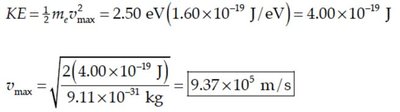
The maximum velocity of ejected electrons can be found from kinetic energy:
$KE = \frac{1}{2} m_e v_{\text{max}}^2$
$v_{\text{max}} = \sqrt{\frac{2 KE}{m_e}}$
\( m_e \): Electron mass (\( 9.11 \times 10^{-31} \) kg)
Example: For \( KE = 4.00 \times 10^{-19} \) J, \( v_{\text{max}} = 9.37 \times 10^5 \) m/s.
Photon Energy from Wavelength
The energy of a photon is related to its wavelength by:
$E_{\text{photon}} = \frac{hc}{\lambda}$
Example: For \( \lambda = 400 \) nm, \( E_{\text{photon}} = 3.11 \) eV.

Wavelength for a Given Kinetic Energy and Work Function
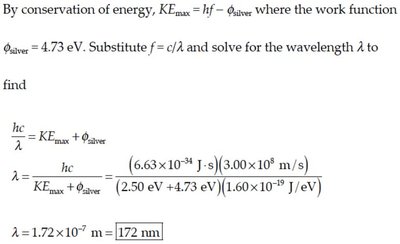
By conservation of energy, \( KE_{\text{max}} = hf - \phi \). Substitute \( f = c/\lambda \) and solve for \( \lambda \):
$\lambda = \frac{hc}{KE_{\text{max}} + \phi}$
Example: For \( KE_{\text{max}} = 2.50 \) eV and \( \phi = 4.73 \) eV, \( \lambda = 172 \) nm.
Work Function from Wavelength and Kinetic Energy
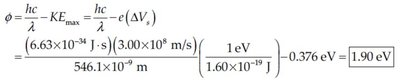
The work function can also be found from the cutoff wavelength and kinetic energy:
$\phi = \frac{hc}{\lambda} - KE_{\text{max}}$
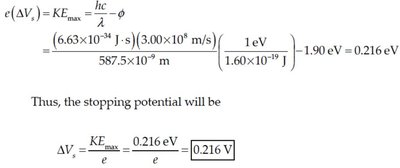
Example: For \( \lambda = 546.1 \) nm and \( KE_{\text{max}} = 0.376 \) eV, \( \phi = 1.90 \) eV.
Stopping Potential from Kinetic Energy
The stopping potential can be calculated as:
$e(\Delta V_s) = KE_{\text{max}}$
Example: For \( KE_{\text{max}} = 0.216 \) eV, \( \Delta V_s = 0.216 \) V.
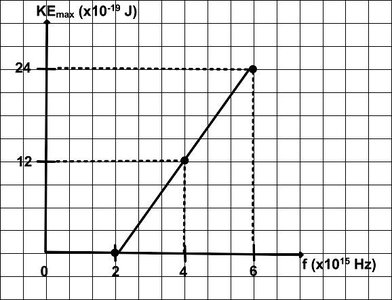
Graphical Representation of the Photoelectric Effect
The relationship between the maximum kinetic energy of photoelectrons and the frequency of incident light is linear above the threshold frequency. The slope of the line is Planck's constant, and the intercept on the frequency axis gives the threshold frequency.
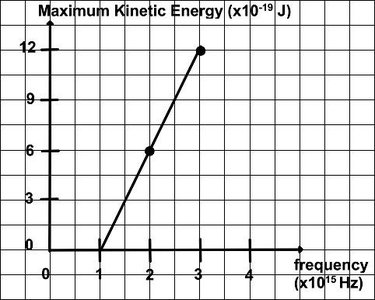
Summary Table: Key Photoelectric Effect Equations
Quantity | Equation | Description |
|---|---|---|
Maximum Kinetic Energy | $KE_{\text{max}} = hf - \phi$ | Energy of ejected electrons |
Cutoff Frequency | $f_c = \frac{\phi}{h}$ | Minimum frequency for emission |
Cutoff Wavelength | $\lambda_c = \frac{hc}{\phi}$ | Maximum wavelength for emission |
Stopping Potential | $V_s = \frac{KE_{\text{max}}}{e}$ | Voltage to stop electrons |
Photon Energy | $E_{\text{photon}} = hf = \frac{hc}{\lambda}$ | Energy of incident photon |
Additional info: The photoelectric effect is a foundational experiment in modern physics, confirming the quantization of light and leading to the development of quantum mechanics. The equations above are essential for solving problems related to the emission of electrons from metals under light exposure, and for understanding the energy relationships involved.
