 Back
BackPHY 131 Practice Exam 2 – Step-by-Step Physics Guidance
Study Guide - Smart Notes
 Tailored notes based on your materials, expanded with key definitions, examples, and context.
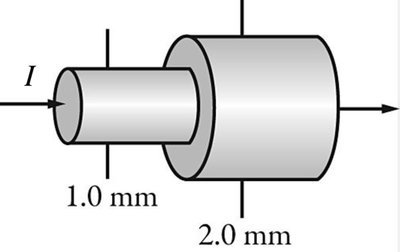
Q1. Suppose that in the wire on the left the electron drift speed is . What is the electron drift speed in the wire on the right side?
Background
Topic: Current Density and Drift Velocity in Conductors
This question tests your understanding of how current, cross-sectional area, and drift velocity are related in wires of different diameters but the same material and length.
Key Terms and Formulas:
Current density:
Drift velocity:
Area of a cylinder:
Step-by-Step Guidance
Recall that the current is the same through both wires since they are connected in series.
Write the expression for current in terms of drift velocity: .
Since and are the same for both wires, relate the drift velocities using the areas: .
Calculate the ratio of the areas using the diameters given (1.0 mm and 2.0 mm).
Try solving on your own before revealing the answer!
Final Answer:
The area increases by a factor of 4, so the drift speed decreases by a factor of 4.
Q2. Suppose that the resistance of the wire on the left is . What is the resistance of the wire on the right?
Background
Topic: Resistance of a Wire
This question tests your understanding of how resistance depends on the dimensions of a wire (length and cross-sectional area).
Key Terms and Formulas:
Resistance:
Area of a cylinder:
Step-by-Step Guidance
Recall that both wires have the same length and are made of the same material (same ).
Write the resistance for each wire: and .
Express in terms of using the diameters (since ).
Find the ratio to see how the resistance changes with area.
Try solving on your own before revealing the answer!
Final Answer:
Doubling the diameter increases the area by 4, so resistance decreases by 4.
Q3. What length of a certain metal wire of diameter 0.15 mm is needed for the wire to have a resistance of 15 Ω? The resistivity of this metal is .
Background
Topic: Resistance and Resistivity
This question tests your ability to use the formula for the resistance of a wire to solve for its length.
Key Terms and Formulas:
Resistance:
Area of a wire:
Step-by-Step Guidance
Convert the diameter to radius in meters: .
Calculate the cross-sectional area using .
Rearrange the resistance formula to solve for : .
Plug in the values for , , and (be careful with units).
Try solving on your own before revealing the answer!
Final Answer:
After plugging in the values and solving, you find the required length is 16 meters.
Q4. An electric device delivers a current of 5.0 A to a device. How many electrons flow through this device in 10 s?
Background
Topic: Electric Current and Charge
This question tests your understanding of the relationship between current, charge, and the number of electrons.
Key Terms and Formulas:
Current:
Charge of one electron:
Number of electrons:
Step-by-Step Guidance
Calculate the total charge that flows in 10 seconds using .
Divide the total charge by the elementary charge to find the number of electrons: .
Try solving on your own before revealing the answer!
Final Answer: electrons
This is the number of electrons passing through the device in 10 seconds at 5.0 A.
Q5. How much current will be flowing through a 40.0 m length of cylindrical metal wire with radius 4.00 mm if it is connected to a source supplying 16.0 V? The resistivity of this metal is . Assume ideal conditions.
Background
Topic: Ohm's Law and Resistance of a Wire
This question tests your ability to calculate current using Ohm's Law and the formula for resistance of a wire.
Key Terms and Formulas:
Ohm's Law:
Resistance:
Area:
Step-by-Step Guidance
Calculate the cross-sectional area using the given radius (convert mm to m).
Calculate the resistance using .
Use Ohm's Law to solve for current: .
Try solving on your own before revealing the answer!
Final Answer:
With the large cross-sectional area and short length, the current is very high for the given voltage.
Q6. A light bulb is connected to a 110-V source. What is the resistance of this bulb if it is a 100-W bulb?
Background
Topic: Power in Electric Circuits
This question tests your ability to relate power, voltage, and resistance in an electric circuit.
Key Terms and Formulas:
Power:
Rearranged:
Step-by-Step Guidance
Write the formula relating power, voltage, and resistance.
Rearrange to solve for resistance: .
Plug in the values for and .
Try solving on your own before revealing the answer!
Final Answer:
This is the resistance that allows the bulb to dissipate 100 W at 110 V.
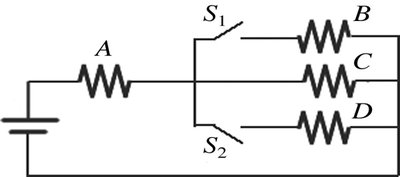
Q7. In the circuit shown in the figure, four identical resistors labeled A to D are connected to a battery as shown. S1 and S2 are switches. Which of the following actions would result in the GREATEST amount of current through resistor A?
Background
Topic: Series and Parallel Circuits
This question tests your understanding of how closing switches affects the current through a specific resistor in a combination circuit.
Key Terms and Formulas:
Series and parallel resistor combinations
Current division in circuits
Step-by-Step Guidance
Analyze the circuit for each switch configuration (open/closed) to see how the total resistance changes.
Recall that the current through A depends on the total resistance in the circuit.
Determine which configuration minimizes total resistance, maximizing current through A.
Try solving on your own before revealing the answer!
Final Answer: Closing both switches (option b)
This configuration puts the most resistors in parallel, minimizing total resistance and maximizing current through A.
