 Back
BackPHY 220 Midterm 1 Review: 2D and Projectile Motion Guidance
Study Guide - Smart Notes
 Tailored notes based on your materials, expanded with key definitions, examples, and context.
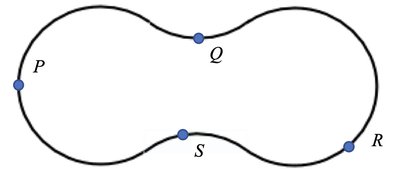
Q2. 2D Motion: Go-Kart on a Track
Background
Topic: Two-dimensional motion and kinematics. This question tests your understanding of velocity and acceleration vectors at different points along a curved path, as well as how to calculate average acceleration and velocity.
Key Terms and Formulas
Velocity vector (): The direction of motion at a given instant, always tangent to the path.
Acceleration vector (): The rate of change of velocity, which can have both tangential (speeding up/slowing down) and centripetal (changing direction) components.
Average acceleration:
Average velocity:
Step-by-Step Guidance
At each labeled point (P, Q, R, S), identify the direction of the velocity vector. Remember, velocity is always tangent to the path and points in the direction of motion (clockwise in this case).
For each point, determine the direction of the acceleration vector:
At P (starting from rest): Acceleration points in the direction the go-kart will begin to move.
At Q (speeding up): Acceleration has a tangential component in the direction of motion and a centripetal component toward the center of curvature.
At R (constant speed): Acceleration is purely centripetal, pointing toward the center of the curve.
At S (slowing down): Acceleration has a tangential component opposite to the direction of motion and a centripetal component.
Draw and label the vectors for velocity and acceleration at each point. Clearly indicate which is which and explain your reasoning for their directions based on the motion described.
For part (b), use the formula for average acceleration: . Plug in the given values: , , and .
For part (c), recall that average velocity for a full lap is . Consider what is for a complete lap (start and end at the same point).
For part (d), think about what is needed to find average speed: total distance traveled (the perimeter of the track) and total time for one lap.
Try solving on your own before revealing the answer!
Q3. Projectile Motion: Billiard Balls Collision
Background
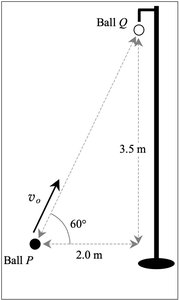
Topic: Projectile motion and kinematics. This question tests your ability to analyze the motion of two objects under gravity—one launched at an angle and one dropped from rest—and determine their positions and velocities at the moment of collision.
Key Terms and Formulas
Vertical displacement under gravity:
Horizontal displacement:
Velocity components: ,
Time of flight: Both balls are in motion for the same time until collision.
Step-by-Step Guidance
For part (a), use the vertical motion equation for ball Q, which is dropped from rest: . Plug in , , and .
Calculate the vertical distance fallen by ball Q in 0.40 s.
For part (b), set up the equations for the horizontal and vertical positions of ball P at , using the initial speed and the launch angle .
Write the equations for the positions of both balls at the collision time and set them equal to each other to solve for .
For part (c), use the velocity components of ball P just before collision: , . Find the magnitude and direction (angle with respect to horizontal) using these components.
Try solving on your own before revealing the answer!
