Back
PHY 241: Foundations and Principles of Thermodynamics, Optics, and Modern Physics
Study Guide - Smart Notes
 Tailored notes based on your materials, expanded with key definitions, examples, and context.
Course Overview
This course, University Physics III (PHY 241), covers advanced topics in physics with calculus, focusing on thermodynamics, wave and ray optics, and modern physics including special relativity and quantum physics. The course is structured into three major units, each corresponding to a set of chapters from the textbook Physics for Scientists and Engineers: A Strategic Approach with Modern Physics by Randall D. Knight.
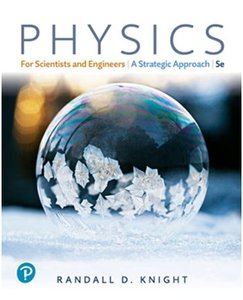
Major Units and Chapters
Unit I: Thermodynamics and Kinetics (Chapters 18-21)
Unit II: Wave and Ray Optics (Chapters 16-17, 33-35)
Unit III: Modern Physics: Special Relativity and Quantum Physics (Chapters 36-40)
Each unit is assessed through quizzes, homework, midterms, and a comprehensive final exam.
How Physics Builds Reliable Laws & Theories
Empirical Evidence and Theoretical Reasoning
Physics relies on a continuous feedback cycle between observation and theory. Empirical evidence constrains theoretical models, which in turn predict new phenomena to observe and measure.
Observation: Measurement of variables, uncertainty, and conditions.
Pattern Recognition: Identifying reproducible empirical regularities.
Modeling: Idealizing phenomena using concepts, assumptions, and mathematics.
Prediction: Deduction of quantitative consequences.
Testing: Designing experiments to distinguish predictions.
Comparison: Agreement or discrepancy with theory; drives refinement.
Example: The discovery of constant acceleration in falling bodies led to mathematical models and predictions tested under various conditions. Special relativity was developed from principles and mathematics, leading to predictions like time dilation and , which were experimentally verified.
Observation: Human Senses and Instruments
Extending the Observable World
Physics began with phenomena accessible to human senses, such as motion, heat, and light. Instruments like microscopes and telescopes expanded the observable world, revealing new scales and demanding new theories.
Direct Human/Macroscopic World: Everyday motion, heat, fluids, sound, visible light, forces.
Microscopic/Atomic/Subatomic: Microscopes, spectroscopy, particle detectors.
Distant/Large-Scale Systems: Telescopes, radio/space observatories, remote sensing.



Precision Measurement and Discovery of New Laws
Role of Precision in Physics
Precision measurements can reveal discrepancies with existing theories, leading to the discovery of new physics. Examples include the precession of Mercury's orbit (Newtonian gravity vs. general relativity), blackbody radiation (classical vs. quantum theory), and the Michelson–Morley experiment (ether theory vs. relativity).
Mercury's Orbit: General relativity explained the extra precession not accounted for by Newtonian gravity.
Spectra & Blackbody Radiation: Quantum theory resolved systematic departures from classical predictions.
Michelson–Morley: The absence of expected fringe shifts led to the abandonment of ether theories.
Discovery Principle: Small, reproducible mismatches in precision measurements can indicate deeper physics, but independent replication and predictive theory are required.
Energy Chains: From Sunlight to Human Well-Being
Connecting Thermodynamics, Optics, Relativity, and Quantum Physics
Everyday energy systems, such as solar energy powering homes, connect macroscopic energy and entropy, classical light propagation, relativistic radiation, and quantum charge generation.
Thermodynamics: Energy conservation and entropy production in heat pumps and stoves.
Wave/Ray Optics: Propagation, reflection, refraction, and absorption of sunlight.
Special Relativity: Invariant speed of light, photon energy-momentum ().
Quantum Physics: Photons create electron–hole pairs in solar cells, leading to voltage and current.
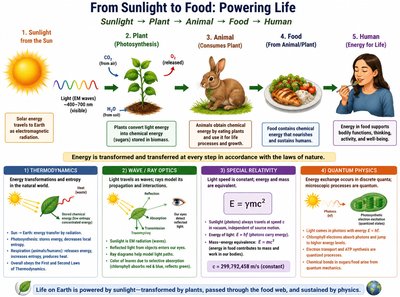
Example: Solar radiation is converted to electrical work, which powers cooling, refrigeration, and cooking, illustrating energy conservation and entropy increase.
Thermodynamic Systems, Surroundings, and Boundaries
Definitions and Types of Systems
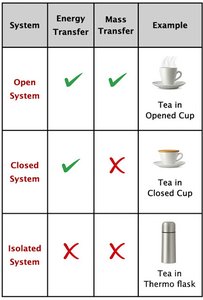
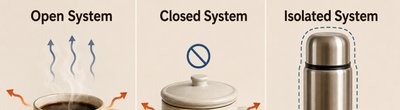
A thermodynamic system is the quantity of matter or region selected for analysis. The surroundings are everything external to the system that can interact with it. The boundary is the dividing surface where interactions occur.
Open System: Both energy and matter can cross the boundary.
Closed System: Only energy can cross; matter cannot.
Isolated System: Neither energy nor matter can cross.
Boundaries can be real or imaginary, fixed or moving, permeable or impermeable.

Thermodynamic Equilibrium
Types of Equilibrium
Equilibrium is a state where no unbalanced driving force remains inside the system. Macroscopic properties are uniform and steady.
Equilibrium: No net change in properties; temperature, pressure, and composition are uniform.
Quasi-equilibrium: Slow processes passing through near-equilibrium states; small gradients relax quickly.
Non-equilibrium: Strong gradients or disturbances; properties vary within the system.



Key Distinction: Equilibrium is a state; quasi-equilibrium is a modeling assumption; non-equilibrium requires local, time-dependent descriptions.
Reversible, Quasi-reversible, and Irreversible Processes
Definitions and Criteria
A reversible process can be undone without leaving any net change in the system or surroundings. A quasi-reversible process is a slow, near-equilibrium process that approximates a reversible path. An irreversible process cannot be reversed without leaving changes.
Reversible: Ideal, exactly undoable; never occurs in practice.
Quasi-reversible: Slow, near-equilibrium approximation; common in modeling gradual changes.
Irreversible: Real change with losses; cannot be exactly reversed.

Two Rules for Reversibility: Mechanical equilibrium (driving and opposing forces balanced) and thermal equilibrium (negligible temperature difference between system and surroundings).

The Four Laws of Thermodynamics
Summary Table
Law | Definition | Key Implication / Common Form |
|---|---|---|
Zeroth Law | If two systems are each in thermal equilibrium with a third system, then they are in thermal equilibrium with each other. | Establishes temperature as a measurable property. |
First Law | The change in a system's internal energy equals heat added to the system minus work done by the system. | ; energy is conserved. |
Second Law | For any spontaneous process, the total entropy of an isolated system cannot decrease. | ; no heat engine is 100% efficient; heat does not move from cold to hot spontaneously. |
Third Law | As temperature approaches absolute zero, the entropy of a perfect crystal approaches zero. | as K for a perfect crystal. T cannot reach zero. |
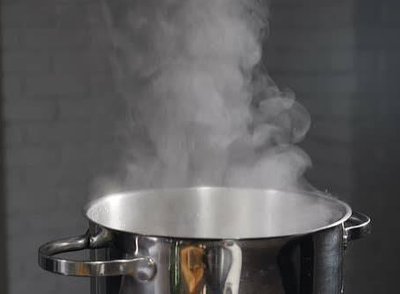
Sign Convention: is heat added to the system; is work done by the system.
Levels of Learning and Academic Skills
Transition from Classical to Modern Physics
As students progress, physics models become less visual and more abstract. Mathematical tools such as multivariable calculus, linear algebra, and ordinary differential equations are essential. Higher levels of understanding require critical thinking, independent study, communication, collaboration, ethical judgment, and creativity.
Core Foundation: Acquire knowledge and develop problem-solving skills.
Additional Goals: Critical thinking, learning how to learn, communication, collaboration, ethical judgment, creativity.
Application Example: Explaining a Dust Storm by Thermodynamics
Thermodynamics can be used to explain atmospheric phenomena such as dust storms, which involve energy transfer, entropy production, and non-equilibrium processes.