 Back
BackPHY121 Exam 3 Practice – Step-by-Step Physics Guidance
Study Guide - Smart Notes
 Tailored notes based on your materials, expanded with key definitions, examples, and context.
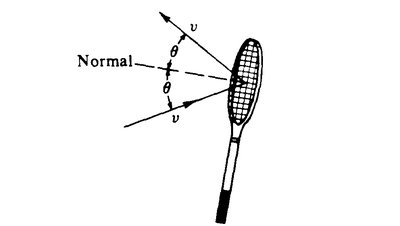
Q1. A tennis ball of mass m rebounds from a racquet with the same speed as it had initially, as shown above. The magnitude of the momentum change of the ball is:
Background
Topic: Conservation of Momentum, Impulse
This question tests your understanding of how to calculate the change in momentum (impulse) when an object rebounds at an angle.
Key Terms and Formulas:
Momentum:
Change in momentum:
Magnitude of vector change:
Step-by-Step Guidance
Draw a diagram showing the initial and final velocity vectors of the ball, noting the angle with respect to the normal.
Express the initial and final velocity vectors in terms of their components (using and ).
Calculate the change in each component of the velocity (especially the component perpendicular to the racquet, since the parallel component does not change if the speed is the same).
Multiply the change in velocity by the mass to find the change in momentum for each component.
Try solving on your own before revealing the answer!
Final Answer: 2mv cos θ
The change in momentum is twice the component of the velocity perpendicular to the racquet, so .
This is because the perpendicular component reverses direction, while the parallel component remains unchanged.
Q2. A 2.0-kg ball traveling at 3.0 m/s hits a vertical wall and rebounds with the same speed. If the contact time with the wall is s, the magnitude of the force exerted on the ball is most nearly:
Background
Topic: Impulse-Momentum Theorem
This question tests your ability to relate impulse (change in momentum) to the average force exerted over a time interval.
Key Terms and Formulas:
Impulse:
Change in momentum:
Step-by-Step Guidance
Calculate the change in velocity: since the ball rebounds with the same speed but in the opposite direction, .
Find the change in momentum: .
Use the impulse-momentum theorem to relate the average force to the change in momentum and the contact time: .
Try solving on your own before revealing the answer!
Final Answer: 1,200 N
The change in velocity is m/s, so kg·m/s|F_{\text{avg}}| = \frac{12}{1.0 \times 10^{-2}} = 1,200$ N.
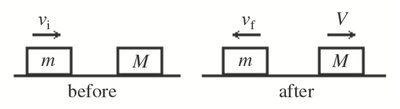
Q3. A block of mass kg, moving on a frictionless surface with a speed m/s, makes a sudden perfectly elastic collision with a stationary block of mass . Just after the collision, the 3.0-kg block recoils (backward) with a speed of m/s. What is the speed of the other block?
Background
Topic: Conservation of Momentum and Energy in Elastic Collisions
This question tests your ability to apply both conservation of momentum and conservation of kinetic energy to solve for unknown velocities after a perfectly elastic collision.
Key Terms and Formulas:
Momentum conservation:
Kinetic energy conservation:
Step-by-Step Guidance
Write the conservation of momentum equation for the system before and after the collision.
Write the conservation of kinetic energy equation for the system.
Plug in the given values for , , and into both equations.
Solve the momentum equation for in terms of and substitute into the energy equation to solve for .
Try solving on your own before revealing the answer!
Final Answer: 6.0 m/s
By solving the two equations simultaneously, you find m/s for the other block.
