Back
BackPHY222 Midterm #2 Study Guide: Waves, Sound, and Thermodynamics
Study Guide - Smart Notes
 Tailored notes based on your materials, expanded with key definitions, examples, and context.
Wave Optics: Diffraction and Interference
Double-Slit Interference
The double-slit experiment demonstrates the wave nature of light through the creation of interference patterns. When monochromatic light passes through two closely spaced slits, it produces bright and dark fringes on a screen due to constructive and destructive interference.
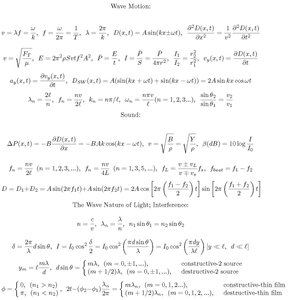
Constructive Interference: Occurs when the path difference between the two slits is an integer multiple of the wavelength (, where ).
Destructive Interference: Occurs when the path difference is a half-integer multiple of the wavelength ().
Fringe Spacing: The distance between adjacent bright fringes can be calculated using , where is the distance to the screen.
Example: If the first order fringe is 6.00 cm from the center, with slit separation mm and screen distance m, the wavelength can be found using .
Thin Film Interference
Thin films, such as oil or soap, produce colorful patterns due to interference between light reflected from the top and bottom surfaces. The conditions for constructive and destructive interference depend on the thickness of the film and the wavelength of light.
Constructive Interference (for thin film): (with phase shift considerations).
Destructive Interference (for thin film): .
Example: For a thin oil layer () on water (), the thinnest layer for constructive interference at nm is .
Wave Motion
Transverse Waves on a String
Transverse waves are described mathematically by sinusoidal functions. The displacement of a wave can be written as , where is amplitude, is wavenumber, and is angular frequency.
Amplitude (): Maximum displacement from equilibrium.
Wavenumber (): , where is wavelength.
Angular Frequency (): , where is frequency.
Wave Speed (): .
Period (): .
Direction of Propagation: Determined by the sign in the argument of the sine function.
Example: For , , , , m/s.
Standing Waves
Standing waves are formed by the superposition of two waves traveling in opposite directions. They have nodes (points of zero displacement) and antinodes (points of maximum displacement).
Wave Function: .
Nodes: Points where for all .
Antinodes: Points where reaches maximum amplitude.
Example: In a 30 cm open tube, nodes occur at the ends and antinodes at the center.
Sound and the Doppler Effect
Standing Sound Waves in Pipes
Sound waves in pipes can form standing waves, with nodes and antinodes depending on whether the pipe is open or closed at the ends.
Wavelength in Open Pipe: for the fundamental mode.
Frequency: , where is the speed of sound.
Example: For a 30 cm pipe, cm for the fundamental, but the problem may show a higher mode.
Doppler Effect
The Doppler effect describes the change in frequency heard by an observer moving relative to a sound source.
Observed Frequency: , where is observer speed, is source speed.
Example: If you run toward a stationary sound source, the frequency increases.
Beat Frequency
When two sound waves of slightly different frequencies interfere, they produce beats with a frequency equal to the difference between the two frequencies.
Beat Frequency: .
Wavelength of Beat: .
Thermodynamics: Engine Cycles and Entropy
Ideal Gas Processes
Engine cycles often involve different thermodynamic processes: isobaric (constant pressure), isochoric (constant volume), and adiabatic (no heat exchange).
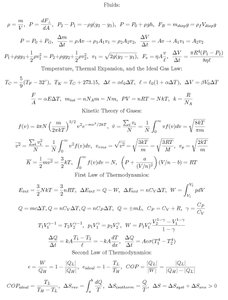
Isobaric Process:
Isochoric Process:
Adiabatic Process: , where
Example: For a monoatomic ideal gas, ,
Heat and Efficiency
The efficiency of a heat engine is the ratio of work output to heat input. The heat absorbed () and heat released () are calculated for each process.
Efficiency:
Example: In a three-step cycle, identify which step absorbs heat and which releases it.
Entropy Changes
Entropy measures the disorder or randomness in a system. For reversible processes, the change in entropy is given by .
Isobaric:
Isochoric:
Adiabatic: (reversible adiabatic)
Equation Sheet Reference
Key Formulas for Exam
Wave Equations: ,
Sound: ,
Thermodynamics: , ,