 Back
BackPHY222 Midterm #3 Study Guidance: Diffraction, Optics, and Polarization
Study Guide - Smart Notes
 Tailored notes based on your materials, expanded with key definitions, examples, and context.
Q1A. What is the angular separation (in degrees) between the first two minima (m=1 and m=2) of the diffraction pattern for a single slit 0.5 mm wide illuminated by 600 nm light?
Background
Topic: Single-Slit Diffraction
This question tests your understanding of how light diffracts through a single slit and how to calculate the angular positions of minima in the diffraction pattern.
Key formula:
Where:
= slit width (in meters)
= angle from the center of the slit
= order of the minimum (integer, )
= wavelength of light (in meters)
Step-by-Step Guidance
Convert the slit width and wavelength to meters: , .
Use the formula to find for and for .
Set up the equations: and .
Calculate and using the inverse sine function (but do not compute the final values yet).
Try solving on your own before revealing the answer!
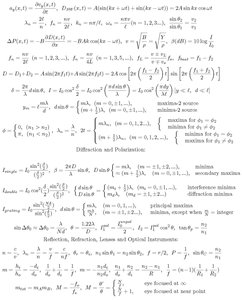
Final Answer: 0.069°
, , and the angular separation is .
This uses the single-slit diffraction formula and the correct conversion of units.
Q1B. What is the intensity of light at an angle of 0.5° from the center of two slits (each 0.1 mm wide, separated by 0.7 mm, illuminated by 400 nm light), in terms of the peak intensity ?
Background
Topic: Double-Slit Diffraction and Interference
This question tests your ability to combine the effects of diffraction (from each slit) and interference (from the separation between slits) to find the intensity at a specific angle.
Key formulas:
(diffraction envelope)
(interference term)
= slit width, = slit separation, = wavelength
Step-by-Step Guidance
Convert all values to meters: , , .
Calculate for .
Compute and using the formulas above.
Set up the intensity formula , but do not plug in the final numbers yet.
Try solving on your own before revealing the answer!
Final Answer: 0.0062I0
After plugging in the values and calculating, the intensity at is .
This combines both the diffraction envelope and interference pattern.
Q1C. How far apart must two shiny pennies be on the ground to be resolved by the JWST (6.5 m diameter mirror, 407 km altitude, 600 nm wavelength)?
Background
Topic: Angular Resolution and Rayleigh Criterion
This question tests your understanding of the resolving power of a telescope and how to use the Rayleigh criterion to determine the minimum separation of two objects that can be distinguished.
Key formula:
= wavelength (in meters)
= diameter of the mirror (in meters)
= minimum resolvable angle (in radians)
Step-by-Step Guidance
Convert , .
Calculate using .
Find the minimum separation using , where (altitude).
Set up the calculation for but do not compute the final value yet.
Try solving on your own before revealing the answer!
Final Answer: 4.6 cm
Using the Rayleigh criterion and the altitude, the minimum separation is .
This shows the resolving power of the JWST for ground targets.
Q1D. What is the angular separation (in degrees) between the red and green principal maxima for the first order (m=1) in a diffraction grating with 10,000 lines/cm, using 700 nm and 500 nm lasers?
Background
Topic: Diffraction Grating
This question tests your ability to use the diffraction grating equation to find the angular positions of maxima for different wavelengths and calculate their separation.
Key formula:
= grating spacing (in meters)
= angle of principal maxima
= order (here, )
= wavelength (in meters)
Step-by-Step Guidance
Calculate .
Set up and for .
Calculate and using the inverse sine function (but do not compute the final values yet).
Find the angular separation .
Try solving on your own before revealing the answer!
Final Answer: 14.4°
The angular separation between the red and green maxima is .
This uses the grating equation and correct unit conversions.
Q1E. What is the minimum number of polarizers needed to reduce the output intensity to 10% of the input intensity, if each polarizer is rotated 10° from the previous?
Background
Topic: Polarization and Malus's Law
This question tests your understanding of how the intensity of polarized light changes as it passes through multiple polarizers, each rotated by a fixed angle.
Key formula:
(Malus's Law for one polarizer)
For polarizers, each rotated by ,
= initial intensity
= angle between each polarizer
= number of polarizers
Step-by-Step Guidance
Set up the equation:
Set and solve for .
Take the logarithm of both sides to isolate .
Set up the calculation for but do not compute the final value yet.
Try solving on your own before revealing the answer!
Final Answer: 53
Solving gives polarizers.
This uses Malus's Law and logarithms to find the minimum number needed.
