 Back
BackPHY222 Midterm Study Guidance: Waves, Interference, Thermodynamics
Study Guide - Smart Notes
 Tailored notes based on your materials, expanded with key definitions, examples, and context.
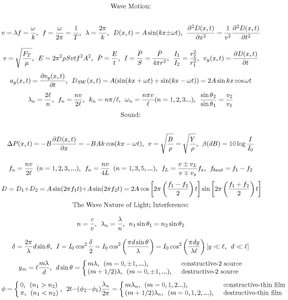
Q1A. Monochromatic light falls on two narrow slits that are 0.05 mm apart. On a screen 4.00 m away, the first order fringe (bright spot) is 6.00 cm from the middle of the interference pattern. What is the wavelength of the light?
Background
Topic: Double-slit Interference
This question tests your understanding of the double-slit experiment and how to relate the fringe spacing to the wavelength of light.
Key formula:
$d \sin\theta = m\lambda$
$d$ = slit separation (in meters)
$\theta$ = angle to the fringe from the center
$m$ = order of the fringe (first order means $m=1$)
$\lambda$ = wavelength of light (in meters)
For small angles, $\sin\theta \approx \tan\theta = \frac{y}{L}$, where $y$ is the distance from the center to the fringe and $L$ is the distance to the screen.
Step-by-Step Guidance
Convert all measurements to SI units: $d = 0.05\ \text{mm} = 5.0 \times 10^{-5}\ \text{m}$, $y = 6.00\ \text{cm} = 0.060\ \text{m}$, $L = 4.00\ \text{m}$.
Use the small angle approximation: $\sin\theta \approx \frac{y}{L}$.
Plug into the double-slit formula for $m=1$: $d \sin\theta = \lambda$.
Set up the equation: $\lambda = d \frac{y}{L}$.
Try solving on your own before revealing the answer!
Final Answer: 7.5 \times 10^{-7} \text{ m}
$\lambda = (5.0 \times 10^{-5}) \frac{0.060}{4.00} = 7.5 \times 10^{-7}\ \text{m}$
This matches answer choice [d]. The calculation uses the correct formula and unit conversions.
Q1B. Monochromatic light of wavelength 500 nm falls on two narrow slits that are 0.04 mm apart and this generates an interference pattern on a distant screen. At what angle (in degrees) does the first minima occur in the interference pattern?
Background
Topic: Double-slit Interference Minima
This question tests your ability to find the angle for the first minimum in a double-slit interference pattern.
Key formula:
$d \sin\theta = (m + \frac{1}{2})\lambda$
$d$ = slit separation (in meters)
$\theta$ = angle to the minimum
$m$ = order (first minimum means $m=0$)
$\lambda$ = wavelength (in meters)
Step-by-Step Guidance
Convert $d = 0.04\ \text{mm} = 4.0 \times 10^{-5}\ \text{m}$ and $\lambda = 500\ \text{nm} = 5.0 \times 10^{-7}\ \text{m}$.
For the first minimum, use $m=0$: $d \sin\theta = (0 + 0.5)\lambda = 0.5\lambda$.
Set up the equation: $\sin\theta = \frac{0.5\lambda}{d}$.
Calculate $\sin\theta$ and then find $\theta$ in degrees.
Try solving on your own before revealing the answer!
Final Answer: 0.72^\circ
$\sin\theta = \frac{0.5 \times 5.0 \times 10^{-7}}{4.0 \times 10^{-5}} = 6.25 \times 10^{-3}$
$\theta = \arcsin(6.25 \times 10^{-3}) \approx 0.72^\circ$
This matches answer choice [a].
Q1C. A light beam traveling through air (n=1.00) reflects perpendicularly off the top and bottom surfaces of a thin layer of oil (n=1.50) floating on water (n=1.33). What is the thinnest layer of oil that will give rise to constructive interference at a wavelength of 700 nm?
Background
Topic: Thin Film Interference
This question tests your understanding of constructive interference in thin films, considering phase shifts at boundaries.
Key formula:
For constructive interference (with one $\pi$ phase shift): $2t = (m + \frac{1}{2})\frac{\lambda}{n}$ for $m=0$ (thinnest layer)
$t$ = thickness of the film
$\lambda$ = wavelength in vacuum
$n$ = refractive index of oil
Step-by-Step Guidance
Convert $\lambda = 700\ \text{nm} = 7.0 \times 10^{-7}\ \text{m}$.
Use $n = 1.50$ for oil.
For the thinnest layer, $m=0$: $2t = 0.5 \frac{\lambda}{n}$.
Rearrange to solve for $t$: $t = \frac{\lambda}{4n}$.
Try solving on your own before revealing the answer!
Final Answer: 117 \text{ nm}
$t = \frac{700 \text{ nm}}{4 \times 1.50} = 116.7 \text{ nm}$
This matches answer choice [a].
Q1D. A soap film (n=1.35) of thickness 150 nm is surrounded by air (n=1.00) on both sides. If light of a certain wavelength is beamed at the soap film such that it hits the film perpendicular to its surface, what is the longest wavelength of light for which you’ll see no reflection?
Background
Topic: Thin Film Interference (Destructive)
This question tests your understanding of destructive interference in thin films, considering phase shifts and thickness.
Key formula:
For destructive interference (with two $\pi$ phase shifts): $2t = m \frac{\lambda}{n}$ for $m=1$ (longest wavelength)
$t$ = thickness of the film
$\lambda$ = wavelength in vacuum
$n$ = refractive index of soap film
Step-by-Step Guidance
Given $t = 150\ \text{nm}$ and $n = 1.35$.
For the longest wavelength, use $m=1$: $2t = \frac{\lambda}{n}$.
Rearrange to solve for $\lambda$: $\lambda = 2tn$.
Plug in the values to set up the calculation.
Try solving on your own before revealing the answer!
Final Answer: 405 \text{ nm}
$\lambda = 2 \times 150 \text{ nm} \times 1.35 = 405 \text{ nm}$
This matches answer choice [e].
