 Back
BackPHYS 102: Introductory Physics II – Study Notes on Electric Charge, Force, and Field
Study Guide - Smart Notes
 Tailored notes based on your materials, expanded with key definitions, examples, and context.
Introduction to PHYS 102: Electricity and Magnetism
PHYS 102 is the second part of Introductory Physics, focusing on the foundational concepts of electricity and magnetism. This course covers electric forces, electric fields, electrical energy, capacitance, current, resistance, direct and alternating current circuits, magnetism, and electromagnetic waves. The following study notes summarize the key concepts, definitions, and problem-solving strategies relevant to the first chapters of the course.
Electric Charge
Nature and Properties of Electric Charge
Electric charge is a fundamental property of matter responsible for electric phenomena. There are two types of charges: positive and negative. The SI unit of charge is the coulomb (C).
Charge Conservation: Charge is neither created nor destroyed; it is transferred between objects.
Charge Quantization: The smallest unit of charge is the elementary charge, C.
Carriers of Charge: Electrons carry negative charge, protons carry positive charge, and neutrons are neutral.
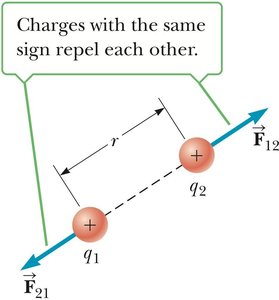
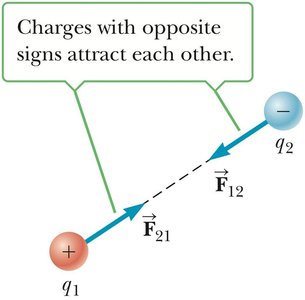
Interaction: Like charges repel, unlike charges attract.
Particle | Charge (C) | Mass (kg) |
|---|---|---|
Electron | -1.60 × 10⁻¹⁹ | 9.11 × 10⁻³¹ |
Proton | +1.60 × 10⁻¹⁹ | 1.67 × 10⁻²⁷ |
Neutron | 0 | 1.67 × 10⁻²⁷ |
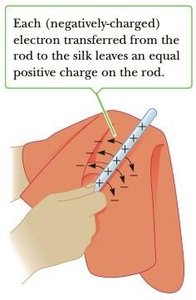
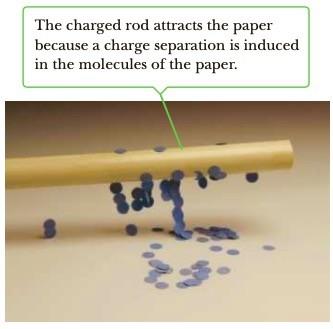
Example: Rubbing a glass rod with silk transfers electrons from the rod to the silk, leaving the rod positively charged.
Conductors and Insulators
Classification of Materials
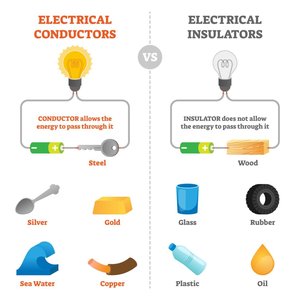
Materials are classified based on their ability to allow electric charge to move freely:
Conductors: Materials (e.g., metals like copper, silver) with free electrons that allow charge to move easily.
Insulators: Materials (e.g., glass, rubber, wood) where electrons are tightly bound and do not move freely.
Methods of Charging
Charging by Conduction
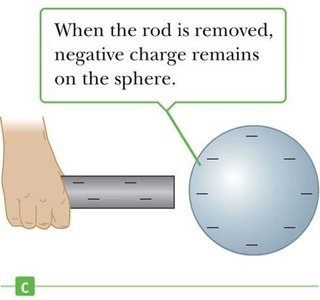
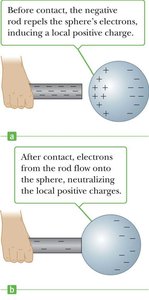
Charging by conduction involves direct contact between a charged object and a neutral object, resulting in the transfer of electrons and leaving both objects with the same type of charge.
After contact, the neutral object acquires the same sign of charge as the charged object.
Charging by Induction
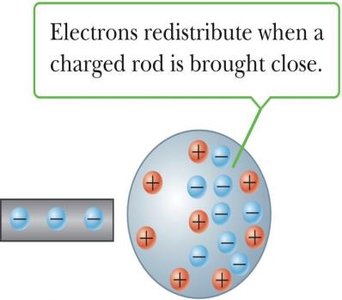
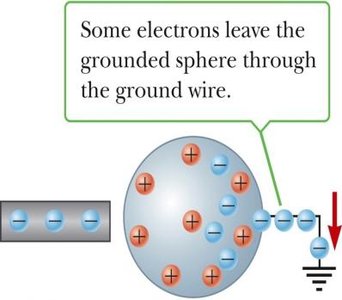
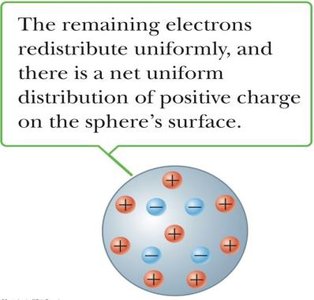
Charging by induction involves bringing a charged object near a neutral conductor, causing a redistribution of charges within the conductor. Grounding allows electrons to leave or enter, resulting in a net charge of opposite sign to the inducing object.
No direct contact is required between the charged and neutral objects.
The neutral object ends up with a charge opposite to that of the inducing object.
Electric Force and Coulomb’s Law
Nature of Electric Force
Electric force is a long-range force that acts between charged objects, described quantitatively by Coulomb’s Law.
Coulomb’s Law: The magnitude of the force between two point charges and separated by a distance is given by:
N·m2/C2 is Coulomb’s constant.
The force is attractive for opposite charges and repulsive for like charges.
Vector Nature of Electric Forces
Electric force is a vector quantity; the direction must be considered when calculating net forces from multiple charges.
Forces between two charges are equal in magnitude and opposite in direction (Newton’s Third Law).
Calculating Electric Forces: Problem-Solving Strategy
Draw a diagram showing all charges and forces.
Identify the charge of interest.
Convert all quantities to SI units.
Apply Coulomb’s Law to find the magnitude of each force.
Resolve forces into x and y components.
Sum all components to find the resultant force vector.
Use the Pythagorean theorem to find the magnitude of the resultant force.
Electric Field
Definition and Properties
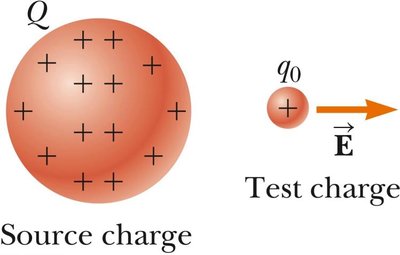
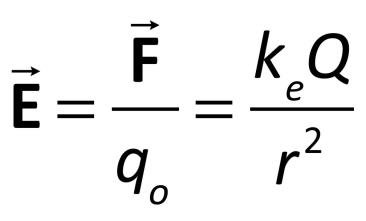
An electric field exists in the region around a charged object. It is defined as the force per unit charge experienced by a small positive test charge placed in the field.
Mathematical Definition:
The direction of is the direction of the force on a positive test charge.
SI unit: N/C (newton per coulomb).
Electric Field Lines
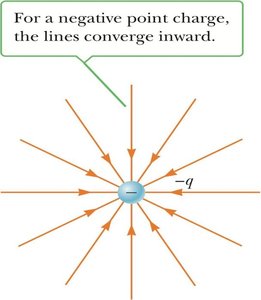
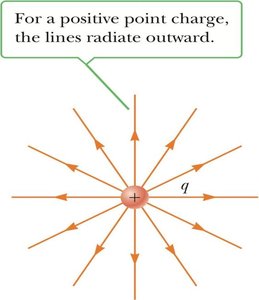
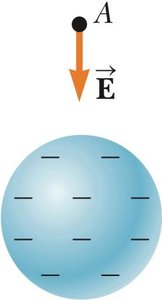
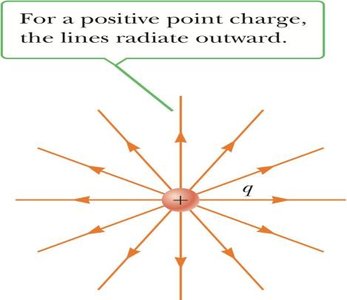
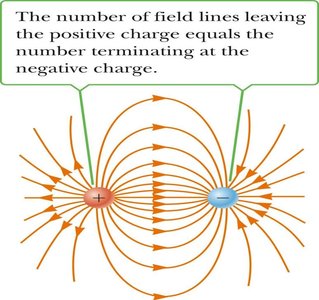
Electric field lines provide a visual representation of the direction and strength of the field.
Lines point away from positive charges and toward negative charges.
The density of lines indicates the strength of the field.
Field lines never intersect.
Electric Dipole and Multiple Charges
An electric dipole consists of two equal and opposite charges. The field pattern shows strong fields between the charges and weaker fields farther away.
Conductors in Electrostatic Equilibrium
Properties of Conductors at Equilibrium
The electric field inside a conductor is zero.
Any excess charge resides on the surface.
The electric field just outside the surface is perpendicular to the surface.
Charge accumulates at sharp points where the radius of curvature is smallest.
Millikan Oil-Drop Experiment
The Millikan oil-drop experiment measured the elementary charge, confirming that charge is quantized in integer multiples of .
Van de Graaff Generator
The Van de Graaff generator is an electrostatic generator used to accumulate large amounts of charge on a metal dome, demonstrating principles of charge transfer and electrostatic potential.
Electric Flux and Gauss’s Law
Electric Flux
Electric flux () is the total number of electric field lines passing through a given surface area .
For a uniform field:
For non-uniform fields:
Gauss’s Law
Gauss’s Law relates the electric flux through a closed surface to the net charge enclosed by the surface:
C2/N·m2 is the permittivity of free space.
Useful for calculating electric fields of symmetric charge distributions (spheres, planes, cylinders).
Summary Table: Key Concepts
Concept | Definition/Formula |
|---|---|
Electric Charge | Property of matter; SI unit: coulomb (C) |
Coulomb’s Law | |
Electric Field | |
Electric Flux | |
Gauss’s Law |
Additional info: For further practice, review the self-quiz and examples in Chapters 22–24 of the recommended textbook, as these concepts are foundational for understanding more advanced topics in electricity and magnetism.
