 Back
BackPHYS 170 Exam Study Guide: Vectors, Kinematics, Dynamics, Energy, Rotation, and Fluids
Study Guide - Smart Notes
 Tailored notes based on your materials, expanded with key definitions, examples, and context.
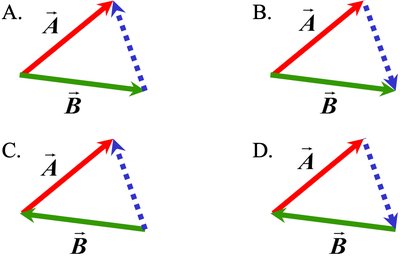
Q4. In which case is the dashed vector equal to \( \vec{A} + \vec{B} \)?
Background
Topic: Vector Addition
This question tests your understanding of how to add vectors graphically using the head-to-tail method.
Key Terms and Formulas
Vector Addition: To add two vectors \( \vec{A} \) and \( \vec{B} \), place the tail of \( \vec{B} \) at the head of \( \vec{A} \). The resultant vector \( \vec{A} + \vec{B} \) is drawn from the tail of \( \vec{A} \) to the head of \( \vec{B} \).
Resultant Vector: The vector that represents the sum of two or more vectors.
Step-by-Step Guidance
Examine each diagram and identify which vector is \( \vec{A} \) and which is \( \vec{B} \).
Recall the head-to-tail method: Place the tail of \( \vec{B} \) at the head of \( \vec{A} \).
The resultant (dashed) vector should start at the tail of \( \vec{A} \) and end at the head of \( \vec{B} \).
Check each option to see which diagram correctly follows this rule.
Try solving on your own before revealing the answer!
Final Answer: C
Option C correctly shows the resultant vector (dashed) starting at the tail of \( \vec{A} \) and ending at the head of \( \vec{B} \), following the head-to-tail method for vector addition.
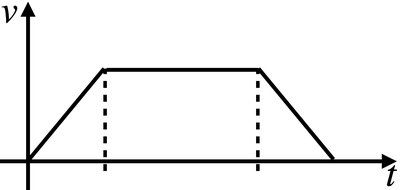
Q6. The graph on the right shows the velocity \( v \) as a function of time \( t \) for an object moving in a straight line. Which of the graphs below shows the corresponding displacement \( x \) as a function of time \( t \)?
Background
Topic: Kinematics – Graphical Analysis
This question tests your ability to interpret velocity-time graphs and relate them to displacement-time graphs.
Key Terms and Formulas
Displacement from Velocity: The area under the velocity-time graph gives the displacement.
Constant Velocity: Results in a straight, sloped line on the displacement-time graph.
Changing Velocity: Results in a curved line on the displacement-time graph.

Step-by-Step Guidance
Observe the velocity-time graph: Identify intervals of constant velocity and intervals where velocity changes.
Recall that the slope of the displacement-time graph corresponds to the value of velocity.
For intervals where velocity is constant, the displacement graph should be a straight line with constant slope.
For intervals where velocity increases or decreases, the displacement graph should be curved (the slope changes).
Match the features of the velocity-time graph to the correct displacement-time graph among the options.
Try solving on your own before revealing the answer!
Final Answer: D
Option D shows a displacement-time graph with straight and curved segments that correspond to the intervals of constant and changing velocity in the original velocity-time graph.
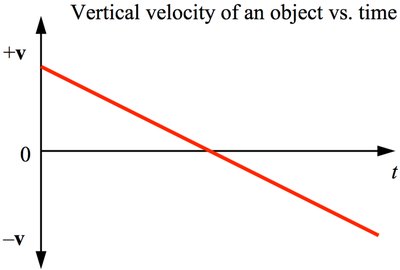
Q9. The vertical velocity vs. time motion for an object is shown, with positive velocity indicating a speed in the upward direction. Based on this graph, what can you infer about the object's motion?
Background
Topic: Projectile Motion and Kinematics
This question tests your ability to interpret a velocity-time graph for vertical motion and relate it to the motion of a projectile.
Key Terms and Formulas
Projectile Motion: The motion of an object under the influence of gravity only.
Velocity-Time Graph: The slope of this graph gives the acceleration.
Constant Acceleration: A straight line on a velocity-time graph indicates constant acceleration.
Step-by-Step Guidance
Examine the graph: The velocity starts positive and decreases linearly, crossing zero and becoming negative.
Recall that a straight, downward-sloping line indicates constant negative acceleration (such as gravity).
When velocity crosses zero, the object changes direction (from upward to downward motion).
This pattern is characteristic of projectile motion, where an object is thrown upward, slows down, stops momentarily, and then falls back down.
Try solving on your own before revealing the answer!
Final Answer: D
The vertical motion of the object is consistent with that of a projectile, as shown by the linear decrease in velocity due to constant acceleration from gravity.
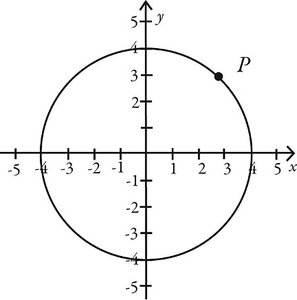
Q13. Point P in the figure indicates the position of an object traveling at constant speed clockwise around the circle. Which arrow best represents the direction of the acceleration of the object at point P?
Background
Topic: Uniform Circular Motion
This question tests your understanding of centripetal acceleration in circular motion.
Key Terms and Formulas
Centripetal Acceleration: The acceleration directed toward the center of the circle for an object moving in a circle at constant speed.
Formula:

Step-by-Step Guidance
Recall that in uniform circular motion, acceleration always points toward the center of the circle (centripetal acceleration).
Identify the center of the circle and the location of point P.
Look at the arrows and determine which one points directly toward the center from point P.
That arrow represents the direction of the acceleration vector at point P.
Try solving on your own before revealing the answer!
Final Answer: C
Arrow C points directly toward the center of the circle, which is the direction of the centripetal acceleration for an object in uniform circular motion.
