 Back
PHYS 2010 Zero-Assumption Companion: Structured Study Guide for College Physics (Non-Calculus)
Study Guide - Smart Notes
 Tailored notes based on your materials, expanded with key definitions, examples, and context.
Mathematics Review for Physics
Scientific Notation and Unit Conversion
Physics relies on concise mathematical language to express relationships among measurable quantities. Scientific notation is used to handle very large or small numbers efficiently, and unit conversion ensures answers are physically meaningful.
Scientific Notation: Numbers are written as a value between 1 and 10 multiplied by a power of ten. Example: 4,500,000 = 4.5 × 10⁶.
Unit Conversion: Multiply by conversion factors arranged so unwanted units cancel. Area and volume conversions require squaring or cubing the conversion factor.
SI Prefixes: Common prefixes include kilo (k, 103), centi (c, 10-2), milli (m, 10-3), micro (µ, 10-6), nano (n, 10-9).
Significant Figures: Communicate measurement precision; round according to the least precise input.
Algebraic Rearrangement and Proportional Reasoning
Isolate the unknown symbol before substituting numbers. Proportional reasoning predicts how changes in one variable affect another.
Direct Proportion: (y doubles if x doubles)
Inverse Proportion: (y halves if x doubles)
Square Relation: (y quadruples if x doubles)
Inverse Square: (y becomes one fourth if x doubles)
Trigonometry and Vectors
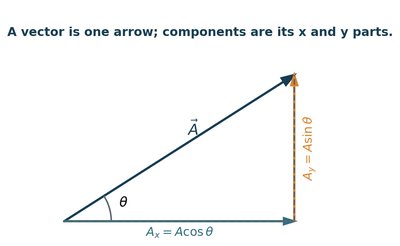
Right-triangle trigonometry is essential for resolving vectors into components. Vectors have both magnitude and direction, while scalars have only magnitude.
Component Formulas: ,
Pythagorean Theorem: for right triangles
Graphs and Physical Meaning
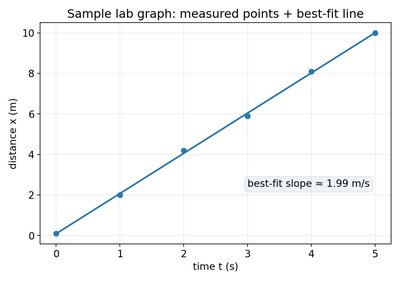
Graphs visually represent relationships. Slope and area have physical interpretations depending on the axes.
Slope: (with units)
Area under curve: Represents accumulated quantity (e.g., displacement, energy)
Models, Measurements, and Vectors
Modeling in Physics
Physics models simplify real situations by focusing on essential features and ignoring negligible details. Assumptions must be stated and checked for validity.
Measurement Quality
Accuracy: Closeness to accepted value
Precision: Repeatability of measurements
Uncertainty: Range of doubt in a result
Vector Addition and Resultants
Vectors are added component-wise. The resultant vector's magnitude and direction are found using Pythagorean theorem and inverse tangent.
Resultant Components: ,
Magnitude:
Direction:
Motion Along a Straight Line (1D Kinematics)
Position, Velocity, and Acceleration
One-dimensional motion is described by position, velocity, and acceleration. Velocity is the rate of change of position; acceleration is the rate of change of velocity.
Average Velocity:
Average Acceleration:
Constant Acceleration Equations
For constant acceleration, use the kinematic equations:
Motion Graphs
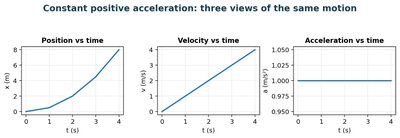
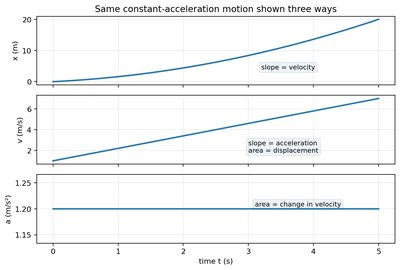
Position, velocity, and acceleration graphs provide different perspectives on the same motion. Slope and area have specific meanings.
x vs t: Slope = velocity
v vs t: Slope = acceleration; area = displacement
a vs t: Area = change in velocity
Motion in a Plane (2D Kinematics & Projectile Motion)
Projectile Motion
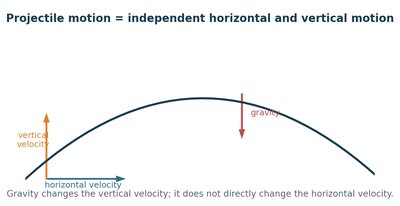
Projectile motion is described by independent horizontal and vertical components. Gravity affects only the vertical motion.
Horizontal motion:
Vertical motion:
Component velocities: ,
Newton's Laws of Motion
Free-Body Diagrams and Force Analysis
Free-body diagrams (FBDs) are essential for analyzing forces acting on an object. Newton's laws connect force and motion.
Newton's First Law: An object remains at rest or in uniform motion unless acted upon by a net external force.
Newton's Second Law:
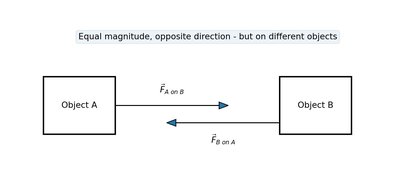
Newton's Third Law: For every action, there is an equal and opposite reaction (forces act on different objects).
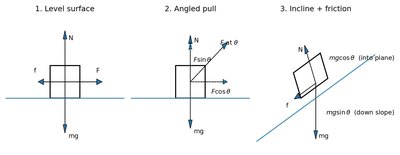
Applications of Newton's Laws: Friction, Inclines, and Systems
Inclined Planes and Friction
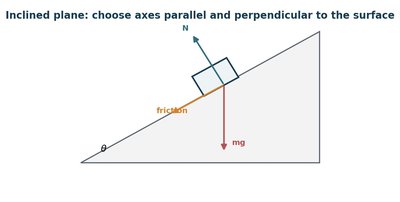
On an incline, resolve weight into components parallel and perpendicular to the surface. Friction opposes motion.
Weight components: ,
Friction: ,
Work, Energy, and Conservation
Work and Energy
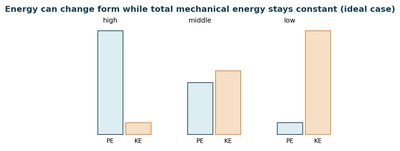
Work is energy transferred by a force through displacement. Energy can change form but is conserved in ideal cases.
Work:
Kinetic Energy:
Potential Energy:
Conservation of Energy: (constant in ideal cases)
Momentum and Impulse
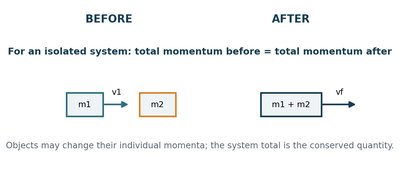
Momentum Conservation
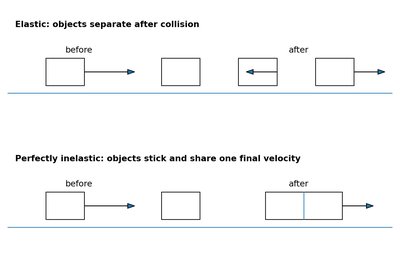
Momentum is conserved in isolated systems. Impulse changes momentum.
Momentum:
Impulse:
Conservation:
Rotational Motion and Dynamics
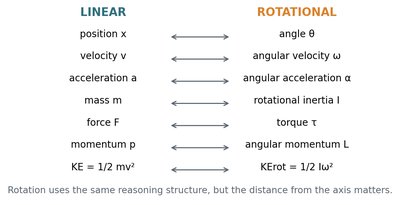
Linear vs Rotational Analogy
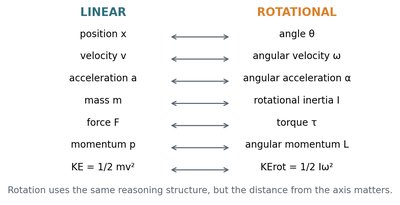
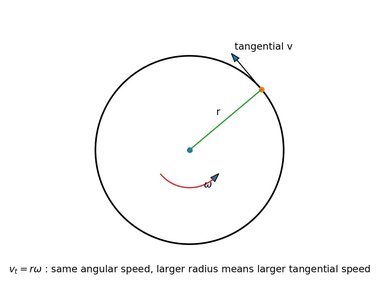
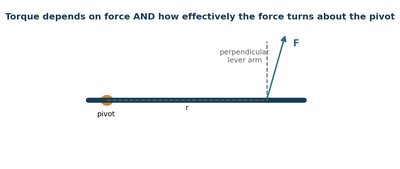
Rotational motion mirrors linear motion, but the distance from the axis matters. Angular quantities are used for rotation.
Position vs Angle:
Velocity vs Angular Velocity:
Acceleration vs Angular Acceleration:
Force vs Torque:
Momentum vs Angular Momentum:
Kinetic Energy: ,
Torque and Rotational Inertia
Torque:
Rotational Inertia:
Elasticity and Periodic Motion
Hooke's Law and Simple Harmonic Motion
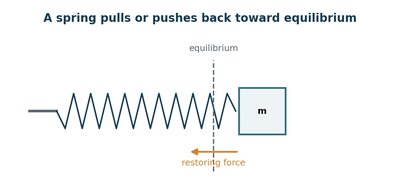
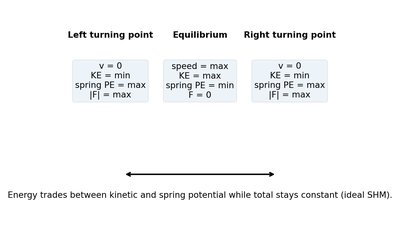
Springs obey Hooke's law in the elastic range. Simple harmonic motion (SHM) is periodic motion with restoring force proportional to displacement.
Hooke's Law:
SHM Period:
Mechanical Waves and Sound
Wave Properties
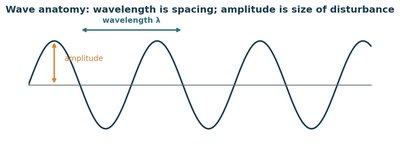
Waves transport energy through a medium. Wavelength, frequency, and amplitude are key properties.
Wave Speed:
Fluid Mechanics
Pressure, Buoyancy, and Flow
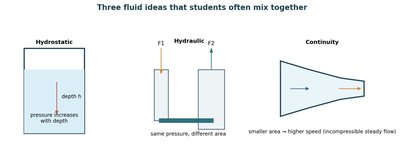
Fluid mechanics covers density, pressure, hydrostatics, hydraulics, continuity, and Bernoulli's principle.
Density:
Pressure:
Hydrostatic Pressure:
Buoyancy:
Continuity:
Bernoulli:
Heat, Temperature, and Thermodynamics
Heat Transfer and Temperature
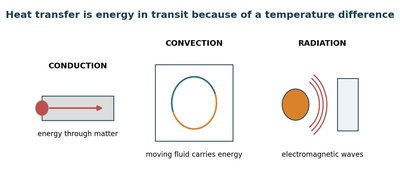
Heat is energy transferred due to temperature difference. Internal energy is stored microscopically.
Specific Heat:
Latent Heat:
Thermal Expansion:
Thermal Properties of Matter and Ideal Gases
Ideal Gas Law and Kinetic Theory
Ideal Gas Law:
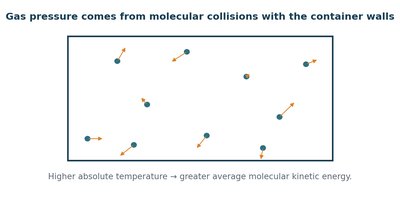
Kinetic Theory:
Internal Energy (monatomic):
The Second Law of Thermodynamics
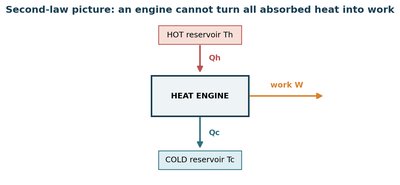
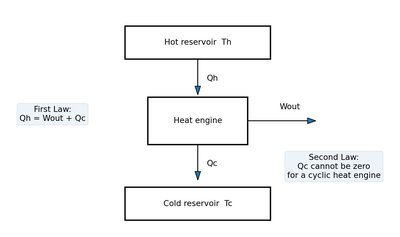
Heat Engines, Efficiency, and Entropy
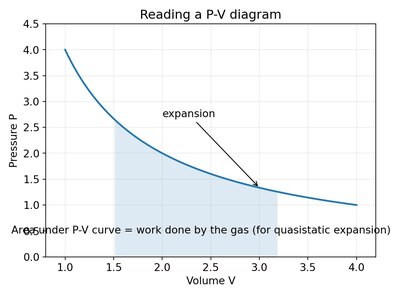
First Law:
Heat Engine Efficiency:
Coefficient of Performance (COP): ,
Entropy Change (reversible):
Carnot Efficiency Limit:
Laboratory Preparation and Measurement
Measurement, Graphing, and Uncertainty
Resolution: Smallest increment readable
Accuracy: Closeness to reference
Precision: Repeatability
Uncertainty: Quantified doubt
Graphing: Slope and intercept have physical meaning; units must be included
Quick Reference: Linear vs Rotational Quantities
Jonathan's Physics Problem-Solving Chain
Structured Approach to Physics Problems
Follow a systematic chain for solving physics problems:
Read the problem
Draw the situation
List knowns and find unknowns
Choose the governing principle
Select the equation based on the principle
Calculate with units
Check and explain the result
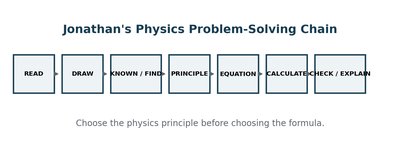
Choose the physics principle before choosing the formula.
