 Back
BackPHYS 230/281 Midterm Exam Study Guidance
Study Guide - Smart Notes
 Tailored notes based on your materials, expanded with key definitions, examples, and context.
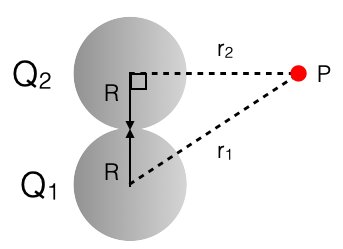
Q5. For two spheres with charges Q1 and Q2 and identical radii R, nearly touching, what must be the ratio Q2/Q1 for the total electric potential at point P to be zero? (Assume the potential is zero at infinity.)
Background
Topic: Electric Potential due to Point Charges
This question tests your understanding of how to calculate the electric potential at a point due to multiple point charges, and how to set up equations for the condition that the net potential at a specific point is zero.
Key Terms and Formulas
Electric Potential (V): The potential at a distance r from a point charge Q is given by:
Superposition Principle: The total potential at a point due to multiple charges is the algebraic sum of the potentials due to each charge.
Step-by-Step Guidance
Write the expression for the electric potential at point P due to charge Q1:
Write the expression for the electric potential at point P due to charge Q2:
Apply the superposition principle to find the total potential at point P:
Set the total potential at point P to zero (as required by the problem):
Substitute the expressions for and and rearrange to solve for the ratio .
Try solving on your own before revealing the answer!
Final Answer:
By setting , you solve for as . The negative sign indicates the charges must be of opposite sign for the potentials to cancel at P.
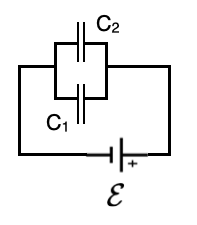
Q9. In the circuit shown, the EMF source E has negligible internal resistance, and C₁ ≠ C₂. Which statement is correct?
Background
Topic: Capacitors in Parallel
This question tests your understanding of how capacitors behave when connected in parallel, including charge, voltage, and energy relationships.
Key Terms and Formulas
Capacitors in Parallel: The voltage across each capacitor is the same and equal to the EMF of the source.
Total Capacitance:
Charge on Each Capacitor:
Energy Stored:
Step-by-Step Guidance
Recall that in a parallel circuit, the voltage across each capacitor is equal to the EMF, .
Determine the charge on each capacitor using .
Compare the charges and energies stored in each capacitor, noting that .
Consider the total current and whether the EMF source dissipates energy (an ideal source does not dissipate energy).
Try solving on your own before revealing the answer!
Final Answer: The capacitors have equal potential difference.
In a parallel connection, each capacitor is directly connected across the EMF source, so regardless of their capacitances.
