 Back
BackPHYS Ch 11 Quiz – Thermodynamics and Heat Engines Study Guide
Study Guide - Smart Notes
 Tailored notes based on your materials, expanded with key definitions, examples, and context.
Q1. A system receives 100 J of heat. If the thermal energy of the system remains constant, how much work does the system do?
Background
Topic: First Law of Thermodynamics
This question tests your understanding of energy conservation in thermodynamic systems, specifically the relationship between heat, work, and internal energy.
Key Terms and Formulas:
First Law of Thermodynamics:
= change in internal energy
= heat added to the system
= work done by the system
Step-by-Step Guidance
Identify what is given: , (thermal energy remains constant).
Substitute the known values into the First Law: .
Rearrange the equation to solve for .
Try solving on your own before revealing the answer!
Q2. Engine 1 takes in 100 J of heat from a hot reservoir and does 20 J of work. Engine 2 takes in the same amount of heat and does 25 J of work. Is the efficiency of engine 1 greater than, less than, or equal to the efficiency of engine 2?
Background
Topic: Heat Engine Efficiency
This question tests your ability to compare the efficiencies of two heat engines based on the work output and heat input.
Key Terms and Formulas:
Efficiency of a heat engine:
= work done by the engine
= heat absorbed from the hot reservoir
Step-by-Step Guidance
Calculate the efficiency for Engine 1: .
Calculate the efficiency for Engine 2: .
Compare and to determine which is greater.
Try solving on your own before revealing the answer!
Q3. Engine 1 takes in 100 J of heat and does 20 J of work. Engine 2 takes in 600 J of heat and does 60 J of work. Is the efficiency of engine 1 greater than, less than, or equal to the efficiency of engine 2?
Background
Topic: Heat Engine Efficiency Comparison
This question asks you to compare the efficiencies of two engines with different heat inputs and work outputs.
Key Terms and Formulas:
Efficiency:
Step-by-Step Guidance
Calculate for Engine 1.
Calculate for Engine 2.
Compare the two efficiencies to answer the question.
Try solving on your own before revealing the answer!
Q4. Which of the following equations illustrates the First Law of Thermodynamics?
Background
Topic: First Law of Thermodynamics
This question tests your ability to recognize the correct mathematical statement of the First Law of Thermodynamics.
Key Terms and Formulas:
First Law:
Step-by-Step Guidance
Review each option and recall the standard form of the First Law.
Identify which equation matches .
Try solving on your own before revealing the answer!
Q5. In an adiabatic compression of an ideal gas, no heat is exchanged with the surroundings (). What happens to the temperature of the gas?
Background
Topic: Adiabatic Processes
This question tests your understanding of how temperature changes during adiabatic compression, where no heat is transferred.
Key Terms and Formulas:
Adiabatic process:
First Law:
For compression, work is done on the gas ()
Step-by-Step Guidance
Recall that in an adiabatic process.
Consider the sign of work during compression (work done on the gas).
Use the First Law to determine the effect on internal energy and temperature.
Try solving on your own before revealing the answer!
Q6. Find the heat associated with this process: ,
Background
Topic: First Law of Thermodynamics (Solving for Heat)
This question asks you to solve for the heat transferred in a process, given the work done and the change in internal energy.
Key Terms and Formulas:
First Law:
Step-by-Step Guidance
Substitute the given values into the First Law: .
Rearrange the equation to solve for .
Try solving on your own before revealing the answer!
Q7. A runner does J of work and gives off J of heat. Determine for the runner.
Background
Topic: First Law of Thermodynamics (Application to Biological Systems)
This question tests your ability to apply the First Law to a real-world scenario involving work and heat loss.
Key Terms and Formulas:
First Law:
Here, is heat given off (so it is negative)
Step-by-Step Guidance
Assign the correct signs: J (heat lost), J (work done by the runner).
Substitute into the First Law: .
Simplify the expression to find .
Try solving on your own before revealing the answer!
Q8. Which of the following physical quantities is zero in a constant-volume process?
Background
Topic: Thermodynamic Processes
This question tests your understanding of what happens during a constant-volume (isochoric) process.
Key Terms and Formulas:
Work done:
Constant volume:
Step-by-Step Guidance
Recall that in a constant-volume process, .
Substitute into the work formula to determine which quantity is zero.
Try solving on your own before revealing the answer!
Q9. Which of the following physical quantities is zero in an isothermal process?
Background
Topic: Isothermal Processes
This question tests your understanding of what remains constant or becomes zero during an isothermal process.
Key Terms and Formulas:
Isothermal:
For an ideal gas,
Step-by-Step Guidance
Recall that temperature does not change in an isothermal process.
Use the internal energy formula to determine which quantity is zero.
Try solving on your own before revealing the answer!
Q10. Which of the following physical quantities is zero in an adiabatic process?
Background
Topic: Adiabatic Processes
This question tests your understanding of what is zero during an adiabatic process.
Key Terms and Formulas:
Adiabatic:
Step-by-Step Guidance
Recall the definition of an adiabatic process.
Identify which physical quantity is zero based on the definition.
Try solving on your own before revealing the answer!
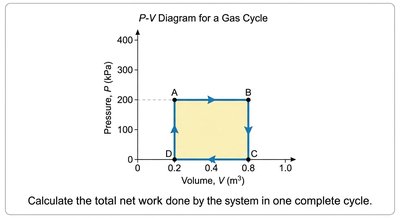
Q11. Use the graph to determine work done in this process.
Background
Topic: Work Done by a Gas in a PV Diagram
This question tests your ability to interpret a PV diagram and calculate the net work done in a thermodynamic cycle.
Key Terms and Formulas:
Work done in a PV diagram: Area enclosed by the cycle
For a rectangle:
Step-by-Step Guidance
Identify the coordinates of the rectangle (pressures and volumes at each corner).
Calculate the area enclosed by the cycle, which represents the net work done.
Multiply the difference in pressure by the difference in volume to find the area.
Try solving on your own before revealing the answer!
Q12. A process that occurs at a constant temperature is called:
Background
Topic: Thermodynamic Processes
This question tests your knowledge of terminology for thermodynamic processes.
Key Terms and Formulas:
Isothermal: Constant temperature
Adiabatic: No heat exchange
Step-by-Step Guidance
Recall the definitions of isothermal and adiabatic processes.
Match the correct term to the description.
Try solving on your own before revealing the answer!
Q13. A fluid expands by at a pressure of . How much work is done by the fluid?
Background
Topic: Work Done by Expanding Gas
This question tests your ability to calculate work done during an isobaric (constant pressure) expansion.
Key Terms and Formulas:
Work:
Pressure must be in Pascals (1 kPa = 1000 Pa)
Step-by-Step Guidance
Convert pressure to Pascals: .
Multiply pressure by the change in volume: .
Try solving on your own before revealing the answer!
Q14. A gas is contained in a cylinder with a pressure of and an initial volume of . How much work is done by the gas if it expands at constant pressure to twice the initial volume?
Background
Topic: Work Done by a Gas at Constant Pressure
This question tests your ability to calculate work done during an isobaric expansion when the volume changes.
Key Terms and Formulas:
Work:
Final volume:
Change in volume:
Step-by-Step Guidance
Calculate the final volume: .
Find the change in volume: .
Convert pressure to Pascals: .
Multiply pressure by to find the work done.
Try solving on your own before revealing the answer!
Q15. If you rub your hands together, the entropy of the universe changes. Choose the best explanation for this.
Background
Topic: Entropy and the Second Law of Thermodynamics
This question tests your understanding of how entropy changes when energy is dissipated as heat.
Key Terms and Formulas:
Entropy: A measure of disorder or randomness
Second Law: Entropy of the universe increases in spontaneous processes
Step-by-Step Guidance
Consider what happens to the energy when you rub your hands together (heat is produced).
Think about how this heat affects the entropy of your hands and the surrounding air.
Try solving on your own before revealing the answer!
Q16. A heat engine operates between a hot reservoir at temperature and a cold reservoir at . If both temperatures are doubled, what happens to the efficiency of the engine?
Background
Topic: Carnot Engine Efficiency
This question tests your understanding of how the efficiency of an ideal (Carnot) engine depends on the temperatures of the reservoirs.
Key Terms and Formulas:
Carnot efficiency:
Step-by-Step Guidance
Write the original efficiency formula: .
Substitute and into the formula.
Simplify to see how the efficiency changes.
Try solving on your own before revealing the answer!
Q17. What is the efficiency of an engine that takes in 610 J of heat and does 230 J of work?
Background
Topic: Heat Engine Efficiency Calculation
This question tests your ability to calculate the efficiency of a heat engine given the heat input and work output.
Key Terms and Formulas:
Efficiency:
Express efficiency as a percentage:
Step-by-Step Guidance
Substitute the given values into the efficiency formula: .
Multiply by 100 to convert to a percentage.
Try solving on your own before revealing the answer!
Q18. An engine receives 780 J of heat from a hot reservoir and does 110 J of work. What is the heat given off to the cold reservoir?
Background
Topic: Conservation of Energy in Heat Engines
This question tests your understanding of energy flow in a heat engine.
Key Terms and Formulas:
First Law for engines:
= heat expelled to the cold reservoir
Step-by-Step Guidance
Write the energy balance: .
Substitute the given values: .
Rearrange to solve for .
Try solving on your own before revealing the answer!
Q19. Absolute zero cannot be reached. True or False?
Background
Topic: Third Law of Thermodynamics
This question tests your understanding of the third law, which states that absolute zero is unattainable.
Key Terms and Formulas:
Absolute zero: , the lowest possible temperature
Third Law: It is impossible to reach absolute zero in a finite number of steps
Step-by-Step Guidance
Recall the statement of the third law of thermodynamics.
Decide whether the statement is true or false based on the law.
Try solving on your own before revealing the answer!
Q20. No engine can be 100% efficient. True or False?
Background
Topic: Second Law of Thermodynamics
This question tests your understanding of the limitations imposed by the second law on the efficiency of heat engines.
Key Terms and Formulas:
Second Law: No engine can convert all heat into work; some energy is always lost as waste heat
Step-by-Step Guidance
Recall the implications of the second law for heat engine efficiency.
Decide whether the statement is true or false based on the law.
Try solving on your own before revealing the answer!
