 Back
BackPhysics-1 Study Guide: Units, Vectors, Significant Figures, and Introductory Motion Concepts
Study Guide - Smart Notes
 Tailored notes based on your materials, expanded with key definitions, examples, and context.
Units, Vectors, and Significant Figures
Significant Figures
Understanding significant figures is essential for reporting measurements accurately in physics. Significant figures reflect the precision of a measured value and dictate how results should be rounded in calculations.
Definition: The digits in a number that are known with certainty plus one digit that is estimated.
Rules:
All nonzero digits are significant.
Zeros between nonzero digits are significant.
Leading zeros are not significant.
Trailing zeros in a decimal number are significant.
Example: 0.00450 has three significant figures.
Units and Dimensional Analysis
Units are fundamental in physics, as they provide a standard for measurement. Dimensional analysis helps verify equations and convert between units.
Key Point: Every physical quantity has associated units (e.g., mass in kg, velocity in m/s).
Example: Momentum () is defined as , where is mass (kg) and is velocity (m/s). Thus, $p$ has units of kg·m/s.
Unit Conversion: Use conversion factors to change units (e.g., years to seconds). Always multiply by the appropriate conversion factor.
Example: To convert 2 years to seconds:
Density and Ratios
Density is a ratio of mass to volume and is used to characterize materials. It is not converted unless specified.
Formula:
Units: Commonly kg/m3 or g/cm3.
Conversion: Only convert density if instructed; otherwise, treat as a fixed ratio.
Volume Calculations
Calculating the volume of objects is a frequent task in physics. Use geometric formulas based on the object's shape.
Sphere:
Example: For a sphere with radius 2.0 m:
Unit Circle and Quadrants
The unit circle is used to understand angles and their signs in different quadrants, which is important for vector analysis.
Quadrant Signs:
Quadrant I: (+x, +y)
Quadrant II: (−x, +y)
Quadrant III: (−x, −y)
Quadrant IV: (+x, −y)
Theta (): Positive and negative angles are measured from the x-axis.
Trigonometry and Geometry in Physics
Trigonometric relationships are used to solve problems involving angles, vectors, and components. Geometry is essential for analyzing shapes and calculating areas or volumes.
Key Formulas:
Sine, cosine, and tangent functions relate angles to side lengths in right triangles.
Pythagorean theorem:
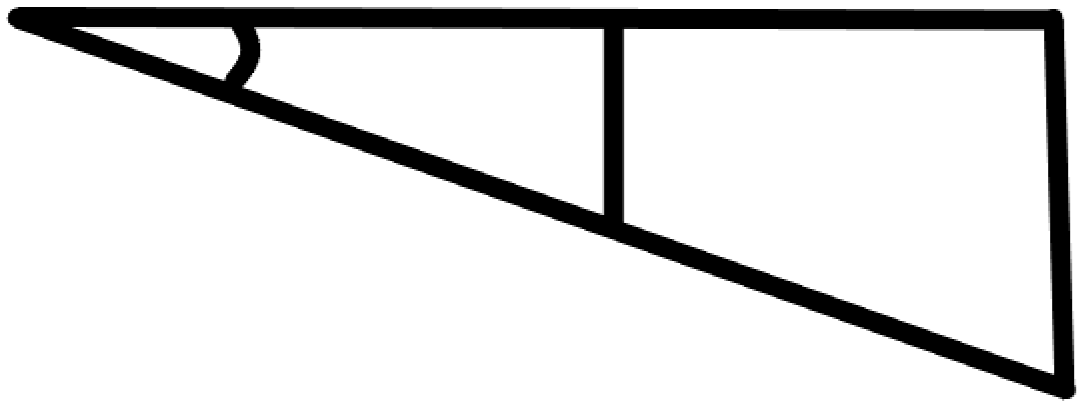
Example: Resolving a vector into x and y components using trigonometry.
Adding Numbers with Significant Figures
When adding or subtracting, the result should have the same number of decimal places as the measurement with the fewest decimal places.
Example: 12.11 + 0.3 = 12.4 (rounded to one decimal place)
Prefix Conversion Rules
Prefixes (e.g., kilo-, milli-) are used to denote multiples or fractions of units. Conversion between prefixes requires knowledge of their values.
Common Prefixes:
kilo- (k):
milli- (m):
micro- ():
Conversion Example: 1 km = 1000 m
Motion in One and Two Dimensions
Variables and Units
Variables such as velocity and acceleration have consistent units regardless of the equation.
Velocity: m/s
Acceleration: m/s2
Impulse-Change in Momentum: (units: m/s)
Total Time in Flight
Problems involving the total time in flight require understanding of kinematic equations and projectile motion.
Key Equations:
Application: Used to determine how long an object remains airborne.
Examples and Exercises
Refer to Example 2.4, Example 2.6, Exercise 2.6, Example 2.8, Exercise 2.8, and Example 2.10 for practice with time in flight and kinematic equations.
Summary Table: Units and Physical Quantities
Quantity | Symbol | Units |
|---|---|---|
Mass | m | kg |
Velocity | v | m/s |
Momentum | p | kg·m/s |
Acceleration | a | m/s2 |
Density | ρ | kg/m3 |
Volume (Sphere) | V | m3 |
Additional info: Academic context was added to clarify significant figures, unit conversions, density, trigonometry, and kinematic equations for completeness.
