 Back
BackPhysics 107 Midterm Study Guidance: Kinematics and Mechanics
Study Guide - Smart Notes
 Tailored notes based on your materials, expanded with key definitions, examples, and context.
Q1. The period of a pendulum depends on the string length and gravity. Which formula gives the period?
Background
Topic: Simple Harmonic Motion (Pendulum)
This question tests your understanding of the physical pendulum and how its period depends on the length of the string and the acceleration due to gravity.
Key Terms and Formulas:
Period (): The time it takes for one complete oscillation.
Length (): The length of the pendulum string.
Gravity (): The acceleration due to gravity.
The formula for the period of a simple pendulum is:
Step-by-Step Guidance
Recall that the period of a simple pendulum depends on the length of the string and the acceleration due to gravity.
Identify the formula that includes both and in the correct relationship.
Check the answer choices for the formula that matches .
Try solving on your own before revealing the answer!
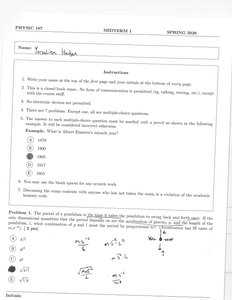
Final Answer: T = 2\pi \sqrt{\frac{L}{g}}
This formula shows that the period increases with the square root of the length and decreases with the square root of gravity.
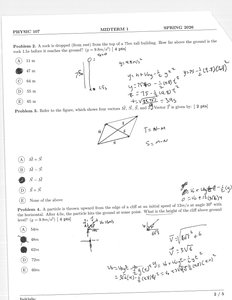
Q2. A rock is dropped (from rest) from the top of a tall building. How far above the ground is the rock 1.0s before it reaches the ground?
Background
Topic: Kinematics (Free Fall)
This question tests your ability to use kinematic equations to analyze the motion of an object in free fall.
Key Terms and Formulas:
Initial velocity (): The velocity at the start (here, ).
Acceleration due to gravity (): downward.
Displacement (): The distance fallen.
Time (): The time elapsed.
The kinematic equation for displacement is:
Step-by-Step Guidance
First, determine the total time it takes for the rock to reach the ground using the kinematic equation.
Subtract 1.0 s from the total time to find the time when the rock is 1.0 s away from hitting the ground.
Use the kinematic equation to calculate the distance fallen at this time.
Subtract this distance from the total height to find how far above the ground the rock is.
Try solving on your own before revealing the answer!
Final Answer: The rock is 20 m above the ground 1.0 s before it lands.
By calculating the total time and using the kinematic equation, you find the height at the specified moment.
Q3. Refer to the figure, which shows two vectors and . What is ?
Background
Topic: Vector Addition
This question tests your ability to add vectors graphically and algebraically.
Key Terms and Formulas:
Vector (): A quantity with both magnitude and direction.
Vector addition: Adding two vectors to get a resultant vector.
To add vectors, use the tip-to-tail method or add their components.
Step-by-Step Guidance
Examine the diagram to determine the direction and magnitude of and .
Use the tip-to-tail method to draw the resultant vector .
If the vectors are given in component form, add their respective components.
Try solving on your own before revealing the answer!
Final Answer: The resultant vector is the diagonal of the parallelogram formed by and .
Vector addition gives the vector from the tail of to the tip of .
Q4. A stone is thrown upward from the edge of a cliff with an initial speed of 8 m/s. How long does it take to reach the ground below if the cliff is 50 m high?
Background
Topic: Kinematics (Projectile Motion)
This question tests your ability to analyze projectile motion with both upward and downward movement.
Key Terms and Formulas:
Initial velocity (): The velocity at which the stone is thrown upward.
Height (): The height of the cliff.
Acceleration due to gravity (): downward.
Time (): The total time to reach the ground.
The kinematic equation for displacement is:
Step-by-Step Guidance
Set up the equation for the total displacement: (since the stone ends up below the starting point).
Plug in the values: , , .
Rearrange the equation to solve for (this will be a quadratic equation).
Use the quadratic formula to find the positive value of .
Try solving on your own before revealing the answer!
Final Answer: The stone takes approximately 5.5 seconds to reach the ground.
Solving the quadratic equation gives the total time for the stone's journey.
