 Back
BackPhysics 111 Exam 3 Study Guidance: Impulse, Collisions, Rotational Motion, Center of Mass, and Moment of Inertia
Study Guide - Smart Notes
 Tailored notes based on your materials, expanded with key definitions, examples, and context.
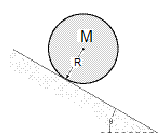
Q7. A hollow, spherical shell with mass 2.00 kg rolls without slipping down a 38.0° slope. Find the acceleration, the friction force, and the minimum coefficient of static friction needed to prevent slipping.
Background
Topic: Rotational Dynamics & Rolling Motion
This question tests your understanding of rolling motion, the forces involved, and how to calculate acceleration and friction for a rolling object.
Key Terms and Formulas:
Moment of inertia for a hollow sphere:
Newton's second law for translation:
Newton's second law for rotation:
Relationship between linear and angular acceleration for rolling without slipping:
Static friction force:
Minimum coefficient of static friction:
Step-by-Step Guidance
Draw a free-body diagram for the sphere, showing gravity, normal force, and friction.
Write Newton's second law for the forces parallel to the slope:
Write the rotational equation: and use to relate linear and angular acceleration.
Substitute for a hollow sphere and solve for in terms of and .
Set up the equations to solve for and using the values found above.
Try solving on your own before revealing the answer!
Final Answer:
Acceleration: Friction force: Minimum coefficient of static friction:
These results are found by applying Newton's laws and the rolling condition, and substituting the values for mass, angle, and moment of inertia.
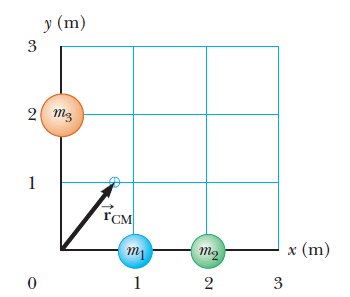
Q14. A system consists of three particles with masses m1 = m2 = 1.0 kg and m3 = 2.0 kg. located as shown in Figure. Find the coordinates of the center of mass of the system.
Background
Topic: Center of Mass
This question tests your ability to calculate the center of mass for a system of particles using their masses and positions.
Key Terms and Formulas:
Center of mass coordinates: ,
Each mass's position is given in the diagram.
Step-by-Step Guidance
Identify the positions for each mass from the diagram.
Write the formula for and using the masses and their coordinates.
Plug in the values for , , and their respective positions.
Calculate the numerator and denominator for each coordinate.
Try solving on your own before revealing the answer!
Final Answer:
,
The center of mass is calculated by weighting each position by its mass and dividing by the total mass.
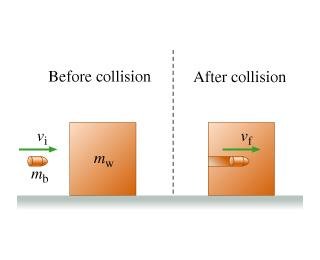
Q16. In order to find the speed of a fast bullet, it is fired into a 4.0 kg wooden block on a horizontal surface. The bullet gets stuck in the block which starts moving with the speed of Vf=2.5 m/s. Find the original speed of the bullet Vi if its mass is 7.54 gram.
Background
Topic: Conservation of Momentum (Inelastic Collision)
This question tests your understanding of momentum conservation in a perfectly inelastic collision, where the bullet embeds in the block.
Key Terms and Formulas:
Conservation of momentum:
Initial velocity of block
Final velocity is given
Step-by-Step Guidance
Write the conservation of momentum equation for the collision.
Plug in the values for the masses and final velocity.
Rearrange the equation to solve for the initial velocity of the bullet .
Convert the bullet mass to kilograms before substituting.
Try solving on your own before revealing the answer!
Final Answer:
By applying conservation of momentum and substituting the values, you find the bullet's original speed.
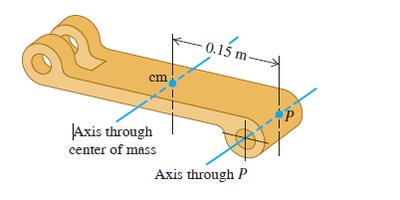
Q20. A part of a mechanical linkage has a mass of 3.6 kg. Its moment of inertia IP about an axis 0.15 m from its center of mass is IP = 0.132 kg m2. What is the moment of inertia Icm about a parallel axis through the center of mass?
Background
Topic: Rotational Inertia & Parallel Axis Theorem
This question tests your ability to use the parallel axis theorem to relate the moment of inertia about two parallel axes.
Key Terms and Formulas:
Parallel axis theorem:
= moment of inertia about axis P
= moment of inertia about center of mass
= mass, = distance between axes
Step-by-Step Guidance
Write the parallel axis theorem equation.
Plug in the values for , , and .
Rearrange the equation to solve for .
Calculate and subtract from to find .
Try solving on your own before revealing the answer!
Final Answer:
Using the parallel axis theorem, you subtract from to find the moment of inertia about the center of mass.
