 Back
BackPhysics 1201: Midterm I Review – Circuits, Capacitors, and Electric Forces
Study Guide - Smart Notes
 Tailored notes based on your materials, expanded with key definitions, examples, and context.
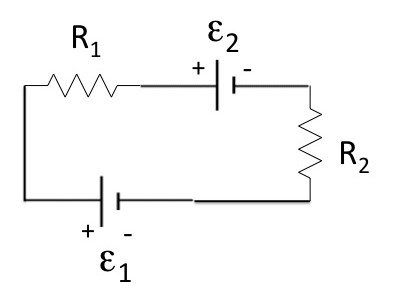
Q8. Find the current flowing in the circuit below if , , and .
Background
Topic: DC Circuits – Kirchhoff's Loop Rule
This question tests your ability to analyze a simple series circuit with two batteries and two resistors using Kirchhoff's loop rule to find the current.
Key Terms and Formulas
Kirchhoff's Loop Rule: The sum of the potential differences around any closed loop in a circuit is zero.
Ohm's Law:
For this circuit, the loop equation is:
Step-by-Step Guidance
Write the loop equation for the circuit, starting at the negative terminal of and moving clockwise:
Combine like terms to group all terms involving together:
Rearrange the equation to solve for the current :
Substitute the given values: , , , .
Try solving on your own before revealing the answer!
Final Answer:
Using , you find the current is or .
This is the current flowing through the circuit, determined by the net emf and total resistance.
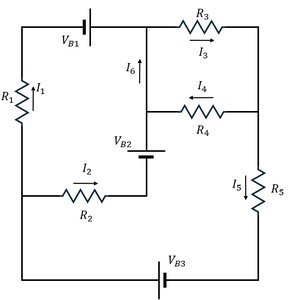
Q9. Which one of the following equations is not correct for the circuit shown?
Background
Topic: Kirchhoff's Rules for Multi-Loop Circuits
This question tests your understanding of how to apply Kirchhoff's loop and junction rules to a complex circuit with multiple loops and branches.
Key Terms and Formulas
Kirchhoff's Junction Rule: The sum of currents entering a junction equals the sum of currents leaving.
Kirchhoff's Loop Rule: The sum of the potential differences around any closed loop is zero.
Step-by-Step Guidance
Examine each equation and identify whether it correctly applies the loop or junction rule to the circuit shown.
For loop equations, check that the sum of voltage drops and rises around the loop equals zero.
For junction equations, check that the sum of currents entering and leaving a node is balanced.
Compare each equation to the actual circuit layout and current directions to see if any equation violates the rules.
Try solving on your own before revealing the answer!
Final Answer: b) is not correct.
This equation suggests that the voltage drops across and sum to zero, which is not generally true unless both currents are zero.
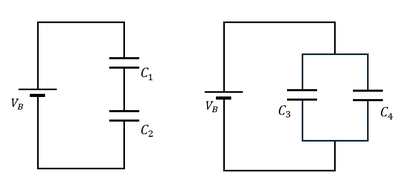
Q10. Consider two circuits below, where , , , and . Assume that is the potential difference across , and is the charge on , etc. for the other capacitors. Which one of the following statements is true?
Background
Topic: Capacitors in Series and Parallel
This question tests your understanding of how voltage and charge are distributed across capacitors in series and parallel arrangements.
Key Terms and Formulas
Series Capacitors: ; charge is the same on each capacitor, voltage divides.
Parallel Capacitors: ; voltage is the same across each, charge divides.
Charge on a Capacitor:
Step-by-Step Guidance
For the series circuit (left), recall that the charge on each capacitor is the same, but the voltage divides according to capacitance.
For the parallel circuit (right), recall that the voltage across each capacitor is the same, but the charge divides according to capacitance.
Review each statement and determine if it matches the rules for series or parallel capacitors.
Identify which statement correctly describes the relationships for the given circuits.
Try solving on your own before revealing the answer!
Final Answer: b) and is true.
In series, capacitors have equal charge; in parallel, capacitors have equal voltage.
