 Back
BackPhysics 1201: Midterm II Review – Step-by-Step Study Guidance
Study Guide - Smart Notes
 Tailored notes based on your materials, expanded with key definitions, examples, and context.
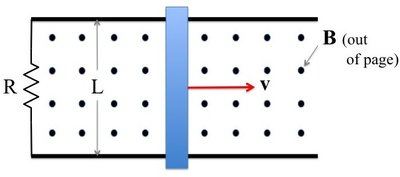
Q2. A conductor is moved by an external force at a constant velocity, , in a magnetic field, , along two conducting rails separated by a distance and connected to a resistor, , as shown in the figure. Assume m/s, T, m, and . Find the magnitude of the induced current in the circuit. And what is the direction of the current?
Background
Topic: Electromagnetic Induction (Faraday's Law, Motional EMF)
This question tests your understanding of how a moving conductor in a magnetic field induces an electromotive force (emf), which then drives a current through a resistor. You also need to determine the direction of the induced current using the right-hand rule or Lenz's Law.
Key Terms and Formulas
Motional emf: The emf () induced in a conductor of length moving at velocity perpendicular to a magnetic field is given by:
Ohm's Law: The current in the circuit is given by:
Lenz's Law: The direction of the induced current opposes the change in magnetic flux.
Step-by-Step Guidance
Identify the known values: T, m, m/s, .
Write the formula for the motional emf: .
Plug the known values into the emf formula (but do not calculate yet): .
Write the formula for the induced current using Ohm's Law: .
Set up the expression for the current with all values substituted, but do not compute the final value: .
To determine the direction, use the right-hand rule: Point your fingers in the direction of (to the right), curl them in the direction of (out of the page), and your thumb points in the direction of the induced current (which will be either clockwise or counterclockwise in the circuit).
Try solving on your own before revealing the answer!
Final Answer: 0.316 A, Counterclockwise
A
The current flows counterclockwise as determined by the right-hand rule and Lenz's Law.
