 Back
BackPhysics 1230G Practice Exam 2 – Step-by-Step Study Guidance
Study Guide - Smart Notes
 Tailored notes based on your materials, expanded with key definitions, examples, and context.
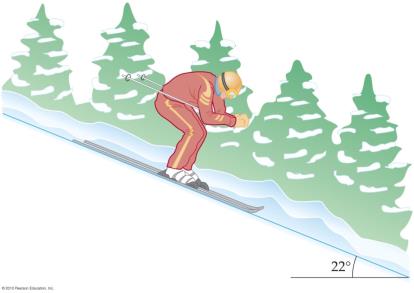
Q4. A 66-kg skier speeds down a trail as shown in the Figure. The surface is smooth and inclined at an angle of 22° with the horizontal. Pick a coordinate system, draw a free-body diagram and sketch the components of all of the forces acting on the skier.
Background
Topic: Newton's Laws and Free-Body Diagrams
This question tests your understanding of forces acting on an object on an inclined plane, including gravity, normal force, and friction (though friction is neglected here).
Key Terms and Formulas
Free-body diagram: A diagram showing all forces acting on an object.
Gravity: Acts vertically downward, .
Normal force: Acts perpendicular to the surface.
Inclined plane: The angle of inclination affects the direction and magnitude of force components.
Step-by-Step Guidance
Choose a coordinate system: Typically, align the x-axis parallel to the incline and the y-axis perpendicular to the incline.
Draw the skier as a dot or box at the center of your diagram.
Draw the force of gravity () acting straight downward. where and .
Draw the normal force () acting perpendicular to the surface of the incline, away from the skier.
Resolve the gravitational force into two components: one parallel to the incline () and one perpendicular to the incline (). Use the angle :
Try solving on your own before revealing the answer!
Final Answer:
The free-body diagram should show three forces: gravity (downward), normal force (perpendicular to the slope), and the resolved components of gravity (parallel and perpendicular to the slope). The parallel component causes the skier to accelerate down the slope, while the normal force balances the perpendicular component.
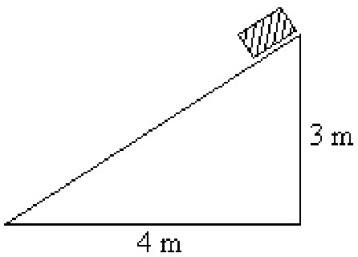
Q18. An object of mass 3.4 kg is held at the top of a triangular wedge as shown, and then released. The reference level for potential energy is at the base of the triangle. Neglect friction. What is the gravitational potential energy of the object at the top of the wedge?
Background
Topic: Gravitational Potential Energy
This question tests your ability to calculate gravitational potential energy using mass, height, and the acceleration due to gravity.
Key Terms and Formulas
Gravitational potential energy (): The energy an object has due to its position above a reference level.
Formula:
= mass (in kg)
= acceleration due to gravity ()
= height above reference level (in m)
Step-by-Step Guidance
Identify the mass of the object: .
Determine the height above the reference level: (from the diagram).
Recall the value for : .
Set up the formula for gravitational potential energy: .
Try solving on your own before revealing the answer!
Final Answer:
The gravitational potential energy is calculated using the mass, height, and gravitational acceleration. The answer is approximately 100 J.
