 Back
BackPhysics 1302W Quiz 1 Study Guidance: Electric Forces, Fields, and Charge Distributions
Study Guide - Smart Notes
 Tailored notes based on your materials, expanded with key definitions, examples, and context.
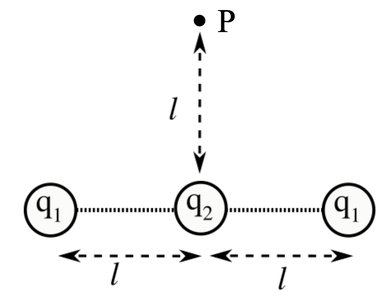
Q1. What is the acceleration of the q1 charge on the right just after the string is cut?
Background
Topic: Electric Forces and Newton's Second Law
This question tests your understanding of Coulomb's Law and how to apply Newton's Second Law to find the acceleration of a charged object when the forces acting on it change.
Key Terms and Formulas:
Coulomb's Law:
Newton's Second Law:
Acceleration:
Where N·m2/C2, is mass, and are charges, is distance.
Step-by-Step Guidance
Draw a free-body diagram for the rightmost charge immediately after the string is cut. Identify all forces acting on it (primarily the electric force from the central charge).
Write the expression for the electric force between (right) and using Coulomb's Law: , where is the distance between the charges.
Determine the direction of the force based on the sign of the charges ( is positive, is negative, so the force is attractive).
Set up Newton's Second Law for the charge: , substituting the expression for from step 2.
Try solving on your own before revealing the answer!
Final Answer:
Plugging in the values: N·m2/C2, C, C, kg, m.
The acceleration is calculated using the formula above, and the direction is toward the central charge due to attraction.
Q2. What is the magnitude of the electric field at point P, located 3 meters above the center charge q2?
Background
Topic: Electric Field of Point Charges
This question tests your ability to calculate the electric field at a point due to multiple point charges using the principle of superposition.
Key Terms and Formulas:
Electric field of a point charge:
Superposition principle: The net electric field is the vector sum of fields from all charges.
Distance from each charge to point P: Use the Pythagorean theorem for the charges at the ends.
Step-by-Step Guidance
Calculate the distance from each charge to point P. For the central charge , the distance is . For each at the ends, use .
Write the expression for the electric field at P due to each charge, considering their positions and signs.
Sum the contributions from all three charges, taking care to add vector components correctly (vertical direction).
Set up the total electric field expression, but do not compute the final value yet.
Try solving on your own before revealing the answer!
Final Answer:
The net electric field at point P is:
Plug in the values for , , , and to find the numerical result.
Q3. Write an expression for the linear charge density λ of the rod in terms of q and L, and calculate its numerical value.
Background
Topic: Charge Distribution
This question tests your understanding of linear charge density and how to relate total charge to the length of a uniformly charged rod.
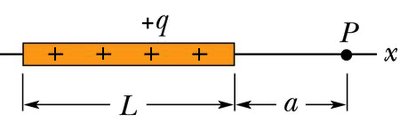
Key Terms and Formulas:
Linear charge density:
Where is total charge, is length of the rod.
Step-by-Step Guidance
Write the formula for linear charge density: .
Substitute the given values: C, m.
Set up the calculation for , but do not compute the final value yet.
Try solving on your own before revealing the answer!
Final Answer:
C/m
Calculate this value to find the linear charge density in C/m.
Q4. What is the magnitude of the electric field produced at point P by the rod, at distance a = 12 cm? (Start from the integral definition and solve the integral.)
Background
Topic: Electric Field of a Continuous Charge Distribution
This question tests your ability to use calculus to find the electric field from a uniformly charged rod at a point along its axis.
Key Terms and Formulas:
Electric field from a line of charge:
Linear charge density:
Set up and for each element of the rod.
Step-by-Step Guidance
Express in terms of : .
Set up the integral for the electric field at point P: .
Use the provided integral hint to solve: .
Write the symbolic result for after evaluating the integral, but do not plug in numbers yet.
Try solving on your own before revealing the answer!
Final Answer:
Plug in the values for , , , and to find the numerical result.
Q5. When point P is very far from the rod (a ≫ L), how does your symbolic answer for the electric field simplify? Explain why this makes physical sense.
Background
Topic: Far-Field Approximation for Charge Distributions
This question tests your understanding of how the electric field from a distributed charge simplifies at large distances, resembling a point charge.
Key Terms and Formulas:
Far-field approximation:
Electric field of a point charge:
Step-by-Step Guidance
Start with the symbolic result from Q4: .
For , expand as (using Taylor expansion).
Show that the difference simplifies to , where .
Explain in one sentence why this result makes sense: At large distances, the rod behaves like a point charge.
Try solving on your own before revealing the answer!
Final Answer:
This matches the electric field of a point charge, because at large distances, the spatial extent of the rod becomes negligible.
Q6. Multiple Choice: Two point charges exert a repulsive force F at distance r. If one charge is tripled, the other doubled, and the distance is increased to 3r, what is the new force in terms of F?
Background
Topic: Coulomb's Law and Scaling
This question tests your ability to analyze how changes in charge and distance affect the force between two point charges.
Key Terms and Formulas:
Coulomb's Law:
Step-by-Step Guidance
Write the original force: .
Write the new force with , , .
Set up the ratio and simplify, but do not select the final answer yet.
Try solving on your own before revealing the answer!
Final Answer:
The new force is scaled by the product of the charge changes and the square of the distance change.
Q7. Multiple Choice: What is the magnitude of the electric field at the center of a hollow metal sphere with charge Q?
Background
Topic: Electric Field Inside Conductors
This question tests your understanding of Gauss's Law and the properties of conductors.
Key Terms and Formulas:
Gauss's Law:
Electric field inside a conductor is zero.
Step-by-Step Guidance
Consider a Gaussian surface inside the sphere. The enclosed charge is zero.
Apply Gauss's Law to show that the electric field at the center is zero.
Try solving on your own before revealing the answer!
Final Answer:
The electric field at the center is zero.
This is because the charge resides on the surface, and the field inside is canceled out.
Q8. Multiple Choice: Three infinite sheets with surface charge densities σ1, σ2, σ3 are arranged as shown. What is the y-component of the net electric field at point P?
Background
Topic: Electric Field of Charged Planes
This question tests your ability to use the principle of superposition and the formula for the electric field near a charged plane.
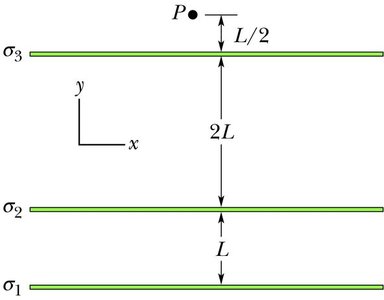
Key Terms and Formulas:
Electric field just outside a charged plane:
Superposition: Add fields from each sheet.
Step-by-Step Guidance
Determine the direction of the field from each sheet at point P.
Write the expression for the net field as the sum of contributions from all sheets.
Simplify the expression in terms of , , , and .
Try solving on your own before revealing the answer!
Final Answer:
The net field is the sum of the fields from each sheet, divided by .
Q9. Multiple Choice: In a spatially-uniform electric field, an electric dipole can feel...
Background
Topic: Electric Dipoles in Uniform Fields
This question tests your understanding of the forces and torques experienced by dipoles in electric fields.
Key Terms and Formulas:
Torque on a dipole:
Net force on a dipole in uniform field is zero.
Step-by-Step Guidance
Recall that a uniform field exerts equal and opposite forces on the dipole's charges.
Show that the net force cancels, but a torque can align the dipole with the field.
Try solving on your own before revealing the answer!
Final Answer:
An electric dipole in a uniform field feels a net torque but no net force.
The forces cancel, but the dipole rotates to align with the field.
Q10. Multiple Choice: A hollow, spherical conducting shell carries +5 C. A point charge of −3 C is placed at the center. What is the net charge on the inner surface?
Background
Topic: Conductors and Induced Charge
This question tests your understanding of how conductors respond to internal charges and the concept of induced charge.
Key Terms and Formulas:
Induced charge: The inner surface must have charge equal and opposite to the central charge.
Total charge is distributed between inner and outer surfaces.
Step-by-Step Guidance
The inner surface must have charge C to neutralize the C at the center.
The remaining charge resides on the outer surface.
Try solving on your own before revealing the answer!
Final Answer:
The net charge on the inner surface is C.
This ensures the electric field inside the shell is zero, as required by electrostatics.
