 Back
BackPhysics 1302W Quiz #2 Study Guidance: Electric Fields, Potential, Capacitance, and Circuits
Study Guide - Smart Notes
 Tailored notes based on your materials, expanded with key definitions, examples, and context.
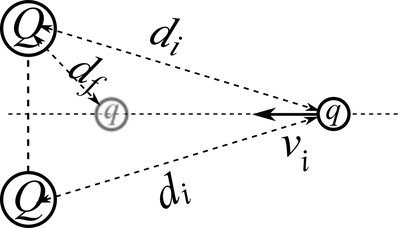
Q1. (A) What is the electric potential due to both of these point charges at the initial location of the proton (when it is a distance away from both point charges)?
Background
Topic: Electric Potential from Point Charges
This question tests your understanding of how to calculate the electric potential at a point due to multiple point charges, using the principle of superposition.
Key formula:
Where:
= electric potential at a point
= Coulomb's constant ( N·m/C)
= charge creating the potential
= distance from the charge to the point
Step-by-Step Guidance
Recognize that the proton is equidistant from both point charges, so the potential at its location is the sum of the potentials from each charge.
Write the expression for the potential due to one charge at distance : .
Since both charges are identical and at the same distance, the total potential is .
Plug in the values for , , and (but do not calculate the final value yet).
Try solving on your own before revealing the answer!
Final Answer: V
This is the sum of the potentials from both charges at the proton's initial location.
Q1. (B) At what distance, , from either of these point charges will the proton momentarily come to rest?
Background
Topic: Conservation of Energy in Electric Fields
This part tests your ability to use energy conservation to relate changes in electric potential energy and kinetic energy for a moving charge.
Key formulas:
(energy conservation)
(electric potential energy)
(kinetic energy)
Step-by-Step Guidance
Set up the energy conservation equation: initial kinetic energy plus initial potential energy equals final kinetic energy plus final potential energy.
At the point where the proton comes to rest, its final kinetic energy is zero.
Write the equation: .
Express in terms of using the formula for the potential from both charges: .
Try solving on your own before revealing the answer!
Final Answer: m
Solving the energy equation for gives the distance where the proton stops.
Q1. (C) After the proton reaches this point, it accelerates away from these point charges. Determine the proton’s speed when it is far () from these point charges.
Background
Topic: Conservation of Energy and Electric Potential
This part tests your understanding of how a charge's kinetic energy changes as it moves in an electric field, using energy conservation.
Key formulas:
Step-by-Step Guidance
Set up the energy conservation equation between the point where the proton is at rest () and at infinity.
At infinity, the electric potential is zero, so the potential energy is zero.
Write: .
Express in terms of as before, and solve for (but do not calculate the final value yet).
Try solving on your own before revealing the answer!
Final Answer: m/s
The proton regains its initial speed as it moves infinitely far from the charges, due to energy conservation.
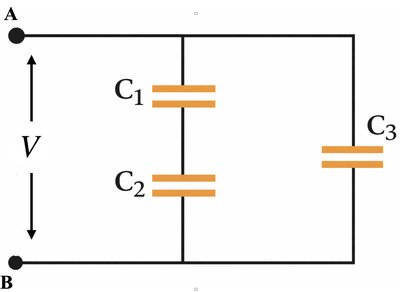
Q2. (A) Find the equivalent capacitance of the circuit between terminals A and B. Express your final answer entirely in terms of , , and .
Background
Topic: Equivalent Capacitance in Series and Parallel Circuits
This question tests your ability to analyze a circuit with capacitors in both series and parallel arrangements.
Key formulas:
For capacitors in parallel:
For capacitors in series:
Step-by-Step Guidance
Identify which capacitors are in parallel and which are in series based on the circuit diagram.
Combine and in parallel: .
Combine and in series: .
Write the final expression for in terms of , , and (but do not simplify or calculate the value yet).
Try solving on your own before revealing the answer!
Final Answer:
This is the equivalent capacitance for the given circuit.
Q2. (B) Suppose the voltage source is 12.0 V and the capacitors have the following values: F, F, F. Find numerical values for the charge on each capacitor (, , ), and the voltage across ().
Background
Topic: Capacitor Charge and Voltage in Circuits
This question tests your ability to apply circuit analysis to find the charge and voltage on individual capacitors.
Key formulas:
(charge stored on a capacitor)
Use the equivalent capacitance and voltage division rules for series and parallel capacitors.
Step-by-Step Guidance
Calculate the equivalent capacitance using the values provided.
Find the total charge supplied by the voltage source: .
Determine the voltage across the parallel combination ( and ) and across using series voltage division.
Calculate the charge on each capacitor using (but do not compute the final values yet).
Try solving on your own before revealing the answer!
Final Answer: C, C, C, V
These are the charges and voltage for each capacitor based on the circuit analysis.
Q2. (C) The 12.0 V voltage source remains connected, and you then insert a dielectric material with a dielectric constant completely filling the space between the plates of . What are the new charges on the capacitors, , , ?
Background
Topic: Dielectrics and Capacitance
This question tests your understanding of how inserting a dielectric affects capacitance and the resulting charge distribution in a circuit.
Key formulas:
(capacitance with dielectric)
Step-by-Step Guidance
Calculate the new capacitance for : .
Recalculate the equivalent capacitance for the circuit with the new .
Find the new total charge supplied by the voltage source: .
Determine the new voltage across each capacitor and calculate the new charges (but do not compute the final values yet).
Try solving on your own before revealing the answer!
Final Answer: C, C, C
The charges increase due to the higher capacitance of with the dielectric.
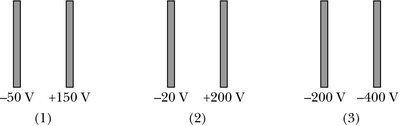
MC1. Rank the pairs according to the magnitude of the electric field between the plates, greatest first.
Background
Topic: Electric Field Between Parallel Plates
This question tests your ability to relate electric field strength to the potential difference and plate separation.
Key formula:
Step-by-Step Guidance
For each pair, calculate the potential difference between the plates.
Assume the plate separation is the same for all pairs, so the electric field depends only on .
Compare the values for each pair to rank the electric fields.
Try solving on your own before revealing the answer!
Final Answer: (A) 3, then 1, then 2
Pair 3 has the largest potential difference, so the largest electric field.
