 Back
BackPhysics 195 Final Exam Practice – Step-by-Step Guidance with Relevant Diagrams
Study Guide - Smart Notes
 Tailored notes based on your materials, expanded with key definitions, examples, and context.
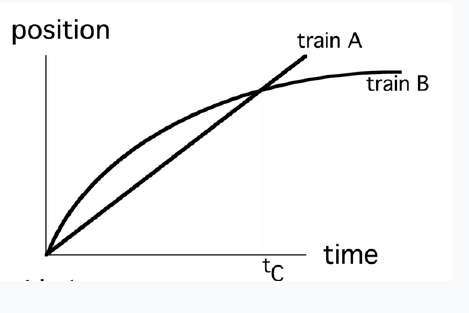
Q4. The graph shows positions as a function of time for two trains running on parallel tracks. When are the trains moving at the same speed?
Background
Topic: Kinematics – Position vs. Time Graphs
This question tests your understanding of how to interpret position vs. time graphs and determine when two objects have the same speed by analyzing the slopes of their position-time curves.
Key Terms and Concepts:
Position vs. Time Graph: The slope of the curve at any point gives the instantaneous velocity (speed and direction) of the object.
Speed: The magnitude of velocity; on a position-time graph, it is the absolute value of the slope.
Instantaneous Velocity: The derivative (slope) of the position with respect to time at a specific instant.
Step-by-Step Guidance
Examine the position vs. time graph for both trains. Notice that the slope of each curve at any point represents the velocity of that train at that moment.
To find when the trains are moving at the same speed, look for the point(s) where the slopes of the two curves are equal. This means the tangent lines to both curves at that time have the same steepness (regardless of direction).
On the graph, visually identify where the curves have parallel tangents. This is often where the curves cross or where their slopes match.
Mathematically, if you have the equations for the curves, you would set their derivatives (slopes) equal to each other and solve for time. Here, use the graph to estimate the time when the slopes are equal.
Try solving on your own before revealing the answer!
Final Answer: At time , the slopes of the position-time curves for both trains are equal, so they are moving at the same speed.
This is the point where the tangent lines to both curves are parallel, indicating equal instantaneous velocities.
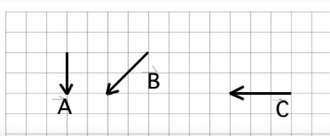
Q11. Three vectors \( \vec{A} \), \( \vec{B} \), \( \vec{C} \) are shown. What is the resultant vector of \( \vec{A} - \vec{B} + \vec{C} \)?
Background
Topic: Vector Addition and Subtraction
This question tests your ability to add and subtract vectors graphically and/or analytically, using their directions and magnitudes.
Key Terms and Formulas:
Vector Addition: Combine vectors tip-to-tail or by components.
Vector Subtraction: Subtracting a vector is the same as adding its negative (reverse direction).
Resultant Vector: The single vector that has the same effect as the original vectors combined.
Step-by-Step Guidance
Draw or visualize the vectors \( \vec{A} \), \( \vec{B} \), and \( \vec{C} \) on the grid as shown in the image.
To compute \( \vec{A} - \vec{B} + \vec{C} \), first reverse the direction of \( \vec{B} \) to get \( -\vec{B} \).
Add \( \vec{A} \) and \( -\vec{B} \) graphically (tip-to-tail method or by components).
Then, add \( \vec{C} \) to the result from the previous step, again using the tip-to-tail method or by adding components.
Try solving on your own before revealing the answer!
Final Answer: The resultant vector points left and slightly downward, starting from the tail of \( \vec{A} \) and ending at the tip after performing the operations.
By following the vector operations, you combine the vectors as described to find the resultant.
