 Back
BackPhysics 1C: Magnetic Forces, Induction, and Circuits – Visual Study Guide
Study Guide - Smart Notes
 Tailored notes based on your materials, expanded with key definitions, examples, and context.
Q1. An electron at point A has a speed . Find the magnitude of the magnetic field that will cause the electron to follow the semicircular path from A to B (radius ).
Background
Topic: Motion of charged particles in magnetic fields
This question tests your understanding of how a magnetic field can exert a force on a moving charge, causing it to move in a circular (or semicircular) path. The force responsible is the magnetic Lorentz force, which acts as a centripetal force for the electron's motion.
Key Terms and Formulas
Magnetic force: (when )
Centripetal force:
Equating forces:
Solving for :
Electron mass:
Electron charge:
Radius:
Step-by-Step Guidance
Identify the forces acting on the electron: The magnetic force provides the centripetal force needed for circular motion.
Write the equation for the magnetic force and set it equal to the centripetal force:
Rearrange the equation to solve for :
Substitute the known values for , , , and into the equation. Be sure to use SI units for all quantities.
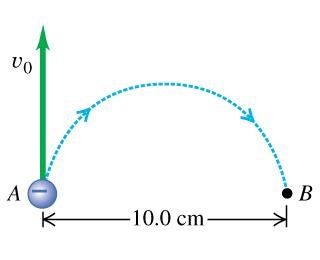
Try solving on your own before revealing the answer!
Final Answer:
Plugging in the values: gives the required magnetic field.
This field will cause the electron to follow the specified semicircular path.
Q2. Find the magnitude of the drift velocity of electrons in the x-direction for a silver ribbon carrying a current of 130 A, with , , .
Background
Topic: Current, drift velocity, and the Hall effect
This question examines your understanding of how current relates to the motion of charge carriers (electrons) in a conductor, and how to calculate the drift velocity given the current and physical dimensions of the conductor.
Key Terms and Formulas
Current:
Drift velocity:
Area: (convert mm to m)
Elementary charge:
Step-by-Step Guidance
Convert and to meters: , .
Calculate the cross-sectional area .
Plug the values for , , , and into the drift velocity formula:
Check that all units are in SI before calculating.
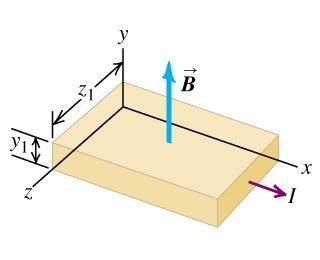
Try solving on your own before revealing the answer!
Final Answer:
Using the formula and plugging in the values gives the drift velocity of electrons in the ribbon.
Q3. Calculate the magnitude of the magnetic force on a voice coil in a loudspeaker with 60 turns, diameter 1.40 cm, current 0.960 A, and a magnetic field of 0.200 T at to the normal.
Background
Topic: Magnetic force on a current-carrying loop
This question tests your ability to calculate the force on a coil in a non-uniform magnetic field, considering the geometry and orientation of the coil.
Key Terms and Formulas
Magnetic force on a coil: (where is the diameter, is the number of turns, is the angle between and the normal to the coil)
For a circular coil, integrate over the circumference if needed
Convert diameter to meters:
Step-by-Step Guidance
Convert the diameter to meters if necessary.
Calculate since the field is from the normal (complementary angle).
Plug the values into the formula:
Be careful with the units and the trigonometric calculation.
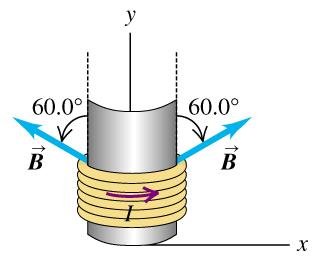
Try solving on your own before revealing the answer!
Final Answer:
Substituting all values gives the net force on the coil in the specified direction.
Q4. For a square loop of wire in the -plane with current and a non-uniform magnetic field , find the magnitude and direction of the magnetic force on each side of the loop.
Background
Topic: Magnetic force on current-carrying loops in non-uniform fields
This question tests your ability to use the differential form of the magnetic force and integrate along each segment of the loop, considering the spatial variation of the field.
Key Terms and Formulas
Differential force:
Integrate along each side, using the appropriate limits and directions for and
Step-by-Step Guidance
For each side, write and at that segment.
Compute the cross product for each side.
Integrate over the length of each side to find the total force.
Determine the direction of each force using the right-hand rule and vector analysis.
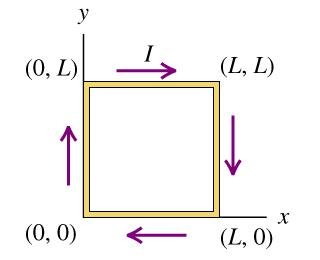
Try solving on your own before revealing the answer!
Final Answer: Side 1: in ; Side 2: in ; Side 3: in ; Side 4:
The net force is in the direction, as only side 2's force survives after cancellation.
