 Back
BackPhysics 2 Midterm Review: Electric Potential, Circuits, and Capacitance
Study Guide - Smart Notes
 Tailored notes based on your materials, expanded with key definitions, examples, and context.
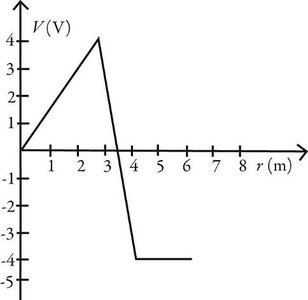
Q2. For which range or value of r is the magnitude of the electric field the largest?
Background
Topic: Relationship between Electric Potential and Electric Field
This question tests your understanding of how the electric field relates to the slope (rate of change) of the electric potential with respect to position. The electric field is strongest where the potential changes most rapidly with distance.
Key Terms and Formulas
Electric Potential (V): The electric potential energy per unit charge at a point in space.
Electric Field (E): The force per unit charge experienced by a test charge at a point in space.
Relationship:
The electric field is the negative gradient (slope) of the electric potential with respect to position.
Step-by-Step Guidance
Examine the graph and identify the regions where the potential V changes most rapidly with respect to r. The steepest slope (largest change in V per change in r) corresponds to the largest electric field magnitude.
Recall that the electric field points in the direction of decreasing potential, and its magnitude is proportional to the absolute value of the slope of the V vs. r graph.
Compare the slopes in each region (e.g., from r = 0 to 3 m, r = 3 to 4 m, r = 4 to 6 m, etc.). The region with the steepest slope (largest ) will have the largest electric field magnitude.
Be careful to consider both positive and negative slopes; the magnitude is what matters for this question.
Try solving on your own before revealing the answer!
Final Answer: B) from r = 3 m to r = 4 m
Between r = 3 m and r = 4 m, the graph shows the steepest drop in potential, indicating the largest magnitude of the electric field.
This is because , and the largest change in V over the smallest change in r gives the largest field.
Q1. A negative charge, if free, will tend to move...
Background
Topic: Electric Potential and Electric Field
This question tests your understanding of how charges move in electric fields and how their sign affects their motion relative to electric potential.
Key Terms and Formulas
Electric Field Direction: Defined as the direction a positive test charge would move.
Potential Difference: Charges move to lower potential energy. For negative charges, this means moving from low to high potential.
Step-by-Step Guidance
Recall that a negative charge experiences a force opposite to the direction of the electric field.
Think about how potential energy changes: negative charges move to regions of higher electric potential when free to move.
Review the definitions of electric field direction and potential difference for positive and negative charges.
Try solving on your own before revealing the answer!
Final Answer: B) from low potential to high potential
Negative charges move from low to high potential because they are attracted to higher potential regions, opposite to the direction of the electric field.
Q5. What is the potential difference, VA - VB, between points A and B for the given charge configuration?
Background
Topic: Electric Potential Due to Point Charges
This question tests your ability to calculate the potential difference between two points due to multiple point charges.
Key Terms and Formulas
Electric Potential from a Point Charge:
where , is the charge, and is the distance from the charge to the point.
Potential Difference:
Step-by-Step Guidance
Identify the positions of points A and B relative to the charges.
Calculate the potential at point A due to each charge using .
Calculate the potential at point B due to each charge in the same way.
Subtract the total potential at B from the total potential at A to find .
Try solving on your own before revealing the answer!
Final Answer: D) 96 kV
By calculating the potentials at A and B and taking their difference, you find the potential difference is 96,000 V (or 96 kV).
