 Back
BackPhysics 202 Exam 2 – Step-by-Step Study Guidance
Study Guide - Smart Notes
 Tailored notes based on your materials, expanded with key definitions, examples, and context.
Q1. Two point particles, one with charge +8 × 10⁻⁹ C and the other with charge -2 × 10⁻⁹ C, are separated by a distance of 4 m. (a) Calculate the magnitude of the electric field in N/C midway between them.
Background
Topic: Electric Fields from Point Charges
This question tests your understanding of how to calculate the electric field at a point between two charges using the principle of superposition.
Key formula:
= electric field (N/C)
= Coulomb's constant ( N·m2/C2)
= charge (C)
= distance from charge to point (m)
Step-by-Step Guidance
Identify the location midway between the charges. Since the total distance is 4 m, the midpoint is 2 m from each charge.
Calculate the electric field due to each charge at the midpoint using for each charge.
Add the fields together, considering their directions. The fields from each charge at the midpoint will both point away from the positive charge and toward the negative charge.
Set up the sum: , where each is calculated using the formula above.
Try solving on your own before revealing the answer!
Final Answer: 22.5 N/C
N/C
The electric field is the sum of the fields from both charges at the midpoint.
Q2. The dotted lines in the figure at right are equipotentials. What is the magnitude and direction of the electric field at point 1?
Background
Topic: Relationship Between Electric Field and Electric Potential
This question tests your ability to relate the electric field to the change in electric potential over a distance.
Key formula:
= change in electric potential (V)
= distance between equipotentials (m)
= electric field (V/m or N/C)
Step-by-Step Guidance
Determine the direction of the electric field: it points from higher to lower potential.
Find the potential difference between the equipotentials near point 1.
Measure the distance between these equipotentials.
Use to set up the calculation for the magnitude.
Try solving on your own before revealing the answer!
Final Answer: 2500 V/m downward
V/m$
The electric field points downward, from high to low potential.
Q3. A housefly walking across a clean surface can accumulate a significant positive or negative charge. In one experiment, the largest positive charge observed was +73 pC. A typical housefly has a mass of 12 mg. (b) Determine the magnitude of the electric field necessary to “levitate” a housefly of charge +73 pC.
Background
Topic: Electric Force and Levitation
This question tests your understanding of balancing electric and gravitational forces.
Key formula:
= charge of fly (C)
= mass of fly (kg)
= acceleration due to gravity (9.8 m/s2)
= electric field (N/C)
Step-by-Step Guidance
Convert the mass of the fly from mg to kg: $12= 1.2 \times 10^{-5}$ kg.
Convert the charge from pC to C: $73= 73 \times 10^{-12}$ C.
Set up the force balance: upward electric force equals downward gravitational force.
Plug values into to set up the calculation.
Try solving on your own before revealing the answer!
Final Answer: N/C
N/C
This is the field required to levitate the fly.
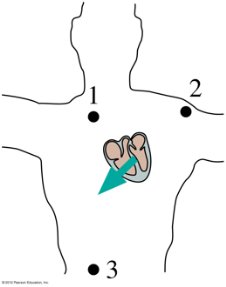
Q4. Imagine you connect a patient to an electrocardiogram (ECG) machine by placing the positive (“+”) and negative (“-”) terminals of the ECG’s voltmeter in the positions shown in the figure. When the heart’s electric dipole moment points in the direction indicated by the arrow, will the measured potential difference be positive, negative, or zero? Explain your reasoning.
Background
Topic: Electric Dipole and Potential Measurement
This question tests your understanding of how electric dipoles affect potential measurements in biological systems.
Key terms:
Electric dipole moment: a vector pointing from negative to positive charge.
Potential difference: the voltage measured between two points.
Step-by-Step Guidance
Recall that the dipole moment points from low to high potential.
Identify which terminal is at a higher potential based on the dipole direction.
Understand that the voltmeter shows how many volts the positive terminal is above or below the negative terminal.
Set up your reasoning for whether the reading is positive, negative, or zero.
Try solving on your own before revealing the answer!
Final Answer: Positive
The voltmeter will show a positive number because the positive terminal is at a higher potential than the negative terminal.
Q5. A particle of mass kg and charge C moves from point A to point B. It starts from rest at point A. The electric potential at point A is 800 V and at point B it is 200 V. Find the speed of the particle when it reaches point B.
Background
Topic: Conservation of Energy in Electric Fields
This question tests your ability to use energy conservation to relate electric potential energy and kinetic energy.
Key formula:
= mass (kg)
= charge (C)
, = initial and final potentials (V)
= final speed (m/s)
Step-by-Step Guidance
Identify the initial and final potentials: V, V.
Calculate the change in potential: .
Plug the values for , , and into the formula for .
Set up the square root expression for the speed.
Try solving on your own before revealing the answer!
Final Answer: 5.5 m/s
m/s
The particle gains kinetic energy as it moves to a lower potential.
Q6. The graph at right shows the electric potential in a region as a function of position x. Sketch a graph of the corresponding electric field as a function of position x.
Background
Topic: Relationship Between Electric Field and Potential
This question tests your ability to relate the electric field to the spatial derivative of electric potential.
Key formula:
= electric field as a function of position (V/m)
= electric potential as a function of position (V)
Step-by-Step Guidance
Examine the slope of the potential graph at each region: where the slope is steep, the electric field is strong.
Remember that the electric field is the negative of the slope: if potential increases with x, field points in the negative x direction.
Sketch the electric field graph, noting regions where the slope changes.
Label axes and indicate direction of the field.
Try solving on your own before revealing the answer!
Final Answer: Electric field graph is the negative slope of the potential graph
Where the potential graph is flat, the field is zero; where the slope is negative, the field is positive, and vice versa.
Q7. The figure at right shows a circuit made of four identical light bulbs (A-D), an ideal battery, and a switch. (a) Rank bulbs A-D from brightest to dimmest while the switch is open. (b) Rank bulbs A-D from brightest to dimmest after the switch closes.
Background
Topic: Series and Parallel Circuits
This question tests your understanding of how current divides in circuits and how brightness relates to current through each bulb.
Key terms:
Brightness: proportional to power dissipated ()
Series and parallel arrangements affect current distribution.
Step-by-Step Guidance
Analyze the circuit with the switch open: identify which bulbs are in series and which are in parallel.
Rank the bulbs based on current through each branch.
Repeat the analysis for the circuit with the switch closed.
Set up the ranking based on the circuit configuration.
Try solving on your own before revealing the answer!
Final Answer: (a) A > B = D > C; (b) A > B = C = D
Switching changes the current distribution, affecting brightness.
Q8. Consider the circuit shown at right. (a) What is the total resistance of the circuit? (b) What is the current through the battery?
Background
Topic: Series and Parallel Resistors
This question tests your ability to calculate equivalent resistance and use Ohm's law to find current.
Key formulas:
= equivalent resistance (Ω)
= battery voltage (V)
= current through battery (A)
Step-by-Step Guidance
Identify which resistors are in series and which are in parallel.
Calculate the parallel combination: .
Add the series resistors to the parallel equivalent.
Set up Ohm's law to find the current: .
Try solving on your own before revealing the answer!
Final Answer: , A
Using the formulas, the total resistance and current are found.
