 Back
BackPhysics 202 Study Guide: Circuits, Magnetism, and Electromagnetic Concepts
Study Guide - Smart Notes
 Tailored notes based on your materials, expanded with key definitions, examples, and context.
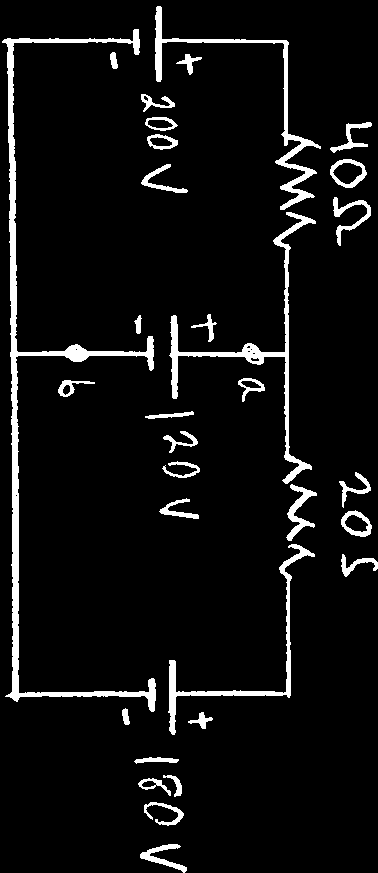
Q1. Consider the circuit shown in the sketch. What is the current through the 120 V emf?
Background
Topic: DC Circuits and Kirchhoff's Rules
This question tests your understanding of how to analyze a multi-loop circuit using Kirchhoff's rules to find the current through a specific battery.
Key Terms and Formulas
Kirchhoff's Junction Rule: $\sum I = 0$ (conservation of charge at a junction)
Kirchhoff's Loop Rule: $\sum V = 0$ (sum of potential differences around a closed loop is zero)
Ohm's Law: $V = IR$
Step-by-Step Guidance
Identify all the emf sources and resistors in the circuit. Note their values and arrangement.
Assign current directions in each branch of the circuit. Label them (e.g., $I_1$, $I_2$).
Write Kirchhoff's loop equations for each independent loop in the circuit, using the loop rule.
Write a junction equation if needed, relating the currents at a node.
Set up the system of equations to solve for the current through the 120 V battery.
Try solving on your own before revealing the answer!
Final Answer: 2.0 A, direction as shown in the circuit
By solving the system of equations using Kirchhoff's rules, the current through the 120 V battery is found to be 2.0 A in the direction indicated in the diagram.
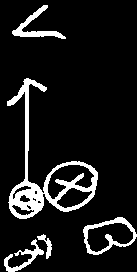
Q3. A small object with positive charge $q = 5.00 \times 10^{-6}$ C moves to the right with speed $v = 2.00 \times 10^3$ m/s. At the location of the charge, there is a magnetic field $B = 0.400$ T (into the page). What are the magnitude and direction of the force that the magnetic field exerts on the object?
Background
Topic: Magnetic Force on Moving Charges
This question tests your ability to calculate the magnetic force on a moving charged particle using the right-hand rule and the formula for magnetic force.
Key Terms and Formulas
Magnetic Force: $F = qvB\sin\theta$
Right-Hand Rule: Determines the direction of the force for positive charges.
Step-by-Step Guidance
Identify the values: $q = 5.00 \times 10^{-6}$ C, $v = 2.00 \times 10^3$ m/s, $B = 0.400$ T.
Determine the angle $\theta$ between velocity and magnetic field. Here, velocity is perpendicular to the field ($\theta = 90^\circ$).
Plug the values into the formula: $F = qvB\sin\theta$.
Use the right-hand rule to find the direction of the force (for positive charge).
Try solving on your own before revealing the answer!
Final Answer: 4.0 \times 10^{-3} N, toward the top of the page
The force is calculated using the formula and the right-hand rule, resulting in a magnitude of $4.0 \times 10^{-3}$ N directed upward.
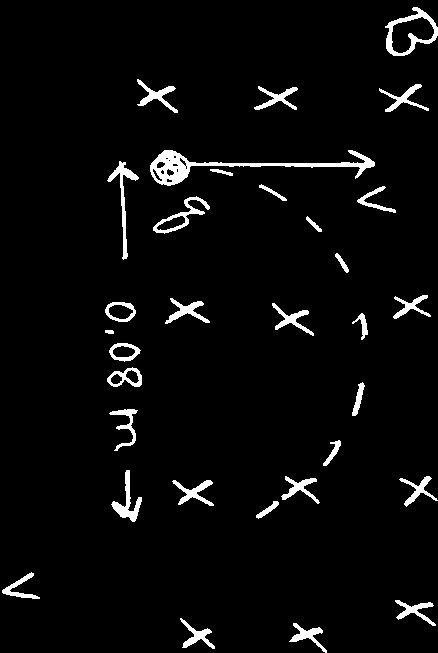
Q5. A small object with mass $8.00 \times 10^{-6}$ kg and charge $q$ enters a region of uniform magnetic field with magnitude $B = 0.400$ T and direction into the page. At it enters the field, the object is traveling with a velocity of $3.00 \times 10^3$ m/s toward the top of the page. The object travels along a semicircular path in the field and exits the field region at a distance of $0.0800$ m from where it entered. What are the sign and magnitude of the charge of the object?
Background
Topic: Motion of Charged Particles in Magnetic Fields
This question tests your understanding of how a charged particle moves in a magnetic field, specifically the relationship between radius, velocity, mass, and charge.
Key Terms and Formulas
Radius of Path: $r = \frac{mv}{|q|B}$
Direction: Use the right-hand rule to determine the sign of the charge based on the path.
Step-by-Step Guidance
Identify the values: $m = 8.00 \times 10^{-6}$ kg, $v = 3.00 \times 10^3$ m/s, $B = 0.400$ T, $r = 0.0800$ m.
Write the formula for the radius of the path: $r = \frac{mv}{|q|B}$.
Rearrange to solve for $|q|$: $|q| = \frac{mv}{rB}$.
Use the diagram and right-hand rule to determine the sign of the charge.
Try solving on your own before revealing the answer!
Final Answer: $+3.0 \times 10^{-6}$ C
The charge is positive, as determined by the right-hand rule and the direction of the semicircular path.
