 Back
BackPhysics 250: Motion, Forces, and Friction – Essential Formulas and Concepts
Study Guide - Smart Notes
 Tailored notes based on your materials, expanded with key definitions, examples, and context.
Fundamental Equations of Motion and Forces
Newton's Laws and Kinematics
Understanding motion and forces is central to classical mechanics. The following equations describe the relationships between displacement, velocity, acceleration, and force for objects in motion.
Newton's Second Law: The net force acting on an object equals its mass times its acceleration.
Average Velocity: Defined as the change in position over the change in time.
Instantaneous Velocity: The derivative of position with respect to time.
Average Acceleration: Change in velocity over change in time.
Instantaneous Acceleration: The derivative of velocity with respect to time.
Gravitational Acceleration: Near Earth's surface, .
Kinematic Equations for Constant Acceleration
These equations are used to solve problems involving linear motion with constant acceleration.
Friction: Static and Kinetic
Definitions and Formulas
Friction is the resistive force that opposes the relative motion of two surfaces in contact. It is classified as static (before motion starts) and kinetic (during motion).
Static Friction: The force that must be overcome to start moving an object. It satisfies .
Kinetic Friction: The force opposing motion once an object is sliding. It is given by .
Normal Force (): The perpendicular contact force exerted by a surface.
Coefficients of Friction (, ): Dimensionless numbers characterizing the interaction between surfaces.
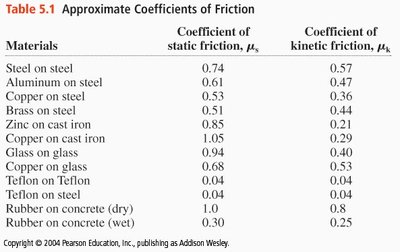
Table: Approximate Coefficients of Friction
The following table summarizes typical values for the coefficients of static and kinetic friction for various material pairs. These values are essential for solving problems involving frictional forces.
Materials | Coefficient of static friction, | Coefficient of kinetic friction, |
|---|---|---|
Steel on steel | 0.74 | 0.57 |
Aluminum on steel | 0.61 | 0.47 |
Copper on steel | 0.53 | 0.36 |
Brass on steel | 0.51 | 0.44 |
Zinc on cast iron | 0.85 | 0.21 |
Copper on cast iron | 1.05 | 0.29 |
Glass on glass | 0.94 | 0.40 |
Copper on glass | 0.68 | 0.53 |
Teflon on Teflon | 0.04 | 0.04 |
Teflon on steel | 0.04 | 0.35 |
Rubber on concrete (dry) | 1.0 | 0.8 |
Rubber on concrete (wet) | 0.6 | 0.25 |
Additional Formulas and Concepts
Volume Formulas
Volume calculations are important for determining mass and density in mechanics.
Sphere:
Cylinder:
Other Useful Equations
Weight:
Period and Frequency:
Centripetal Acceleration:
Tangential Acceleration:
Example: Friction in Everyday Life
When pushing a box across a floor, the force required to start moving the box is determined by the static friction coefficient. Once the box is sliding, the kinetic friction coefficient determines the force needed to keep it moving. For rubber on dry concrete, the static friction is high (), making it difficult to start motion, but the kinetic friction () is slightly lower, so less force is needed to maintain motion.
