 Back
BackPhysics 7A Midterm Study Guidance: Mechanics, Forces, and Motion
Study Guide - Smart Notes
 Tailored notes based on your materials, expanded with key definitions, examples, and context.
Q1a. What property would give a string uniform tension along its length? Show how tension is not constant when this property is not present.
Background
Topic: Tension in Strings
This question tests your understanding of how tension is distributed in a string, especially when supporting a mass, and what physical property ensures uniform tension.
Key Terms:
Tension: The pulling force transmitted along a string, rope, or cable when it is pulled tight by forces acting from opposite ends.
Massless String: An idealization where the string's mass is considered negligible compared to other masses in the system.
Step-by-Step Guidance
Consider a string fixed at one end with a mass hanging from the other. The tension at any point in the string is the force needed to support the weight below that point.
If the string has mass, the tension must also support the weight of the string below the point, so tension varies along the length.
If the string is massless, the only force to support is the hanging mass, so the tension is the same everywhere.
Think about how to express the tension at a point a distance from the mass for both a massless and a massive string.
Try solving on your own before revealing the answer!
Q1b. Why do you sometimes get very high friction between two smooth flat surfaces of the same material, e.g., aluminum on aluminum?
Background
Topic: Friction and Surface Interactions
This question explores the microscopic origins of friction, especially between similar materials, and why friction can be unexpectedly high even for smooth surfaces.
Key Terms:
Friction: The resistive force that occurs when two surfaces slide against each other.
Cold Welding: The phenomenon where clean, flat surfaces of the same metal can bond together at the atomic level.
Step-by-Step Guidance
Recall that friction is not only determined by surface roughness but also by the nature of the materials in contact.
When two very smooth, clean surfaces of the same metal touch, atoms from each surface can come into close contact.
This can lead to microscopic bonding (cold welding), increasing the force needed to slide the surfaces apart.
Think about how this effect is different from friction between rough or different materials.
Try solving on your own before revealing the answer!
Q1c. Is it correct to say that water is removed from clothes in a washing machine by centrifugal force? Explain why or why not.
Background
Topic: Centripetal and Centrifugal Forces
This question tests your understanding of rotating reference frames and the distinction between real and fictitious forces.
Key Terms:
Centripetal Force: The real force that keeps an object moving in a circle, directed toward the center of rotation.
Centrifugal Force: A fictitious force that appears to act outward on a mass when viewed from a rotating reference frame.
Step-by-Step Guidance
Consider the forces acting on water in the rotating drum of a washing machine.
In the inertial (lab) frame, water moves in a straight line due to inertia when the drum spins, escaping through holes.
In the rotating frame, a centrifugal force appears to push water outward, but this is not a real force—it's a result of the non-inertial frame.
Think about which explanation is more physically accurate and why.
Try solving on your own before revealing the answer!
Q2a. At what initial speed must a volcanic bomb be ejected at angle from point A to land at point B, a vertical distance below and horizontal distance away? (Ignore air resistance.)
Background
Topic: Projectile Motion
This question asks you to apply the equations of projectile motion to find the required initial speed for a projectile to reach a specific point.
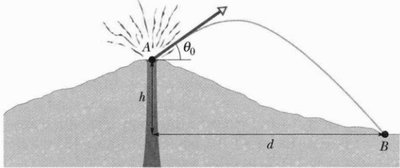
Key Formulas:
Horizontal displacement:
Vertical displacement:
Step-by-Step Guidance
Write the equations for horizontal and vertical displacement as functions of time .
Express in terms of , , and using the horizontal motion equation.
Substitute this expression for into the vertical motion equation to eliminate .
Rearrange the resulting equation to solve for the initial speed in terms of , , , and .
Try solving on your own before revealing the answer!
Q2b. What is the time of flight in terms of , , , and ?
Background
Topic: Projectile Motion
This part focuses on expressing the total time the projectile spends in the air using the given variables.
Key Formulas:
Horizontal displacement:
Vertical displacement:
Step-by-Step Guidance
From the horizontal motion equation, solve for in terms of , , and .
Use the vertical motion equation to relate to , , , and .
Combine the two equations to eliminate if possible, expressing only in terms of , , , and .
Set up the resulting equation for and consider how you would solve for algebraically.
Try solving on your own before revealing the answer!
Q3a. At what angular velocity is the centripetal acceleration equal to if the rider is a distance from the center?
Background
Topic: Circular Motion and Centripetal Acceleration
This question tests your ability to relate angular velocity to centripetal acceleration for an object moving in a circle.
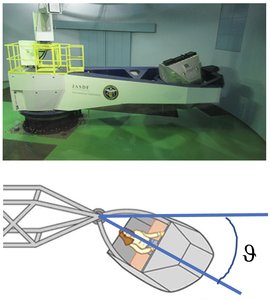
Key Formula:
Centripetal acceleration:
Step-by-Step Guidance
Recall the formula for centripetal acceleration in terms of angular velocity and radius.
Set the centripetal acceleration equal to and solve for .
Rearrange the equation to isolate in terms of and .
Try solving on your own before revealing the answer!
Q3b. At what angle below the horizontal will the cage hang when the centripetal acceleration is ?
Background
Topic: Non-inertial Reference Frames and Forces
This question explores the equilibrium of forces in a rotating frame, where the cage swings out due to the combination of gravity and the apparent outward force.
Key Concepts:
Forces acting: gravity (downward), normal/tension (along the cage), and the effective outward force due to rotation (centrifugal in rotating frame).
At equilibrium, the resultant force points along the direction of the cage.
Step-by-Step Guidance
Draw a free-body diagram showing the forces acting on the cage: gravitational force downward and the outward force due to rotation.
Set up the condition for equilibrium: the cage aligns with the net force vector.
Express the tangent of the angle in terms of the ratio of the outward acceleration to gravitational acceleration .
Write the equation and consider how to solve for .
Try solving on your own before revealing the answer!
Q4a. What is the acceleration of the box along the incline if there is no friction between the box and the incline, and the incline is fixed?
Background
Topic: Newton's Laws and Inclined Planes
This question asks you to analyze the forces on a box sliding down a frictionless incline that is itself fixed in place.
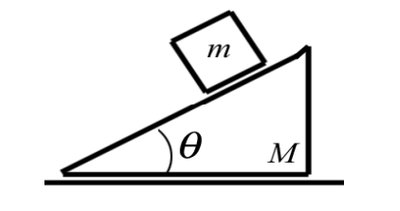
Key Formula:
Component of gravity along the incline:
Newton's second law:
Step-by-Step Guidance
Draw a free-body diagram for the box, identifying all forces acting on it.
Resolve the gravitational force into components parallel and perpendicular to the incline.
Write Newton's second law along the incline and solve for the acceleration .
Try solving on your own before revealing the answer!
Q4b. What is the acceleration of the box if there is no friction between the box and the incline or between the incline and the surface (the incline is free to move)? Give the acceleration as a vector in components.
Background
Topic: Conservation of Momentum and Relative Motion
This question involves analyzing the motion of two objects (box and incline) that can both move, requiring you to use conservation of momentum and Newton's laws.
Key Concepts:
Both the box and the incline can accelerate, so you must consider their motions together.
Use Newton's laws for each object and the constraint that the box moves along the incline.
Step-by-Step Guidance
Define coordinate axes: typically, is horizontal and is vertical.
Write Newton's second law for both the box and the incline, considering all forces.
Express the acceleration of the box relative to the incline and relate it to the acceleration of the incline.
Set up the equations to solve for the accelerations as vectors in terms of , , , and .
Try solving on your own before revealing the answer!
Q4c. What is the minimum coefficient of static friction between the incline and the table so the incline does not move?
Background
Topic: Static Friction and Equilibrium
This question tests your understanding of the conditions required to prevent motion due to frictional forces.
Key Formula:
Maximum static friction:
Sum of forces must be zero for equilibrium.
Step-by-Step Guidance
Identify the horizontal force exerted by the box on the incline.
Set the maximum static friction force equal to or greater than this horizontal force to prevent motion.
Express the minimum coefficient of static friction in terms of , , , and .
Try solving on your own before revealing the answer!
