 Back
BackPhysics 7B Final Exam Review – Step-by-Step Study Guidance
Study Guide - Smart Notes
 Tailored notes based on your materials, expanded with key definitions, examples, and context.
Q1. RC Discharge Through a Resistive Wire
Background
Topic: RC Circuits, Exponential Discharge, Energy Dissipation
This question tests your understanding of how a charged capacitor discharges through a resistor, including time constants, voltage decay, energy transfer, and thermal effects.
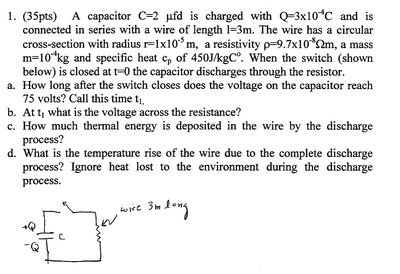
Key Terms and Formulas:
Resistance of wire:
Capacitor discharge: ,
Thermal energy:
Temperature rise:
Step-by-Step Guidance
Calculate the resistance of the wire using its geometry and material properties: , where is resistivity, is length, and is radius.
Write the equation for the voltage across the capacitor as it discharges: , where .
Set and solve for using the exponential decay formula. Rearrange to isolate .
For the voltage across the resistor at , use Kirchhoff's law: during discharge.
To find the thermal energy deposited, use energy conservation: .
Calculate the temperature rise: , where is mass and is specific heat.
Try solving on your own before revealing the answer!
Final Answer:
Resistance:
Time to reach 75 V:
Voltage across resistor at :
Thermal energy:
Temperature rise:
Each step uses the correct formula and reasoning for RC discharge and energy transfer.
Q2. Faraday’s Law and Capacitor Breakdown
Background
Topic: Faraday’s Law, Induced EMF, Capacitor Breakdown
This question tests your ability to apply Faraday’s law to a loop with a time-varying magnetic field and determine the breakdown condition for a capacitor.
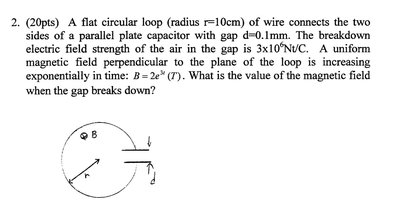
Key Terms and Formulas:
Magnetic flux:
Faraday’s law:
Breakdown field:
Step-by-Step Guidance
Express the magnetic flux through the loop: .
Find the rate of change of flux: , with .
Apply Faraday’s law to find the induced EMF: .
Set the induced EMF equal to the breakdown voltage across the gap: .
Solve for at the breakdown moment using the given values.
Try solving on your own before revealing the answer!
Final Answer:
Breakdown magnetic field:
This uses Faraday’s law and the breakdown condition for the capacitor gap.
Q3. Coaxial Cable: B Field and Magnetic Energy
Background
Topic: Ampère’s Law, Magnetic Fields in Cylindrical Geometry, Magnetic Energy
This question tests your understanding of magnetic fields in coaxial cables and how to compute the energy stored in the magnetic field.
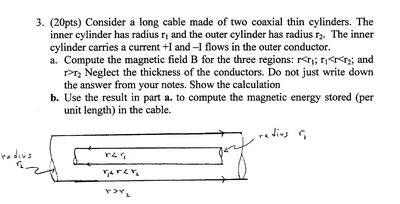
Key Terms and Formulas:
Ampère’s law:
Magnetic energy density:
Energy per unit length:
Step-by-Step Guidance
Apply Ampère’s law for each region: , , .
Determine the enclosed current for each region and solve for .
For , .
Write the expression for magnetic energy density and set up the integral for energy per unit length.
Integrate over the region to find .
Try solving on your own before revealing the answer!
Final Answer:
Magnetic field: for
Energy per unit length:
These results follow from Ampère’s law and integrating the energy density.
Q4. Force & Torque on a Current Loop
Background
Topic: Magnetic Forces and Torques, Non-uniform Magnetic Fields
This question tests your understanding of how a current loop interacts with a nearby current-carrying wire, including torque and net force calculations.
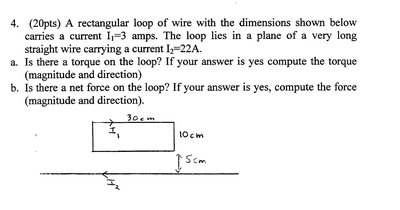
Key Terms and Formulas:
Torque:
Force:
Magnetic field from a long wire:
Step-by-Step Guidance
Determine the direction of from the long wire using the right-hand rule.
Calculate the magnetic dipole moment for the loop.
Check if and are parallel; if so, torque is zero.
For net force, analyze each segment of the loop and calculate the force using .
Sum the forces on the top and bottom sides, considering their distances from the wire.
Try solving on your own before revealing the answer!
Final Answer:
No torque () since and are parallel.
Net force: , directed downward.
Forces are calculated using the non-uniform field from the wire.
Q5. Steady-State Energy Stored in a Capacitor
Background
Topic: DC Circuits, Capacitor Energy, Voltage Divider
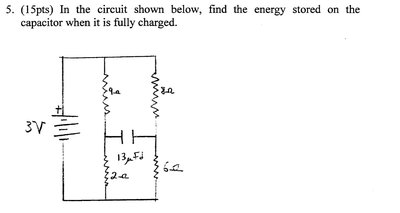
This question tests your ability to analyze a circuit at steady state and calculate the energy stored in a capacitor.
Key Terms and Formulas:
Energy stored:
Voltage divider principle
Step-by-Step Guidance
Recognize that the capacitor acts as an open circuit at steady state (DC).
Identify the two independent branches and calculate their total resistance.
Find the current in each branch using .
Calculate the voltage at each capacitor terminal using Ohm’s law.
Find the voltage across the capacitor and use it to compute the stored energy.
Try solving on your own before revealing the answer!
Final Answer:
Energy stored:
Voltage across capacitor is found using the voltage divider and branch analysis.
Q6. Heat Pump Cooling Cost
Background
Topic: Thermodynamics, Heat Transfer, Heat Pump Efficiency
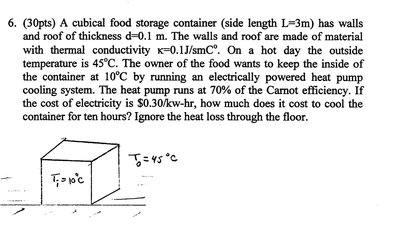
This question tests your ability to calculate heat transfer, heat pump performance, and energy cost for cooling.
Key Terms and Formulas:
Fourier’s law:
COP (Coefficient of Performance):
Electrical power:
Cost:
Step-by-Step Guidance
Calculate the total area for heat conduction (ignore the floor).
Apply Fourier’s law to find the heat leak rate .
Calculate the Carnot COP and adjust for 70% efficiency.
Find the electrical power required to remove the heat leak.
Compute the total energy used and the cost for ten hours.
Try solving on your own before revealing the answer!
Final Answer:
Heat leak rate:
COP:
Electrical power:
Cost for 10 hours:
Each step uses heat transfer and heat pump efficiency formulas.
Q7. Charge Released near a Cylinder + Spherical Shell
Background
Topic: Electrostatics, Gauss’s Law, Energy Conservation
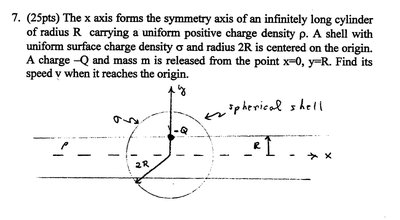
This question tests your understanding of electric fields inside cylinders and shells, and how to use energy conservation to find the speed of a released charge.
Key Terms and Formulas:
Shell theorem: inside
Electric field inside cylinder:
Potential difference:
Energy conservation:
Step-by-Step Guidance
Apply the shell theorem to show the spherical shell exerts no force inside.
Use Gauss’s law to find the electric field inside the cylinder.
Calculate the potential difference from to by integrating .
Set up energy conservation: initial potential energy converts to kinetic energy.
Solve for the speed at the origin using the derived potential difference.
Try solving on your own before revealing the answer!
Final Answer:
Speed at origin:
This result uses Gauss’s law, potential difference, and energy conservation.
