 Back
BackPhysics College Course Review: Kinematics, Dynamics, Energy, and Momentum
Study Guide - Smart Notes
 Tailored notes based on your materials, expanded with key definitions, examples, and context.
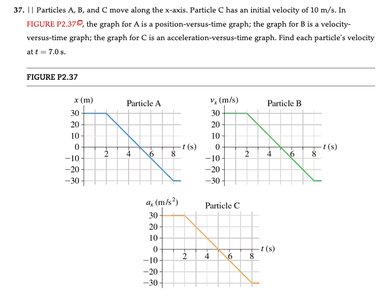
Q37. Particles A, B, and C move along the x-axis. Find each particle’s velocity at t = 7.0 s.
Background
Topic: Kinematics and Graphical Analysis
This question tests your ability to interpret position, velocity, and acceleration graphs to determine velocity at a specific time.
Key Terms and Formulas:
Velocity (): Rate of change of position, or slope of position-time graph.
Acceleration (): Rate of change of velocity, or slope of velocity-time graph.
Area under acceleration-time graph gives change in velocity.
For constant acceleration:
Step-by-Step Guidance
For Particle A: Examine the position-time graph. The slope of the line between t = 2 s and t = 8 s gives the velocity. Calculate the slope using .
For Particle B: Read the velocity directly from the velocity-time graph at t = 7.0 s.
For Particle C: Use the acceleration-time graph. Find the area under the curve from t = 0 to t = 7.0 s to determine the change in velocity, then add the initial velocity.
Break the area under the acceleration curve into sections (e.g., rectangles and triangles) for easier calculation.
Try solving on your own before revealing the answer!
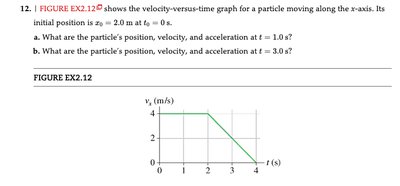
Q12. A particle moves along the x-axis. What are its position, velocity, and acceleration at t = 1.0 s and t = 3.0 s?
Background
Topic: Kinematics and Velocity-Time Graphs
This question tests your ability to use velocity-time graphs to find position, velocity, and acceleration at specific times.
Key Terms and Formulas:
Position (): Area under the velocity-time graph plus initial position.
Velocity (): Value from the graph at the given time.
Acceleration (): Slope of the velocity-time graph.
Step-by-Step Guidance
For t = 1.0 s: Find the area under the velocity-time graph from t = 0 to t = 1.0 s, then add the initial position.
Read the velocity at t = 1.0 s directly from the graph.
Determine the acceleration at t = 1.0 s by finding the slope of the graph in that interval.
Repeat the process for t = 3.0 s: Calculate the area under the graph from t = 0 to t = 3.0 s, read the velocity, and find the slope for acceleration.
Try solving on your own before revealing the answer!
Q50. A ball is thrown toward a cliff with a speed of 30 m/s at an angle of 60° above horizontal. It lands on the edge of the cliff 4.0 s later. a) How high is the cliff? b) What is the maximum height of the ball? c) What is the ball’s impact speed?
Background
Topic: Projectile Motion
This question tests your ability to analyze projectile motion using kinematic equations and vector decomposition.
Key Terms and Formulas:
Initial velocity components: ,
Vertical displacement:
Maximum height: at peak
Impact speed: Combine final and using Pythagorean theorem
Step-by-Step Guidance
Calculate the initial velocity components using the given speed and angle.
Use the vertical displacement equation to solve for the height of the cliff at t = 4.0 s.
Find the time when the ball reaches maximum height (when ), then use the vertical displacement equation to find the maximum height.
Determine the final velocity components at impact and combine them to find the impact speed.
Try solving on your own before revealing the answer!
Q57. A stunt man drives a 1500 kg car at a speed of 20 m/s off a 30-m-high cliff inclined upward at 20°. a) How far from the base of the cliff does the car land? b) What is the car’s impact speed?
Background
Topic: Projectile Motion and Energy
This question tests your ability to analyze projectile motion with an inclined launch and calculate impact speed using kinematics and energy principles.
Key Terms and Formulas:
Initial velocity components: ,
Time of flight: Use vertical displacement equation
Horizontal range:
Impact speed: Combine final and
Step-by-Step Guidance
Calculate the initial velocity components using the speed and incline angle.
Use the vertical displacement equation to solve for the time the car is airborne.
Calculate the horizontal distance traveled using the time of flight and horizontal velocity.
Find the final velocity components at impact and combine them to determine the impact speed.
Try solving on your own before revealing the answer!
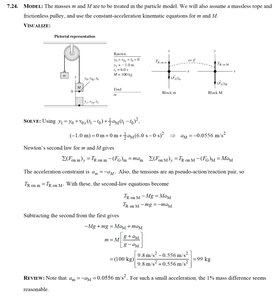
Q43. A 1000 kg elevator accelerates upward at 1.0 m/s² for 10 m, starting from rest. a) How much work does gravity do on the elevator? b) How much work does the tension in the elevator cable do? c) What is the elevator’s kinetic energy after traveling 10 m?
Background
Topic: Work, Energy, and Forces
This question tests your understanding of work done by forces, energy principles, and Newton’s second law.
Key Terms and Formulas:
Work by gravity:
Work by tension:
Newton’s second law:
Kinetic energy:
Step-by-Step Guidance
Calculate the work done by gravity using the elevator’s mass and displacement.
Find the tension in the cable using Newton’s second law, then calculate the work done by tension.
Use the work-energy principle to find the elevator’s kinetic energy after moving 10 m.
Set up the equations for each part, but stop before plugging in the final values.
Try solving on your own before revealing the answer!
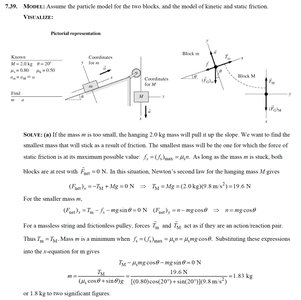
Q39. A block of mass m rests on a 20° slope, connected by a string to a hanging 2.0 kg mass. What is the minimum mass m that will stick and not slip? If it starts moving, what acceleration will it have?
Background
Topic: Forces, Friction, and Newton’s Laws
This question tests your ability to analyze static and kinetic friction, and apply Newton’s second law to a system with pulleys.
Key Terms and Formulas:
Static friction:
Kinetic friction:
Newton’s second law:
Force components along the slope: ,
Step-by-Step Guidance
Draw free-body diagrams for both blocks and identify all forces acting on each.
Write Newton’s second law equations for both blocks, considering friction and tension.
Set up the condition for static equilibrium to find the minimum mass m.
For the case where the block starts moving, use kinetic friction and solve for the acceleration using the combined equations.
Try solving on your own before revealing the answer!
