 Back
BackPhysics Equation Sheet and Moments of Inertia Reference
Study Guide - Smart Notes
 Tailored notes based on your materials, expanded with key definitions, examples, and context.
Physics Equation Sheet
Fundamental Constants and Geometry
Pi (\(\pi\)): \(\pi = 3.14\)
Circumference of a circle: \(C = 2\pi r\)
Area of a circle: \(A = \pi r^2\)
Surface area of a sphere: \(A = 4\pi r^2\)
1 revolution: \(1 \text{ rev} = 2\pi = 360^\circ\)
Acceleration due to gravity: \(g = 9.8\ \mathrm{m/s^2}\)
Universal gravitational constant: \(G = 6.67 \times 10^{-11}\ \mathrm{N\,m^2/kg^2}\)
Avogadro's number: \(N_A = 6.02 \times 10^{23}\)
Boltmann constant: \(k_B = 1.38 \times 10^{-23}\ \mathrm{J/K}\)
Kinematics
Quadratic formula: For \(0 = ax^2 + bx + c\), \(x = \frac{-b \pm \sqrt{b^2 - 4ac}}{2a}\)
Time interval: \(\Delta t = t - t_0\)
Average velocity: \(v_{x,\text{avg}} = \frac{\Delta x}{\Delta t} = \frac{x_f - x_0}{t_f - t_0}\)
Average acceleration: \(a_{x,\text{avg}} = \frac{\Delta v_x}{\Delta t} = \frac{v_{x,f} - v_{x,0}}{t_f - t_0}\)
Kinematic equations (constant acceleration):
\(v_x = v_{x,0} + a_x \Delta t\)
\(v_x^2 = v_{x,0}^2 + 2a_x(x - x_0)\)
\(x = x_0 + v_{x,0}\Delta t + \frac{1}{2}a_x(\Delta t)^2\)
\(v_{x,\text{avg}} = \frac{v_{x,0} + v_{x,f}}{2}\)
Range equation (projectile motion): \(x = \frac{v_0^2 \sin(2\theta)}{g}\)
Rotational Kinematics
Average angular velocity: \(\omega_{\text{avg}} = \frac{\Delta \theta}{\Delta t} = \frac{\theta_f - \theta_0}{t_f - t_0}\)
Average angular acceleration: \(\alpha_{\text{avg}} = \frac{\Delta \omega}{\Delta t} = \frac{\omega_f - \omega_0}{t_f - t_0}\)
Rotational kinematic equations (constant angular acceleration):
\(\omega = \omega_0 + \alpha \Delta t\)
\(\omega^2 = \omega_0^2 + 2\alpha(\theta - \theta_0)\)
\(\theta = \theta_0 + \omega_0 \Delta t + \frac{1}{2}\alpha (\Delta t)^2\)
\(\omega_{\text{avg}} = \frac{\omega_0 + \omega_f}{2}\)
Newtonian Mechanics
Newton's Second Law (linear): \(F_{\text{net},x} = ma_x\)
Newton's Second Law (vertical): \(F_{\text{net},y} = ma_y\)
Weight: \(F_g = mg\)
Universal law of gravitation: \(F_g = \frac{Gm_1m_2}{r^2}\)
Friction (static): \(f_s = \mu_s F_N\)
Friction (kinetic): \(f_k = \mu_k F_N\)
Centripetal acceleration: \(a_c = \frac{v^2}{r}\)
Speed in circular motion: \(v = \frac{2\pi r}{T}\)
Period and frequency: \(T = \frac{1}{f}\)
Work, Energy, and Power
Work: \(W = Fd \cos \theta\)
Change in energy: \(\Delta E = W_{\text{net}}\)
Kinetic energy (linear): \(K = \frac{1}{2}mv^2\)
Kinetic energy (rotational): \(K = \frac{1}{2}I\omega^2\)
Potential energy (gravitational): \(U = mgy\)
Potential energy (spring): \(U = \frac{1}{2}kx^2\)
Power (average): \(P_{\text{avg}} = \frac{W}{\Delta t}\)
Linear and Angular Momentum
Linear momentum: \(p_x = mv_x\)
Impulse: \(\Delta p_x = F_x \Delta t\)
Angular momentum: \(L = I\omega\)
Change in angular momentum: \(\Delta L = \tau \Delta t\)
Rotational Dynamics
Torque: \(\tau = I\alpha\)
Torque (force): \(\tau = rF \sin \theta = r_\perp F = rF_\perp\)
Oscillations and Waves
Simple harmonic motion (spring): \(F = -kx\)
Angular frequency: \(\omega = 2\pi f\)
Displacement: \(x = A \cos(\omega t)\)
Velocity: \(v_x = -\omega A \sin(\omega t)\)
Acceleration: \(a_x = -\omega^2 A \cos(\omega t)\)
Period (pendulum): \(T = 2\pi \sqrt{\frac{L}{g}}\)
Period (spring): \(T = 2\pi \sqrt{\frac{m}{k}}\)
Mechanical Waves
Wave equation: \(y = A \cos\left(2\pi \frac{t}{T} \pm 2\pi \frac{x}{\lambda}\right)\)
Wave speed: \(v = \lambda f\)
Speed on a string: \(v = \sqrt{\frac{F_T}{\mu}}\)
Fluids and Thermodynamics
Pressure: \(P = \frac{F}{A}\)
Continuity equation: \(Q = vA\)
Bernoulli's equation: \(P_1 + \frac{1}{2}\rho v_1^2 + \rho g y_1 = P_2 + \frac{1}{2}\rho v_2^2 + \rho g y_2\)
Ideal gas law: \(PV = nRT\)
Specific heat: \(Q = mc\Delta T\)
Latent heat: \(Q = mL\)
First law of thermodynamics: \(\Delta U_{int} = Q + W\)
Second law of thermodynamics (entropy): \(\Delta S = \frac{Q_{rev}}{T}\)
Electricity and Magnetism
Current density: \(J = \frac{I}{A}\)
Intensity (sound): \(I = \frac{P}{A}\)
Sound level (decibels): \(\beta = 10 \log_{10}\left(\frac{I}{I_0}\right)\)
Mathematical Tools
Right triangle relations: \(\sin \theta = \frac{a}{c}, \cos \theta = \frac{b}{c}, \tan \theta = \frac{a}{b}\)
Pythagorean theorem: \(a^2 + b^2 = c^2\)
Moments of Inertia for Common Objects
Reference Table: Moments of Inertia
The moment of inertia quantifies an object's resistance to changes in rotational motion about a specified axis. It depends on the mass distribution relative to the axis of rotation. Below is a summary table for common shapes:
Object | Location of Axis | Moment of Inertia |
|---|---|---|
Thin hoop, radius R | Through center | |
Thin hoop, radius R | Through central diameter | |
Solid cylinder, radius R | Through center | |
Hollow cylinder, inner radius , outer radius | Through center | |
Uniform sphere, radius R | Through center | |
Long uniform rod, length L | Through center | |
Long uniform rod, length L | Through end | |
Rectangular thin plate, length a, width b | Through center, axis perpendicular to plate |
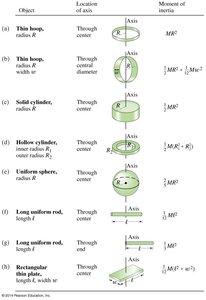
Application: Use these formulas to calculate rotational kinetic energy, angular acceleration, and analyze rotational dynamics problems.
Additional info: The table above is essential for solving problems in rotational motion, especially when applying Newton's second law for rotation (\(\tau = I\alpha\)) and calculating the energy of rotating bodies.
