 Back
BackPhysics Exam 1 Study Guide – Step-by-Step Guidance
Study Guide - Smart Notes
 Tailored notes based on your materials, expanded with key definitions, examples, and context.
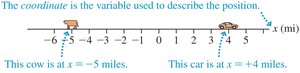
Q5. Mark and Sofia walk together down a long, straight road. They walk without stopping for 4 miles. At this point Sofia says their displacement during the trip must have been 4 miles; Mark says their current position must be 4 miles. Who, if either, is correct? Explain.
Background
Topic: Displacement vs. Position
This question tests your understanding of the difference between displacement and position in one-dimensional motion.
Key Terms:
Displacement: The change in position from the initial to the final point. It is a vector quantity and can be positive or negative.
Position: The location of an object relative to a chosen origin.
Step-by-Step Guidance
Consider the starting point: If they start at , their initial position is miles.
After walking 4 miles, their final position is miles (assuming they walk in the positive direction).
Displacement is calculated as .
Think about what each person is referring to: Sofia is talking about displacement, Mark is talking about position.
Try solving on your own before revealing the answer!
Final Answer:
Sofia is correct: their displacement is 4 miles, assuming they started at 0. Mark is also correct if their current position is 4 miles from the origin. Both statements are true, but they refer to different concepts.
Displacement is the change in position, while position is the location relative to the origin.
Q6. Give an example of a trip you might take in your car for which the distance traveled as measured on your car’s odometer is not equal to the displacement between your initial and final positions.
Background
Topic: Distance vs. Displacement
This question tests your ability to distinguish between the total distance traveled and the net displacement.
Key Terms:
Distance: The total length of the path traveled, regardless of direction.
Displacement: The straight-line change in position from start to finish.
Step-by-Step Guidance
Think about situations where you return to your starting point, or take a winding path.
Consider a round trip: You drive from home to a store and back home.
Distance is the sum of all segments traveled, while displacement is the straight-line distance from start to end.
Try to describe a scenario where these values are different.
Try solving on your own before revealing the answer!
Final Answer:
A round trip (e.g., driving to a store and back home) results in a distance traveled (as measured by the odometer) that is greater than the displacement (which is zero, since you end where you started).
Q7. Write a sentence or two describing the difference between speed and velocity. Give one example of each.
Background
Topic: Speed vs. Velocity
This question tests your understanding of scalar and vector quantities in motion.
Key Terms:
Speed: The rate at which an object moves, regardless of direction (scalar).
Velocity: The rate of change of position with a specified direction (vector).
Step-by-Step Guidance
Recall that speed is always positive and does not include direction.
Velocity can be positive or negative, depending on direction.
Think of examples: Speed—"A car travels at 60 mph." Velocity—"A car moves east at 60 mph."
Write a clear comparison and provide one example for each.
Try solving on your own before revealing the answer!
Final Answer:
Speed is the magnitude of how fast an object moves, while velocity includes both speed and direction. Example: Speed—"A runner moves at 5 m/s." Velocity—"A runner moves north at 5 m/s."
Q9. You are standing on a straight stretch of road and watching the motion of a bicycle; you choose your position as the origin. At one instant, the position of the bicycle is negative and its velocity is positive. Is the bicycle getting closer to you or farther away? Explain.
Background
Topic: Position and Velocity Signs
This question tests your understanding of how the signs of position and velocity relate to motion relative to an origin.
Key Terms:
Position: The location of the bicycle relative to the origin (can be negative).
Velocity: The rate and direction of motion (positive means moving in the positive direction).
Step-by-Step Guidance
If the bicycle's position is negative, it is located on the negative side of the origin.
A positive velocity means the bicycle is moving toward increasing position values (toward the origin and beyond).
Think about whether the bicycle is approaching or receding from the origin as it moves.
Use a number line to visualize the motion.
Try solving on your own before revealing the answer!
Final Answer:
The bicycle is getting closer to you. A negative position with positive velocity means it is moving toward the origin.
Q13. It takes Harry 3.5 s to walk from x = -12 m to x = -47 m. What is his velocity?
Background
Topic: Average Velocity Calculation
This question tests your ability to calculate average velocity using displacement and time.
Key Formula:
Step-by-Step Guidance
Identify the initial and final positions: m, m.
Calculate the displacement: .
Identify the time interval: s.
Set up the formula for average velocity: .
Try solving on your own before revealing the answer!
Final Answer:
m/s$
The negative sign indicates motion in the negative direction.
Q21. Compute the following numbers to three significant figures.
Background
Topic: Significant Figures and Scientific Calculations
This question tests your ability to perform calculations and round results to the correct number of significant figures.
Key Concepts:
Multiplication/division: Result should have the same number of significant figures as the value with the fewest significant figures.
Addition/subtraction: Result should have the same number of decimal places as the value with the fewest decimal places.
Square roots: The result should have the same number of significant figures as the input value.
Step-by-Step Guidance
For each calculation, identify the number of significant figures in the input values.
Perform the calculation (multiplication, subtraction, square root, division).
Round the result to three significant figures.
Check your rounding for each part (a–d).
Try solving on your own before revealing the answer!
Final Answer:
a. b. c. d.
Each result is rounded to three significant figures.
