 Back
BackPhysics Exam 2 Study Guidance: Circular Motion, Inclined Planes, Gravity, and Energy
Study Guide - Smart Notes
 Tailored notes based on your materials, expanded with key definitions, examples, and context.
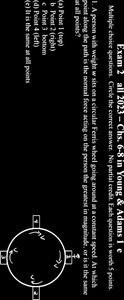
Q1. A woman with weight w sits on a circular Ferris wheel moving at a constant speed. At which point along the path is the normal force acting on the person (the force exerted by the seat) greatest in magnitude, or is it the same at all points?
Background
Topic: Circular Motion and Forces
This question tests your understanding of the forces acting on a person in circular motion, specifically the normal force at different points on a vertical circular path (like a Ferris wheel).
Key Terms and Formulas:
Normal Force (N): The force exerted by a surface (here, the seat) perpendicular to the object.
Weight (w): The gravitational force acting on the person, .
Centripetal Force: The net force required to keep an object moving in a circle, .
Step-by-Step Guidance
Identify the forces acting on the person at the top and bottom of the Ferris wheel: gravity (downward) and the normal force (perpendicular from the seat).
At the top of the circle, both gravity and the normal force point toward the center. At the bottom, gravity points away from the center, and the normal force points toward the center.
Write the equation for the net force toward the center (centripetal force) at the top and bottom:
Top:
Bottom:
Rearrange each equation to solve for the normal force at the top and bottom (but do not calculate yet):
Top:
Bottom:
Try solving on your own before revealing the answer!
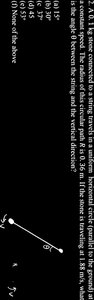
Q2. A horse connected to a plow travels in a uniform horizontal circle (radius 0.35 m) at 1.8 m/s. What is the angle θ between the plow rope and the vertical direction?
Background
Topic: Circular Motion and Forces
This question tests your ability to analyze forces in uniform circular motion, specifically the relationship between tension, gravity, and the angle of the rope.
Key Terms and Formulas:
Tension (T): The force in the rope.
Uniform Circular Motion: Motion in a circle at constant speed.
Centripetal Force:
Components of Tension: (vertical), (horizontal)
Step-by-Step Guidance
Draw a free-body diagram showing the forces acting on the horse: tension in the rope (at angle θ) and gravity (downward).
Resolve the tension into vertical and horizontal components.
Set up equations for vertical equilibrium () and for horizontal (centripetal) force ().
Divide the horizontal equation by the vertical equation to eliminate T and solve for :
Try solving on your own before revealing the answer!
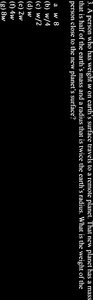
Q3. A person has mass m on Earth (surface gravity g). On a new planet, the person has the same mass, but the planet has twice the mass and twice the radius of Earth. What is the weight of the person on the new planet's surface?
Background
Topic: Universal Gravitation and Weight
This question tests your understanding of how gravitational force (weight) depends on the mass and radius of a planet.
Key Terms and Formulas:
Weight (W): The gravitational force on a mass at the surface, .
Gravitational Acceleration: , where G is the gravitational constant, M is the planet's mass, and R is its radius.
Step-by-Step Guidance
Recall that the weight of an object is , where depends on the planet.
Write the formula for gravitational acceleration on a planet: .
Substitute the new planet's mass () and radius () into the formula:
Simplify the expression to find in terms of .
Try solving on your own before revealing the answer!
