 Back
BackPhysics Exam #3 Practice Test – Fluid Mechanics & Thermodynamics Guidance
Study Guide - Smart Notes
 Tailored notes based on your materials, expanded with key definitions, examples, and context.
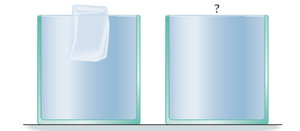
Q1. When ice melts, what happens to the water level in the cup?
Background
Topic: Buoyancy and Phase Change
This question tests your understanding of Archimedes' principle and the behavior of floating ice as it melts in water.
Key Terms and Formulas:
Archimedes' Principle: An object immersed in a fluid experiences an upward buoyant force equal to the weight of the fluid displaced.
Phase Change: Ice melting is a transition from solid to liquid.
Displacement: Floating ice displaces water equal to its weight.
Step-by-Step Guidance
Consider that ice floats because its density is less than water, so it displaces a volume of water equal to its weight.
When the ice melts, it turns into water and mixes with the liquid already in the cup.
Think about whether the volume of water produced by the melting ice is equal to the volume of water it displaced while floating.
Recall that the density of ice is less than that of water, so the ice occupies more volume than the water it becomes.
Try solving on your own before revealing the answer!
Final Answer: Water level remains the same
When ice melts, the water it produces exactly fills the space of the water it displaced while floating, so the water level does not change.
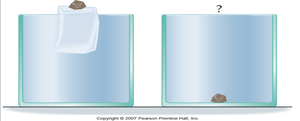
Q2. When ice melts, what happens to the water level in the cup (with a rock on the ice)?
Background
Topic: Buoyancy, Phase Change, and Added Mass
This question explores how the presence of a rock on the ice affects the water level after the ice melts.
Key Terms and Formulas:
Archimedes' Principle: The combined weight of the ice and rock determines the volume of water displaced.
Phase Change: Ice melts into water, and the rock sinks to the bottom.
Displacement: The rock displaces water based on its own volume when it sinks.
Step-by-Step Guidance
Initially, the ice and rock together displace water equal to their combined weight.
When the ice melts, the rock sinks to the bottom and displaces water equal to its own volume (not weight).
The melted ice becomes water and mixes with the rest of the water in the cup.
Compare the volume of water displaced by the rock when it sinks to the volume displaced by the rock and ice when floating.
Try solving on your own before revealing the answer!
Final Answer: Water level decreases
When the rock sinks, it displaces less water than when it was on the floating ice, so the water level drops.
