 Back
BackPhysics Exam Review: Oscillations, Waves, Sound, and Light
Study Guide - Smart Notes
 Tailored notes based on your materials, expanded with key definitions, examples, and context.
Q1. When the displacement of a mass on a spring is half the amplitude, what fraction of the mechanical energy is kinetic energy?
Background
Topic: Energy in Simple Harmonic Motion
This question tests your understanding of how mechanical energy is distributed between kinetic and potential energy for a mass-spring system in simple harmonic motion.
Key Terms and Formulas
Amplitude (): Maximum displacement from equilibrium.
Displacement (): Position of the mass relative to equilibrium.
Total mechanical energy ():
Kinetic energy ():
Potential energy ():
Step-by-Step Guidance
Recall that the total mechanical energy in a mass-spring system is constant and given by .
At displacement , calculate the potential energy: .
Simplify the expression for to relate it to the total energy .
Find the kinetic energy by subtracting from : .

Try solving on your own before revealing the answer!
Final Answer: 0.75
At , the kinetic energy is 75% of the total mechanical energy.
This is because the potential energy at this displacement is of the total energy, so the kinetic energy is .
Q2. At what displacement, as a fraction of amplitude , is the mechanical energy half kinetic and half potential?
Background
Topic: Energy Distribution in Simple Harmonic Motion
This question asks you to find the displacement where kinetic and potential energies are equal in a mass-spring system.
Key Terms and Formulas
Kinetic energy ():
Potential energy ():
Total mechanical energy ():
Step-by-Step Guidance
Set and use the expressions for kinetic and potential energy.
Write and .
Set and solve for in terms of .
Express as a fraction of .

Try solving on your own before revealing the answer!
Final Answer:
At this displacement, kinetic and potential energies are equal.
This is found by solving and expressing as a fraction of .
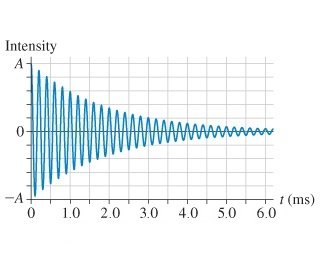
Q3. The common field cricket makes its characteristic chirping sound using a vibrating structure in its wings. The motion and sound intensity can be modeled as a damped oscillation. What is the frequency of oscillations?
Background
Topic: Damped Oscillations
This question tests your ability to analyze a damped oscillation and determine its frequency from a graph of intensity versus time.
Key Terms and Formulas
Damped oscillation: An oscillation where amplitude decreases over time due to energy loss.
Frequency (): Number of cycles per second.
Period (): Time for one cycle, .
Step-by-Step Guidance
Examine the graph and identify the time interval for a complete cycle.
Count the number of cycles within a given time span to estimate the period.
Calculate the frequency using .
Try solving on your own before revealing the answer!
Final Answer: 5.0 Hz
The frequency is determined by counting cycles and dividing by the time interval.
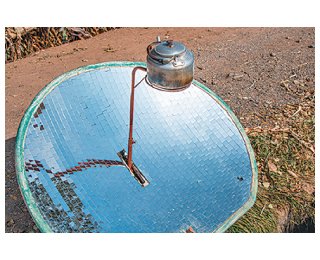
Q4. Using a dish-shaped mirror, a solar cooker concentrates the sun's energy onto a pot. Given the intensity of sunlight is about 1000 W/m2, how much solar power does the dish capture?
Background
Topic: Power and Intensity
This question tests your understanding of how to calculate the power captured by a surface given the intensity and area.
Key Terms and Formulas
Intensity (): Power per unit area,
Power ():
Area of a circle:
Step-by-Step Guidance
Find the radius of the dish from its diameter.
Calculate the area of the dish using .
Multiply the area by the intensity to find the power: .
Try solving on your own before revealing the answer!
Final Answer: 1.5 kW
The power is calculated by multiplying the area of the dish by the intensity of sunlight.
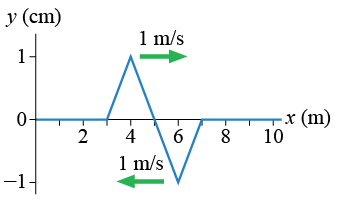
Q5. The figure shows a snapshot graph at t = 0 s of two waves approaching each other at 1 m/s. Choose a correct snapshot graph showing the string at t = 2 s.
Background
Topic: Wave Superposition and Motion
This question tests your ability to predict the position of waves after a certain time, given their speed and direction.
Key Terms and Formulas
Wave speed (): Distance traveled per unit time.
Superposition principle: The resultant displacement is the sum of individual displacements.
Step-by-Step Guidance
Determine how far each wave will travel in 2 seconds: .
Shift each wave's position accordingly, considering their direction.
Draw or select the graph that represents the new positions after 2 seconds.
Try solving on your own before revealing the answer!
Final Answer: See image_8 for the correct graph at t = 2 s.
The waves have moved 2 meters in their respective directions.
