 Back
BackPhysics Exam Review: Step-by-Step Guidance for College-Level Problems
Study Guide - Smart Notes
 Tailored notes based on your materials, expanded with key definitions, examples, and context.
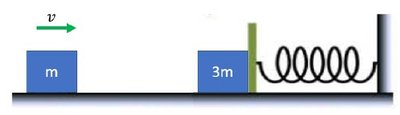
Q18. A 5 kg block is traveling at 3.0 m/s towards a spring along a frictionless horizontal surface. The spring is ideal and has a stiffness of k = 450 N/m. A second block of mass 3m is sitting in contact with a massless plate on the spring. The first block will eventually collide inelastically with the second block, compressing the spring, and eventually the system will be brought (instantaneously) to rest. Find the maximum compression of the spring.
Background
Topic: Conservation of Energy and Momentum in Collisions
This question tests your understanding of inelastic collisions, conservation of momentum, and energy transfer to a spring. You'll need to analyze the collision and the subsequent compression of the spring.
Key Terms and Formulas
Inelastic Collision: A collision where the objects stick together after impact.
Conservation of Momentum:
Kinetic Energy:
Spring Potential Energy:
Step-by-Step Guidance
First, identify the masses involved: , , and the initial velocity of is .
Since the second block is at rest, . Use conservation of momentum to find the velocity of the combined mass after the inelastic collision:
Plug in the values and solve for .
After the collision, the combined mass compresses the spring until it comes to rest. The kinetic energy of the combined mass is converted into spring potential energy:
Set up the equation to solve for , the maximum compression.
Rearrange the equation to solve for :
Try solving on your own before revealing the answer!
Final Answer: 15.8 cm
The maximum compression is found by equating the kinetic energy after collision to the spring's potential energy.
