 Back
BackPhysics Exam Study Guide: Momentum, Energy, Rotational Motion, and More
Study Guide - Smart Notes
 Tailored notes based on your materials, expanded with key definitions, examples, and context.
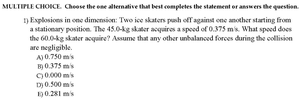
Q1. Two ice skaters push off against one another starting from rest. The 45.0-kg skater acquires a speed of 0.375 m/s. What speed does the 60.0-kg skater acquire? Assume no unbalanced forces during the collision.
Background
Topic: Conservation of Momentum
This question tests your understanding of momentum conservation in collisions, specifically in explosions or separations where two objects move apart from rest.
Key Terms and Formulas:
Momentum ():
Conservation of Momentum: (since initial momentum is zero)
Step-by-Step Guidance
Write the conservation of momentum equation for the two skaters: .
Plug in the known values: kg, m/s, kg, .
Rearrange the equation to solve for : .
Substitute the numbers into the formula, but do not calculate the final value yet.
Try solving on your own before revealing the answer!
Final Answer: 0.281 m/s
m/s$
The negative sign indicates the direction is opposite to the first skater.
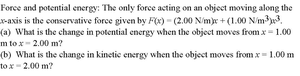
Q2. The only force acting on an object moving along the x-axis is given by . (a) What is the change in potential energy when the object moves from m to m? (b) What is the change in kinetic energy for the same displacement?
Background
Topic: Work, Potential Energy, and Kinetic Energy
This question tests your ability to calculate changes in potential and kinetic energy using force functions and the work-energy theorem.
Key Terms and Formulas:
Potential Energy Change:
Kinetic Energy Change: (if only conservative forces act)
Step-by-Step Guidance
Set up the integral for the change in potential energy: .
Integrate each term separately: and .
Evaluate the definite integral from m to m.
For part (b), use the result from part (a) to find the change in kinetic energy.
Try solving on your own before revealing the answer!
Final Answer:
(a) evaluated from 1.00 to 2.00.
(b) (since only conservative forces act).
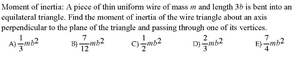
Q3. A piece of thin uniform wire of mass and length is bent into an equilateral triangle. Find the moment of inertia of the wire triangle about an axis perpendicular to the plane of the triangle and passing through one of its vertices.
Background
Topic: Rotational Inertia (Moment of Inertia)
This question tests your understanding of how to calculate the moment of inertia for composite shapes, specifically a triangle formed from a uniform wire.
Key Terms and Formulas:
Moment of Inertia ():
For a wire bent into a shape, integrate over the length:
Step-by-Step Guidance
Visualize the triangle and identify the axis through one vertex, perpendicular to the plane.
Divide the triangle into three sides and consider the distance from the axis to each segment.
Set up the integral for each side, using the mass per unit length ().
Sum the moments of inertia for all three sides, but do not compute the final value yet.
Try solving on your own before revealing the answer!
Final Answer:
The calculation involves integrating over each side and summing the results.
Q4. When a rigid body rotates about a fixed axis, all the points in the body have the same:
Background
Topic: Rotational Motion
This question tests your understanding of basic rotational quantities and how they apply to all points in a rigid body.
Key Terms and Formulas:
Angular acceleration (): Rate of change of angular velocity, same for all points in a rigid body.
Other quantities (linear displacement, tangential speed, etc.) vary with distance from the axis.
Step-by-Step Guidance
Recall that angular acceleration and angular velocity are properties of the entire rigid body.
Consider how linear and tangential quantities depend on the radius from the axis.
Identify which quantity remains constant for all points.
Try solving on your own before revealing the answer!
Final Answer: Angular acceleration
All points in a rigid body share the same angular acceleration when rotating about a fixed axis.
Q5. A machinist turns the power on to a grinding wheel at rest. The wheel accelerates uniformly for 10 s to reach 93 rad/s, runs at that speed for 26 s, then decelerates uniformly at 2.8 rad/s2 until it stops. What is the time interval of angular deceleration?
Background
Topic: Rotational Kinematics with Constant Angular Acceleration
This question tests your ability to apply rotational kinematics equations to find the time required for a wheel to decelerate to rest.
Key Terms and Formulas:
Angular acceleration ():
Initial angular velocity (), final angular velocity ()
Step-by-Step Guidance
Identify the initial angular velocity ( rad/s) and final angular velocity ( rad/s).
Use the formula to solve for .
Rearrange to .
Plug in the values, but do not calculate the final time interval yet.
Try solving on your own before revealing the answer!
Final Answer: 33 s
s s
The negative sign in acceleration indicates deceleration.
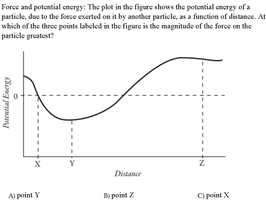
Q6. At which of the three points labeled in the figure is the magnitude of the force on the particle greatest?
Background
Topic: Force and Potential Energy
This question tests your understanding of the relationship between force and the slope of the potential energy curve.
Key Terms and Formulas:
Force from potential energy:
The magnitude of force is greatest where the slope of is steepest.
Step-by-Step Guidance
Examine the potential energy curve and identify the points X, Y, and Z.
Determine where the slope () is largest in magnitude.
Recall that the force is greatest where the curve is steepest.
Try solving on your own before revealing the answer!
Final Answer: Point X
The slope at point X is steepest, so the force magnitude is greatest there.
