 Back
BackPhysics Exam Study Guide: Step-by-Step Guidance with Relevant Images
Study Guide - Smart Notes
 Tailored notes based on your materials, expanded with key definitions, examples, and context.
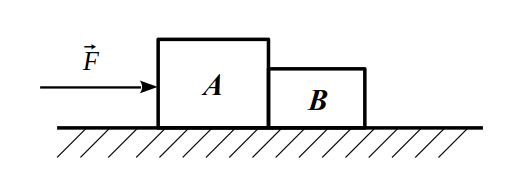
Q2. Newton’s 2nd Law with Friction: In the picture below, a horizontal force of magnitude 30.0 N is pushing two blocks to the right. Block A has mass kg and block B has mass kg. The coefficient of kinetic friction between the blocks and the floor is . What is the magnitude of the force that block A exerts on block B?
Background
Topic: Newton's Laws of Motion & Friction
This question tests your understanding of Newton's second law, free-body diagrams, and the effects of friction when multiple objects are pushed together.
Key Terms and Formulas:
Newton's Second Law:
Kinetic friction force:
Free-body diagram: Analyze forces acting on each block.
Step-by-Step Guidance
Draw a free-body diagram for both blocks. Identify all forces: applied force , friction force, and the contact force between blocks A and B.
Calculate the total friction force acting on both blocks: .
Apply Newton's second law to the system (both blocks together) to find the acceleration: .
Now, focus on block B. The only horizontal force acting on block B is the force from block A (call it ), minus friction. Set up Newton's second law for block B: .
Try solving on your own before revealing the answer!
Final Answer: 12.0 N
is found from the total system, and . Plug in the values to get N.
This is the contact force between the two blocks, accounting for friction and acceleration.
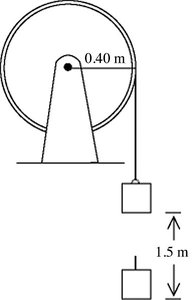
Q6. Rotational Dynamics about a Fixed Axis: A wheel has a radius of 0.40 m and is mounted on frictionless bearings. A block is suspended from a rope that is wound on the wheel and attached to it (see figure). The wheel is released from rest and the block descends 1.5 m in 2.00 s without any slipping of the rope. The tension in the rope during the descent of the block is 20 N. What is the moment of inertia of the wheel?
Background
Topic: Rotational Dynamics & Moment of Inertia
This question tests your ability to relate linear and rotational motion, and to use Newton's second law for rotation to solve for the moment of inertia.
Key Terms and Formulas:
Moment of inertia (): Resistance to rotational acceleration.
Newton's second law for rotation:
Relationship between linear and angular acceleration:
Tension in the rope provides torque:
Step-by-Step Guidance
Calculate the linear acceleration of the block using kinematics: .
Relate the linear acceleration to angular acceleration: .
Set up the torque equation: .
Combine the equations to solve for : .
Try solving on your own before revealing the answer!
Final Answer: 4.3 kg·m2
Plug in N, m, and from kinematics to get kg·m2.
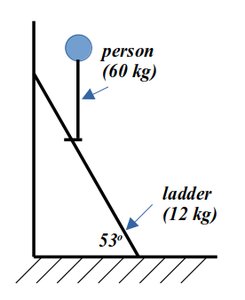
Q7. Static Equilibrium: A 5.0-m long, 12-kg uniform ladder rests against a smooth vertical wall. The ladder forms an angle of 53° above horizontal. The coefficient of static friction between the floor and the ladder is 0.28. What distance, measured along the ladder from the bottom, can a 60-kg person climb before the ladder starts to slip?
Background
Topic: Static Equilibrium & Friction
This question tests your ability to analyze forces and torques in a system at rest, and to determine the maximum safe position before slipping occurs.
Key Terms and Formulas:
Static equilibrium: ,
Maximum static friction:
Torque:
Step-by-Step Guidance
Draw a free-body diagram showing all forces: weight of ladder, weight of person, normal force, friction force, and reaction force from the wall.
Write the equilibrium equations for forces in horizontal and vertical directions.
Set up the torque equation about the base of the ladder to relate the position of the person to the maximum static friction.
Solve for the distance along the ladder where the torque due to the person’s weight causes the friction force to reach its maximum value.
Try solving on your own before revealing the answer!
Final Answer: 1.73 m
m
This is the farthest the person can climb before the ladder slips, based on static friction and equilibrium.
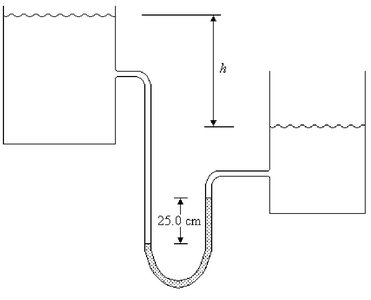
Q9. Pressure in a Fluid: The two water reservoirs shown in the figure are open to the atmosphere, and the water has density 1000 kg/m3. The manometer contains incompressible mercury with a density of 13,600 kg/m3. What is the difference in elevation h if the manometer reading m is 25.0 cm?
Background
Topic: Fluid Statics & Pressure Measurement
This question tests your understanding of pressure differences in fluids, manometers, and the use of density in calculating pressure.
Key Terms and Formulas:
Pressure difference:
Manometer principle: relates height of fluid columns to pressure difference
Density (): mass per unit volume
Step-by-Step Guidance
Write the pressure difference equation for the manometer: .
Set up the equation relating the pressure difference to the height difference in the water reservoirs: .
Equate the two expressions for and solve for .
Plug in the values for densities, , and to set up the calculation for .
Try solving on your own before revealing the answer!
Final Answer: 3.15 m
Plug in the values to get m.
Q11. Bernoulli's Principle: A paint sprayer pumps air through a constriction in a 2.50-cm diameter pipe, as shown in the figure. The flow causes the pressure in the constricted area to drop and paint rises up the feed tube and enters the air stream. The speed of the air stream in the 2.50-cm diameter sections is 5.00 m/s. The density of the air is 1.29 kg/m3, and the density of the paint is 1200 kg/m3. We can treat the air and paint as incompressible ideal fluids. What is the maximum diameter of the constriction that will allow the sprayer to operate?
Background
Topic: Fluid Dynamics & Bernoulli's Principle
This question tests your ability to apply Bernoulli's equation and continuity equation to determine the conditions for fluid flow and pressure differences.
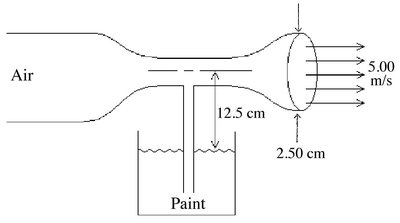
Key Terms and Formulas:
Bernoulli's equation:
Continuity equation:
Pressure difference needed to lift paint:
Step-by-Step Guidance
Use the continuity equation to relate the velocities in the wide and narrow sections: .
Apply Bernoulli's equation between the wide and narrow sections to find the pressure drop.
Set the pressure drop equal to the pressure needed to lift the paint: .
Solve for the maximum diameter of the constriction using the equations above.
Try solving on your own before revealing the answer!
Final Answer: 8.07 mm
mm
This ensures the pressure drop is sufficient to lift the paint into the air stream.
Q13. Mathematics of Traveling Waves: The figure shows the displacement y of a traveling wave at a given position as a function of time and the displacement of the same wave at a given time as a function of position. How fast is the wave traveling?
Background
Topic: Wave Motion & Speed Calculation
This question tests your ability to interpret wave graphs and use the relationship between wavelength, period, and speed.
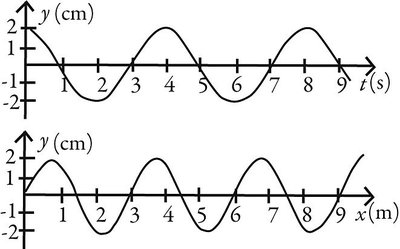
Key Terms and Formulas:
Wave speed:
Wavelength (): distance between two consecutive points in phase
Period (): time for one complete cycle
Step-by-Step Guidance
From the position graph, determine the wavelength by measuring the distance between two peaks.
From the time graph, determine the period by measuring the time between two peaks.
Use the formula to set up the calculation for wave speed.
Try solving on your own before revealing the answer!
Final Answer: 0.75 m/s
m/s
This is the speed at which the wave travels along the string.
Q24. Saturated Vapor Pressure and Humidity: The saturated vapor pressure for water is given in the table to the right. On a cold winter day, the outside temperature is 0°C with a relative humidity of 60%. The heater of your apartment works by drawing cold air from the outside and heating it up to a comfortable temperature of 20°C. As a result, the air becomes very dry. How much water do you need to let evaporate if you’d like to raise the humidity of your bedroom (with a volume of 30 m3) to a comfortable 40%? (The molar mass of water is 18 g/mol)
Background
Topic: Vapor Pressure, Humidity, and Phase Changes
This question tests your understanding of relative humidity, vapor pressure, and the calculation of mass of water needed to achieve a desired humidity level.
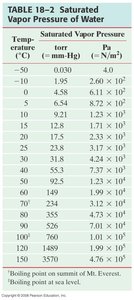
Key Terms and Formulas:
Relative humidity:
Mass of water vapor:
Ideal gas law:
Step-by-Step Guidance
Find the saturated vapor pressure at 20°C from the table.
Calculate the partial pressure of water vapor needed for 40% relative humidity at 20°C.
Use the ideal gas law to find the number of moles of water vapor needed in the room.
Convert moles to mass using the molar mass of water.
Try solving on your own before revealing the answer!
Final Answer: 125 g
g
This is the amount of water you need to evaporate to reach 40% humidity in your room.
