 Back
BackPhysics Final Review: Step-by-Step Study Guidance
Study Guide - Smart Notes
 Tailored notes based on your materials, expanded with key definitions, examples, and context.
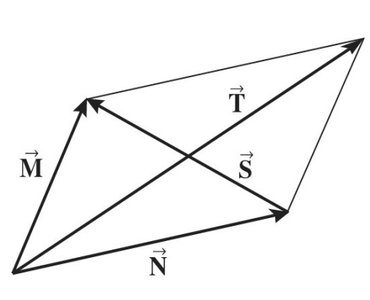
Q3(A). In the figure below, how can vector \( \vec{S} \) be written in terms of vectors \( \vec{M} \) and \( \vec{N} \)?
Background
Topic: 2D Vector Algebra (Vector Addition/Subtraction)
This question tests your understanding of how to express one vector as a combination (sum or difference) of other vectors, using a graphical diagram.
Key Terms and Formulas:
Vector addition: If two vectors are drawn tip-to-tail, their sum is the vector from the tail of the first to the tip of the second.
Vector subtraction: \( \vec{A} - \vec{B} \) means "start at the tip of \( \vec{B} \), go to the tip of \( \vec{A} \)".
Notation: \( \vec{S} \), \( \vec{M} \), \( \vec{N} \) are displacement vectors in the diagram.
Step-by-Step Guidance
Identify the start and end points of each vector in the diagram. Notice that \( \vec{M} \) and \( \vec{N} \) both start at the same point (bottom left).
Think about how to get from the tip of \( \vec{M} \) (top left) to the tip of \( \vec{N} \) (bottom right). This is the direction of \( \vec{S} \).
Recall that subtracting a vector means "undoing" its direction. So, \( \vec{N} - \vec{M} \) gives you a vector from the tip of \( \vec{M} \) to the tip of \( \vec{N} \).
Write the vector equation: \( \vec{S} = \vec{N} - \vec{M} \).
Try solving on your own before revealing the answer!
Final Answer: \( \vec{S} = \vec{N} - \vec{M} \)
This matches the vector that goes from the tip of \( \vec{M} \) to the tip of \( \vec{N} \) in the diagram.
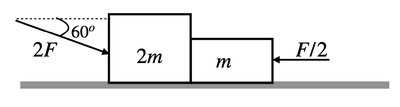
Q7. Two blocks rest on a frictionless horizontal surface and accelerate toward the right. A force of magnitude \( 2F \) is applied to the left block of mass \( 2m \) at an angle of 60° below the horizontal. A second force of magnitude \( F/2 \) acts on the right block of mass \( m \) toward the left.
Background
Topic: Newton's 2nd Law, Free-Body Diagrams, Dynamics of Multiple Objects
This question tests your ability to analyze forces on a system of two blocks, draw free-body diagrams, and calculate acceleration and contact forces.
Key Terms and Formulas:
Newton's 2nd Law: \( F_{\text{net}} = ma \)
Free-body diagram: Shows all forces acting on each object.
Component forces: \( F_x = F \cos \theta \), \( F_y = F \sin \theta \)
Contact force: The force one block exerts on the other at their interface.
Step-by-Step Guidance
Break the angled force \( 2F \) into horizontal and vertical components. Horizontal: \( 2F \cos 60^\circ = F \). Vertical: \( -2F \sin 60^\circ = -\sqrt{3}F \).
Draw free-body diagrams for each block, labeling all forces (weight, normal, applied, contact).
For the combined system, sum the horizontal forces: \( F - F/2 \) (since vertical forces cancel due to frictionless surface).
Apply Newton's 2nd Law to the combined mass: \( (2m + m)a = F - F/2 \).
Set up the equation for the contact force between blocks using Newton's 2nd Law for one block.
Try solving on your own before revealing the answer!
Final Answer:
Acceleration: \( a = \frac{F - F/2}{3m} = \frac{F}{6m} \)
Contact force: \( F_{\text{contact}} = m(g - a) \) (direction: left)
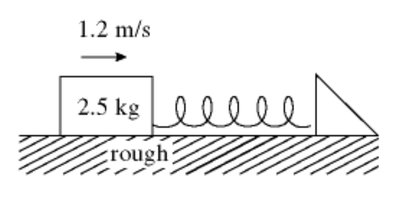
Q8. A 2.5-kg box sliding on a rough horizontal surface has a speed of 1.2 m/s when it makes contact with a spring. The block comes to a momentary halt when the compression of the spring is 5.0 cm. The work done by friction during this process is -0.50 J. What is the spring constant?
Background
Topic: Work–Energy Principle, Spring Potential Energy, Friction
This question tests your ability to use energy conservation and work to solve for the spring constant when friction is present.
Key Terms and Formulas:
Kinetic energy: \( K = \frac{1}{2}mv^2 \)
Spring potential energy: \( U_s = \frac{1}{2}kx^2 \)
Work by friction: \( W_f = -0.50 \text{ J} \)
Energy conservation: \( K_i + W_f = U_s \)
Step-by-Step Guidance
Calculate the initial kinetic energy: \( K_i = \frac{1}{2}mv^2 \).
Set up the energy equation: \( K_i + W_f = \frac{1}{2}kx^2 \).
Plug in the values for mass, speed, work, and compression distance (convert cm to m).
Rearrange the equation to solve for \( k \): \( k = \frac{2(K_i + W_f)}{x^2} \).
Try solving on your own before revealing the answer!
Final Answer: \( k \approx 1.0 \times 10^3 \text{ N/m} \)
We used the work–energy principle and included the work done by friction to solve for the spring constant.
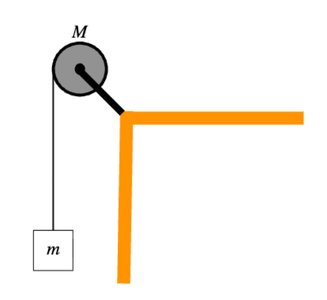
Q4. A block of mass \( m \) hangs from a massless cord wrapped around the rim of a uniform disk of mass \( M \) and radius \( R \). Find the acceleration of the block, angular acceleration of the disk, and the tension in the cord. The cord does not slip, and there is no friction at the axle.
Background
Topic: Rotational Dynamics, Coupled Translation and Rotation
This question tests your ability to analyze a system where a falling mass causes a disk to rotate, using Newton's 2nd law and torque.
Key Terms and Formulas:
Newton's 2nd Law for the block: \( mg - T = ma \)
Torque for the disk: \( TR = I\alpha \), where \( I = \frac{1}{2}MR^2 \) for a uniform disk
No-slip condition: \( a = \alpha R \)
Step-by-Step Guidance
Write the force equation for the block: \( mg - T = ma \).
Write the torque equation for the disk: \( TR = I\alpha \).
Use the no-slip condition: \( a = \alpha R \).
Combine the equations to eliminate \( T \) and \( \alpha \), and solve for \( a \).
Try solving on your own before revealing the answer!
Final Answers:
Acceleration: \( a = \frac{mg}{m + \frac{1}{2}M} \)
Angular acceleration: \( \alpha = \frac{a}{R} \)
Tension: \( T = m(g - a) \)
