 Back
BackPhysics Foundations: Units, Measurement, and 1D Kinematics
Study Guide - Smart Notes
 Tailored notes based on your materials, expanded with key definitions, examples, and context.
Math Review and Scientific Notation
Working with Powers of Ten and Significant Figures
Physics relies heavily on expressing quantities using scientific notation and understanding significant figures. This allows for clear communication of very large or small numbers and the precision of measurements.
Scientific Notation: Numbers are written as a product of a coefficient and a power of ten, e.g., .
Significant Figures: The digits in a measurement that are known with certainty plus one estimated digit. Calculations should reflect the correct number of significant figures.
Examples:
Convert to decimal:
Express mm in scientific notation: m
Metric (SI) Prefixes
SI prefixes are used to simplify the expression of very large or small quantities. Each prefix represents a specific power of ten.
Prefix Name | Prefix Symbol | Scientific Notation | Exponential Notation | Name | Decimal Form |
|---|---|---|---|---|---|
tera | T | 1.0E+12 | Trillion | 1,000,000,000,000 | |
giga | G | 1.0E+09 | Billion | 1,000,000,000 | |
mega | M | 1.0E+06 | Million | 1,000,000 | |
kilo | k | 1.0E+03 | Thousand | 1,000 | |
centi | c | 1.0E-02 | Hundredth | 0.01 | |
milli | m | 1.0E-03 | Thousandth | 0.001 | |
micro | μ | 1.0E-06 | Millionth | 0.000001 | |
nano | n | 1.0E-09 | Billionth | 0.000000001 |

Example: volts = 3 megavolts (MV)
Intro to Physics Units
Importance of Units and Dimensional Analysis
Units are essential in physics for clarity and accuracy. Dimensional analysis uses the "magic one"—multiplying by conversion factors equal to one—to convert between units.
Magic One: Multiplying by a conversion factor that equals one does not change the value, only the units.
Example: To convert 6.5 dozen to objects:
Example: To convert miles to inches:
Measurement and Uncertainty
Precision, Accuracy, and Uncertainty
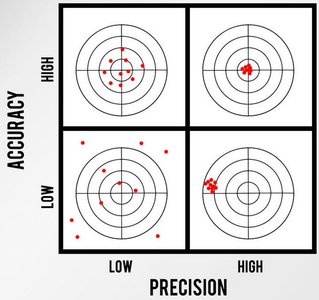
All measurements have some degree of uncertainty. Understanding the difference between accuracy and precision is crucial for interpreting results.
Accuracy: How close a measurement is to the true value.
Precision: How repeatable measurements are, regardless of their closeness to the true value.
Estimated Uncertainty: Expressed as a value, e.g., cm.
Example: could mean to , while could mean to .
Models, Theories, Laws, and Scientific Inquiry
Definitions and Roles in Physics
Physics uses models, theories, and laws to describe and predict natural phenomena.
Model: A simplified representation to help visualize and understand complex systems (e.g., computer simulations of black holes).
Theory: A well-tested, broad explanation of phenomena (e.g., quantum mechanics).
Law: A concise statement describing a fundamental relationship (e.g., conservation of energy).
Hypothesis: A tentative explanation to be tested.
Evidence: Data or observations supporting or refuting a hypothesis or theory.
Scientific Inquiry: The systematic process of investigating scientific questions.
Order of Magnitude and Estimation
Rapid Estimating and Approximations
Order of magnitude estimates help quickly assess the scale of a quantity and check the plausibility of results.
Order of Magnitude: The power of ten closest to a value.
Approximations: Useful for quick calculations and sanity checks.
Example: Estimating the thickness of a textbook page by dividing the total thickness by the number of pages.
Mechanics: Kinematics and Dynamics
Key Definitions
Mechanics is the branch of physics dealing with motion and its causes. Kinematics describes motion, while dynamics explains why motion occurs.
Mechanics: Study of motion, forces, and energy.
Kinematics: Describes how objects move (position, velocity, acceleration).
Dynamics: Explains why objects move (forces and interactions).
Frame of Reference: The perspective from which motion is measured (e.g., a train or the ground).
Cartesian Coordinates: The x-y (and z) coordinate system for specifying positions in space.
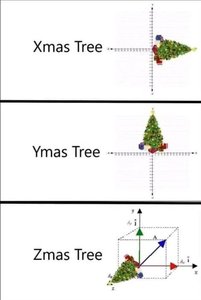
1D Motion / Kinematics
Describing Motion in One Dimension
One-dimensional kinematics focuses on motion along a straight line, using position, velocity, and acceleration.
Position (x, y, z): The location of an object in space, often in meters (m).
Distance: The total length of the path traveled, regardless of direction.
Displacement: The straight-line change in position, including direction.
Speed: The magnitude of how fast an object moves ().
Velocity: The rate of change of position with direction ().
Acceleration: The rate of change of velocity ().

Example: A drag race is a classic example of 1D motion, where cars accelerate along a straight track.
Distance vs. Displacement: Driving to a destination and back covers a large distance, but the displacement could be zero if you return to your starting point.
Summary Table: Key Kinematics Quantities
Quantity | Symbol | Definition | SI Unit |
|---|---|---|---|
Position | x, y, z | Location in space | meter (m) |
Distance | d | Total path length | meter (m) |
Displacement | Δx | Straight-line change in position | meter (m) |
Speed | v | Rate of distance change | m/s |
Velocity | \vec{v} | Rate of displacement change | m/s |
Acceleration | a | Rate of velocity change | m/s² |
Additional info: The notes also reference the importance of using correct units, the difference between models, theories, and laws, and the process of scientific inquiry, all foundational to the study of physics.
