 Back
BackPhysics Fundamentals 2: Electric Circuits, RC Circuits, and Magnetism Study Guidance
Study Guide - Smart Notes
 Tailored notes based on your materials, expanded with key definitions, examples, and context.
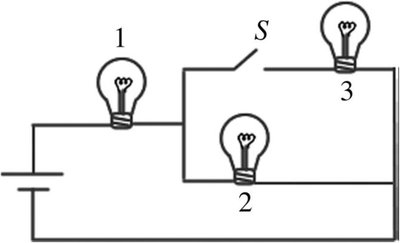
Q1. What happens to the brightness of lightbulb 1 when the switch S is closed? The three lightbulbs are identical.
Background
Topic: Electric Circuits (Series and Parallel)
This question tests your understanding of how current and voltage are distributed in series and parallel circuits, and how changes in the circuit (like closing a switch) affect the brightness of bulbs.
Key Terms and Formulas
Series Circuit: Current is the same through all components; total resistance is the sum of individual resistances.
Parallel Circuit: Voltage is the same across all branches; total resistance decreases as more branches are added.
Ohm's Law: $V = IR$
Power (brightness): $P = I^2R$ or $P = \frac{V^2}{R}$
Step-by-Step Guidance
Analyze the circuit before the switch is closed: Bulb 1 is in series with the combination of bulbs 2 and 3 (which are in parallel when the switch is closed).
When the switch is open, all current flows through bulb 1 and then through bulbs 2 and 3 in series.
When the switch is closed, bulbs 2 and 3 form a parallel branch, changing the total resistance of the circuit.
Consider how the total resistance changes and how that affects the current through bulb 1 (using Ohm's Law and the formulas for series and parallel resistance).
Try solving on your own before revealing the answer!
Final Answer: It increases permanently.
When the switch is closed, the total resistance of the circuit decreases, causing the total current to increase. Since bulb 1 is in series with the battery, it receives more current and thus becomes brighter.
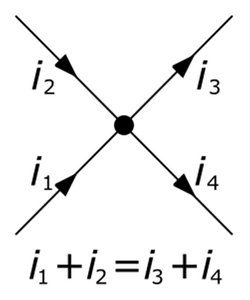
Q2. Which of the following is true about the pictured circuit?
Background
Topic: Kirchhoff's Laws (Loop and Node Laws)
This question tests your ability to apply Kirchhoff's laws to analyze current and voltage in a circuit with multiple branches.
Key Terms and Formulas
Kirchhoff's Current Law (Node Law): The sum of currents entering a node equals the sum of currents leaving the node.
Kirchhoff's Voltage Law (Loop Law): The sum of the potential differences (voltage) around any closed loop is zero.
Step-by-Step Guidance
Identify the branches and nodes in the circuit. Note where the current splits and recombines.
Apply Kirchhoff's Current Law at a node where the circuit splits into branches (e.g., where the current divides between R2 and R3).
Apply Kirchhoff's Voltage Law to a closed loop that includes the battery and resistors. Check if the sum of voltage drops equals the battery voltage.
Compare the voltage drops across different parts of the circuit to see if any are equal (e.g., across R1 and the parallel combination of R2 and R3).
Try solving on your own before revealing the answer!
Final Answer: D. All of the above.
All statements are correct: the total current from the battery splits among the branches, the voltage drop across R1 equals that across the parallel combination, and the sum of voltage drops around any loop is zero.
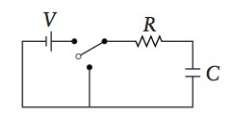
Q3. An RC circuit consists of a battery, a 10 Ω resistor, and a capacitor. If the time constant is 1.0 ms, what is the capacitance of the capacitor?
Background
Topic: RC Circuits (Time Constant)
This question tests your understanding of the time constant in an RC circuit and how to calculate capacitance from given values.
Key Terms and Formulas
Time Constant (τ): $\tau = RC$
R: Resistance in ohms (Ω)
C: Capacitance in farads (F)
τ: Time constant in seconds (s)
Step-by-Step Guidance
Write the formula for the time constant: $\tau = RC$
Identify the given values: $R = 10\ \Omega$, $\tau = 1.0\ \text{ms} = 1.0 \times 10^{-3}\ \text{s}$
Rearrange the formula to solve for $C$: $C = \frac{\tau}{R}$
Plug in the values for $\tau$ and $R$ to set up the calculation for $C$.
Try solving on your own before revealing the answer!
Final Answer: 100 μF
Using $C = \frac{1.0 \times 10^{-3}\ \text{s}}{10\ \Omega} = 1.0 \times 10^{-4}\ \text{F} = 100\ \mu\text{F}$.
Q4. A proton is moving in the magnetic field as shown. In what direction is the resulting force?

Background
Topic: Magnetic Force on a Moving Charge
This question tests your understanding of the right-hand rule and the direction of the magnetic force on a positive charge moving in a magnetic field.
Key Terms and Formulas
Magnetic Force: $\vec{F}_B = q\vec{v} \times \vec{B}$
Right-Hand Rule: For a positive charge, point your fingers in the direction of $\vec{v}$, curl toward $\vec{B}$, and your thumb points in the direction of $\vec{F}_B$.
Step-by-Step Guidance
Identify the direction of the velocity vector ($\vec{v}$) and the magnetic field ($\vec{B}$) from the diagram.
Apply the right-hand rule: Point your fingers in the direction of $\vec{v}$, then curl them toward $\vec{B}$.
Determine the direction your thumb points—this is the direction of the force on a positive charge (proton).
Match this direction to one of the answer choices (e.g., into the screen, out of the screen, left, right).
Try solving on your own before revealing the answer!
Final Answer: A. Into the screen.
Using the right-hand rule for a positive charge, the force is directed into the screen.
